Back
BackEcology: Population, Community, and Ecosystem Dynamics
Study Guide - Smart Notes
 Tailored notes based on your materials, expanded with key definitions, examples, and context.
Ecology: Population, Community, and Ecosystem Dynamics
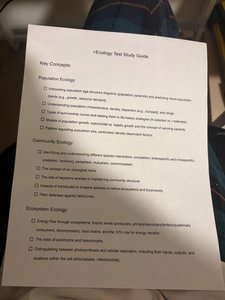
Population Ecology
Population ecology examines how populations of organisms change over time and space, and the factors that regulate these changes. It is fundamental for understanding species survival, resource use, and ecosystem stability.
Population Growth: Populations grow or decline based on birth rates, death rates, immigration, and emigration. Growth can be exponential or logistic, with carrying capacity limiting size.
Population Dispersion: The spatial arrangement of individuals within a population can be clumped, uniform, or random, influenced by resource distribution and social interactions.
Life History Strategies: Species exhibit different reproductive strategies (r-selected vs. K-selected) that affect population dynamics.
Density-Dependent and Density-Independent Factors: Population size is regulated by factors such as competition, predation, disease (density-dependent), and weather or natural disasters (density-independent).
Survivorship Curves: Graphs that show the proportion of individuals surviving at each age; Types I, II, and III represent different survival strategies.
Human Population Growth: Human populations have grown rapidly due to advances in technology, medicine, and agriculture, impacting global ecosystems.
Population Regulation: Mechanisms such as resource limitation, predation, and disease keep populations in check.
Example: The logistic growth of a deer population in a forest, where food availability limits maximum population size.
Community Ecology
Community ecology explores the interactions between different species living in the same area and how these interactions shape community structure and dynamics.
Species Interactions: Includes competition, predation, herbivory, mutualism, commensalism, and parasitism.
Ecological Niches: The role and position a species has in its environment, including all its interactions with biotic and abiotic factors.
Competitive Exclusion Principle: Two species competing for the same resources cannot coexist indefinitely.
Keystone Species: Species that have a disproportionately large effect on community structure.
Succession: The process by which the structure of a biological community evolves over time, including primary and secondary succession.
Example: The removal of sea otters (a keystone species) leads to an increase in sea urchin populations and a decline in kelp forests.
Ecosystem Ecology
Ecosystem ecology focuses on the flow of energy and cycling of nutrients among organisms and their physical environment.
Energy Flow: Energy enters ecosystems through photosynthesis and moves through trophic levels (producers, consumers, decomposers).
Primary Production: The rate at which plants and other producers convert solar energy into chemical energy.
Food Chains and Food Webs: Illustrate the transfer of energy and nutrients through different trophic levels.
Biogeochemical Cycles: The movement of elements like carbon, nitrogen, and phosphorus through living and nonliving components of ecosystems.
Distinguishing Photosynthesis and Cellular Respiration: Photosynthesis stores energy in glucose, while respiration releases energy for cellular use.
Example: The carbon cycle, where carbon moves from the atmosphere into plants, animals, and back through respiration and decomposition.
Human Impacts
Human activities significantly alter ecosystems, affecting biodiversity, nutrient cycles, and climate.
Phosphorus and Nutrient Runoff: Excess nutrients from agriculture can cause eutrophication in aquatic systems.
Invasive Species: Non-native species can disrupt community structure and ecosystem function.
Climate Change: Alters species distributions, phenology, and ecosystem processes.
Example: Introduction of zebra mussels in North American lakes has altered food webs and nutrient cycling.
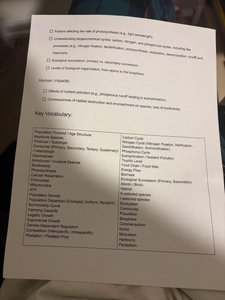
Key Vocabulary
The following terms are essential for understanding ecology. They cover population dynamics, community interactions, ecosystem processes, and human impacts.
Population & Community | Ecosystem & Human Impact |
|---|---|
Population Density, Age Structure, Survivorship Curve, Exponential Growth, Logistic Growth, Carrying Capacity, Density-Dependent/Independent Factors, r/K Selection, Life History, Niche, Competition, Predation, Herbivory, Mutualism, Commensalism, Parasitism, Keystone Species, Invasive Species, Succession (Primary, Secondary), Disturbance, Trophic Structure, Food Chain, Food Web, Biomagnification, Biodiversity, Species Richness, Species Evenness, Ecological Niche, Competitive Exclusion, Resource Partitioning | Carbon Cycle, Nitrogen Cycle, Phosphorus Cycle, Primary Production, Net Primary Production, Trophic Efficiency, Energy Pyramid, Decomposer, Detritivore, Biogeochemical Cycle, Eutrophication, Greenhouse Effect, Climate Change, Invasive Species, Habitat Fragmentation, Ecosystem Services, Restoration Ecology, Conservation Biology, Endangered Species, Extinction, Biodiversity Hotspot |