 Back
BackEcosystem Dynamics: Energy Flow and Nutrient Cycling
Study Guide - Smart Notes
 Tailored notes based on your materials, expanded with key definitions, examples, and context.
Ecosystem Structure and Function
Definition and Components of Ecosystems
An ecosystem is a community of living organisms (biotic factors) interacting with each other and with their nonliving (abiotic) environment. Ecosystem dynamics are governed by two main processes: energy flow and chemical cycling. Energy flows through ecosystems, while matter cycles within them.
Biotic factors: All living organisms, including plants, animals, fungi, and microorganisms.
Abiotic factors: Nonliving components such as sunlight, water, temperature, and minerals.

Physical Laws Governing Ecosystem Processes
Conservation of Energy
The first law of thermodynamics states that energy cannot be created or destroyed, only transformed. In ecosystems, energy enters as solar radiation, is converted by primary producers, and is eventually lost as heat. The second law of thermodynamics states that every energy transfer increases the entropy (disorder) of the universe, making energy conversions inherently inefficient.
Energy enters as sunlight, is transformed by photosynthesis, and dissipates as heat.
Energy flow is unidirectional; it cannot be recycled.
Conservation of Mass
The law of conservation of mass states that matter cannot be created or destroyed. Chemical elements are continually recycled within ecosystems. Ecosystems are open systems, absorbing energy and mass and releasing heat and waste products.
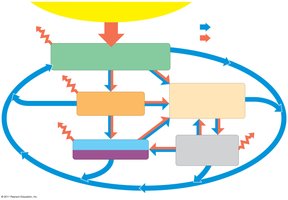
Energy Flow and Chemical Cycling
Decomposers and Detritivores
Decomposers (such as fungi and bacteria) and detritivores play a crucial role in breaking down dead organic matter, returning nutrients to the ecosystem for reuse by primary producers.

Primary Production in Ecosystems
Gross and Net Primary Production
Primary production is the amount of light energy converted to chemical energy by autotrophs (mainly plants and algae) in a given time period. The total primary production is called gross primary production (GPP). Net primary production (NPP) is the energy remaining after accounting for the energy used by producers for respiration:
GPP: Total energy captured by photosynthesis per unit time.
NPP: GPP minus energy used for respiration by producers.
Mathematically,
Global Patterns of NPP
NPP varies greatly among biomes, with tropical rainforests and estuaries among the most productive. Deserts and open oceans have low NPP per unit area.
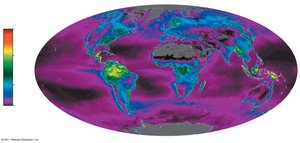
Limiting Factors of Primary Production
Aquatic Ecosystems
In aquatic systems, light and nutrients (especially nitrogen and phosphorus) limit primary production. The photic zone is the region where light penetrates and photosynthesis can occur. Nutrient enrichment experiments show that adding limiting nutrients can greatly increase primary production.
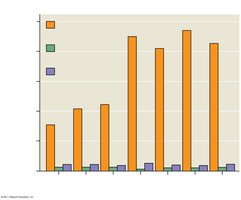
Excess nutrient runoff can cause eutrophication, leading to algal blooms, oxygen depletion (anoxia), and loss of aquatic life.

Iron Limitation in Oceans
In some ocean regions, iron is a limiting nutrient. Experiments in the Sargasso Sea show that adding iron dramatically increases primary production.
Nutrients Added | Relative Uptake of 14C |
|---|---|
None (control) | 1.00 |
N + P only | 1.10 |
N + P + metals (excluding iron) | 1.08 |
N + P + metals (including iron) | 12.90 |
N + P + iron | 12.00 |
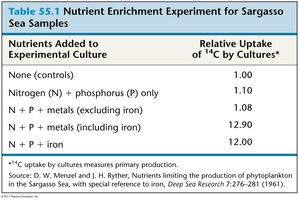
Terrestrial Ecosystems
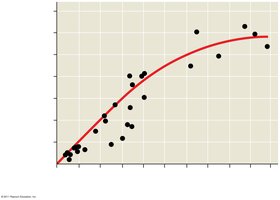
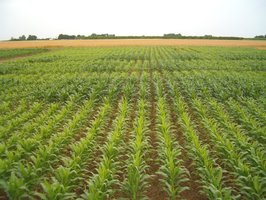
On land, temperature and moisture are the main factors affecting primary production. Nutrient availability, especially nitrogen and phosphorus, can also limit productivity, particularly in older soils.

Adaptations to Nutrient Limitation
Mutualisms with nitrogen-fixing bacteria (e.g., in root nodules of legumes)
Mycorrhizal associations with fungi to enhance phosphorus uptake
Root hairs and cation exchange systems to increase nutrient absorption
Energy Transfer and Trophic Efficiency
Secondary Production and Production Efficiency
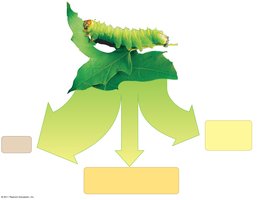
Secondary production is the amount of chemical energy in food converted to new biomass by consumers. Production efficiency is the fraction of energy stored in food that is not used for respiration:
Production efficiencies vary among organisms:
Birds and mammals: 1–3%
Fish: ~10%
Insects and microorganisms: 40% or more
Trophic Efficiency and Ecological Pyramids
Trophic efficiency is the percentage of production transferred from one trophic level to the next, typically about 10%. This results in a pyramid of energy, with less energy available at each successive trophic level.
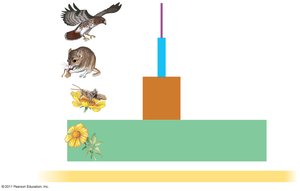
Some aquatic ecosystems have inverted biomass pyramids, where primary consumers outweigh primary producers due to rapid turnover of producers.
Nutrient Cycling in Ecosystems
Global and Local Cycles
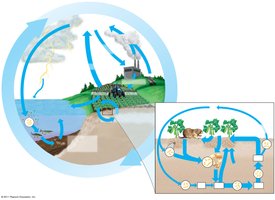
Elements such as carbon, oxygen, sulfur, and nitrogen cycle globally, while less mobile elements like phosphorus, potassium, and calcium cycle locally in terrestrial systems but more broadly in aquatic systems.
The Nitrogen Cycle
Nitrogen is essential for amino acids, proteins, and nucleic acids. The main reservoir is atmospheric N2, which must be fixed by bacteria into forms usable by plants (NH4+ or NO3–). Key processes include:
Nitrogen fixation: Conversion of N2 to NH4+ by bacteria
Ammonification: Decomposition of organic nitrogen to NH4+
Nitrification: Conversion of NH4+ to NO3–
Denitrification: Conversion of NO3– back to N2
The Phosphorus Cycle
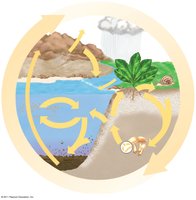
Phosphorus is a key component of nucleic acids, phospholipids, and ATP. The main inorganic form is phosphate (PO43–). Major reservoirs include sedimentary rocks, oceans, and living organisms. Phosphate binds to soil particles, so its movement is often localized.
Additional info: These notes synthesize and expand upon the provided material, adding definitions, equations, and context for clarity and completeness.
