 Back
BackEcosystem Ecology: Energy Flow and Biogeochemical Cycles
Study Guide - Smart Notes
 Tailored notes based on your materials, expanded with key definitions, examples, and context.
Ecosystem Ecology
Introduction to Ecosystems
An ecosystem consists of all living organisms (the community) and non-living components that interact within a given area. The structure and function of ecosystems are determined by the flow of energy and the cycling of nutrients (biogeochemical cycles). Ecosystem ecology examines these interactions and contrasts them with community-level interactions, which focus solely on living organisms.
Living components: Plants, animals, fungi, bacteria, etc.
Non-living components: Water, air, minerals, sunlight, etc.
Key processes: Energy flow and nutrient cycling
Energy Flow in Ecosystems
Pathways of Energy Movement
Energy enters ecosystems primarily as solar radiation. Autotrophs (producers) convert this energy into chemical bonds via photosynthesis. Energy then moves through various trophic levels and ultimately exits the system as heat. The efficiency of energy transfer and the productivity of different ecosystems are central to understanding ecosystem structure.
Gross Primary Production (GPP): Total energy produced by autotrophs.
Net Primary Production (NPP): Energy remaining after autotrophs meet their own metabolic needs; used for growth and reproduction (biomass).
Secondary Production: Energy used by heterotrophs (consumers) to build their own biomass.
Energy transfer: Only a fraction of energy is transferred from one trophic level to the next; most is lost as heat.
Productivity varies by ecosystem:
Terrestrial: Highest NPP in warm, wet climates (e.g., tropical rainforests).
Aquatic: Highest NPP where light and nutrients are abundant (e.g., algal beds, reefs).
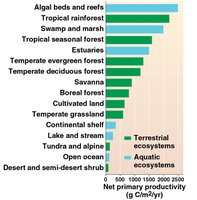
Example: Algal beds and reefs have the highest net primary productivity, while deserts and open oceans have the lowest.
Energy Flow Diagram
The movement of energy through an ecosystem is unidirectional. Producers capture solar energy, which is then transferred to consumers and decomposers. At each step, energy is lost as heat.
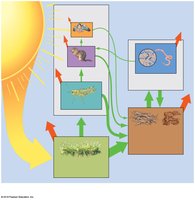
Example: Grass (producer) captures sunlight, which is consumed by grasshoppers (primary consumers), then by rodents and hawks (higher-level consumers), with detritivores and decomposers recycling nonliving organic matter.
Biogeochemical Cycles
Overview of Nutrient Cycling
Nutrients are elements or compounds essential for life. They cycle through ecosystems in biogeochemical cycles, moving between different reservoirs (e.g., atmosphere, water, soil, organisms). The residence time is the duration a nutrient spends in a particular reservoir.
Major cycles: Water, carbon, nitrogen, phosphorus
Reservoirs: Locations where nutrients are stored (e.g., ocean, atmosphere, rocks)
Processes: Movement between reservoirs (e.g., evaporation, fixation, decomposition)
Matter Cycling Diagram
Unlike energy, matter is conserved and cycles within ecosystems. Nutrients are continually recycled between living and non-living components.
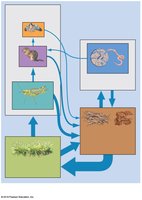
Example: Decomposers break down detritus, returning nutrients to the soil for uptake by plants.
Major Biogeochemical Cycles
Water Cycle
The water cycle describes the continuous movement of water among reservoirs such as oceans, ice, groundwater, atmosphere, and living organisms. Key processes include evaporation, transpiration, precipitation, infiltration, and runoff.
Major reservoir: Oceans (97% of Earth's water)
Freshwater: 2% in ice/snow, 1% available for use
Movement: Driven by solar energy and gravity
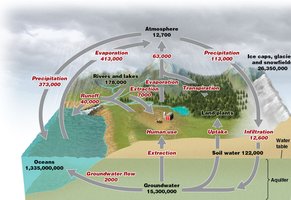
Example: Water evaporates from oceans, forms clouds, precipitates as rain, and returns via rivers and groundwater flow.
Carbon Cycle
The carbon cycle tracks the movement of carbon among the atmosphere, biosphere, oceans, and geosphere. Major reservoirs include sedimentary rock, oceans, atmosphere, and living organisms. Carbon is exchanged through processes such as photosynthesis, respiration, combustion, and decomposition.
Major reservoir: Sedimentary rock (long residence time)
Key processes: Photosynthesis (removes CO2), respiration, volcanic emissions, burning fossil fuels (returns CO2)
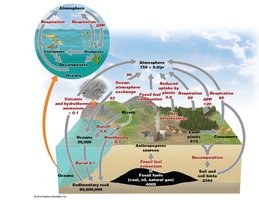
Example: Plants absorb CO2 during photosynthesis; animals and decomposers return CO2 to the atmosphere via respiration and decomposition.
Nitrogen Cycle
The nitrogen cycle involves the transformation and movement of nitrogen through the atmosphere, biosphere, and geosphere. Nitrogen is essential for proteins and nucleic acids. Key processes include nitrogen fixation, nitrification, assimilation, ammonification, and denitrification.
Major reservoir: Atmosphere (N2 gas)
Key processes: Biological fixation (by bacteria), industrial fixation, decomposition, denitrification
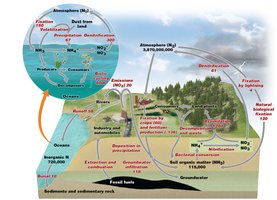
Example: Nitrogen-fixing bacteria convert atmospheric N2 into forms usable by plants; denitrifying bacteria return N2 to the atmosphere.
Phosphorus Cycle
The phosphorus cycle describes the movement of phosphorus through rocks, water, soil, and living organisms. Unlike other cycles, phosphorus does not have a significant atmospheric component. It is essential for nucleic acids, ATP, and cell membranes.
Major reservoir: Sedimentary rock
Key processes: Weathering, uptake by plants, consumption by animals, decomposition, sedimentation
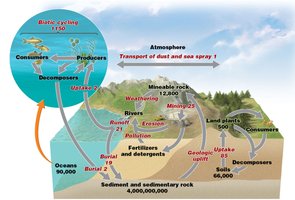
Example: Phosphorus is released from rocks by weathering, taken up by plants, moves through food webs, and returns to soil via decomposition.
Human Impacts on Nutrient Cycles
Alterations and Consequences
Humans significantly alter nutrient cycles through activities such as fossil fuel combustion, deforestation, fertilizer use, and industrial processes. These changes can lead to environmental issues like eutrophication, acid rain, and climate change.
Carbon: Increased atmospheric CO2 from burning fossil fuels contributes to global warming.
Nitrogen: Fertilizer runoff causes eutrophication in aquatic systems.
Phosphorus: Excess phosphorus from detergents and fertilizers leads to algal blooms.
Water: Overuse and pollution reduce freshwater availability.
Example: The use of synthetic fertilizers increases nitrogen and phosphorus in water bodies, causing excessive algal growth and oxygen depletion (dead zones).
