 Back
BackEcosystem Ecology: Energy Flow and Chemical Cycling
Study Guide - Smart Notes
 Tailored notes based on your materials, expanded with key definitions, examples, and context.
Energy Flow and Chemical Cycling in Ecosystems
Introduction to Ecosystem Dynamics
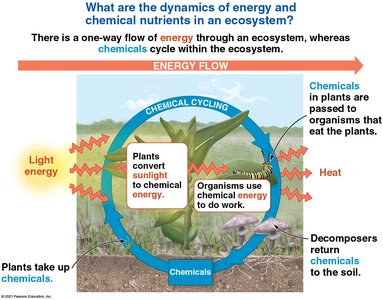
An ecosystem consists of all living organisms in a given area, interacting with each other and with their abiotic environment. Ecosystem dynamics are governed by the flow of energy and the cycling of chemical elements, which together sustain life and regulate ecosystem processes.
Energy flow is unidirectional: energy enters as sunlight, is converted by autotrophs, transferred through food webs, and eventually lost as heat.
Chemical cycling involves the movement of elements like carbon and nitrogen between biotic and abiotic components, allowing for the reuse of essential nutrients.
Components of Ecosystems
Biotic factors: All living organisms (plants, animals, fungi, bacteria).
Abiotic factors: Nonliving components (water, soil, climate, sunlight).
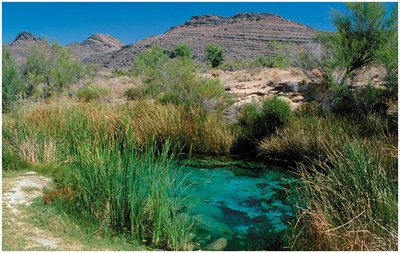
Ecosystems can be large (forests, lakes) or small (a fallen log, a spring).
Energy Flow in Ecosystems
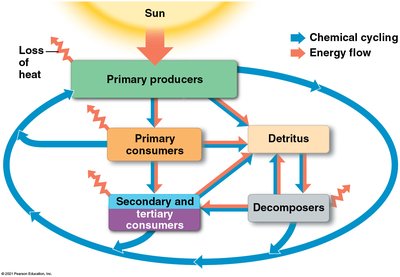
Energy enters most ecosystems as sunlight and is converted to chemical energy by autotrophs (primary producers). This energy is then transferred to heterotrophs (consumers) and eventually dissipates as heat.
Energy cannot be recycled; a constant input from the sun is required.
Energy transfer is governed by the laws of thermodynamics:
First law: Energy cannot be created or destroyed, only transformed.
Second law: Every energy transfer increases entropy; some energy is lost as heat.
Chemical Cycling in Ecosystems
Elements such as carbon and nitrogen cycle between living organisms and the environment. Photosynthetic and chemosynthetic organisms incorporate inorganic chemicals into organic compounds, while decomposers return elements to inorganic forms.
Trophic Structure and Levels
Primary producers: Autotrophs (plants, algae, some prokaryotes) that build organic molecules using sunlight or inorganic compounds.
Primary consumers: Herbivores that eat primary producers.
Secondary consumers: Carnivores that eat herbivores.
Tertiary consumers: Carnivores that eat other carnivores.
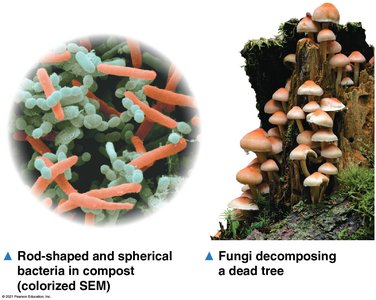
Decomposers: Heterotrophs (mainly prokaryotes and fungi) that obtain energy from detritus (nonliving organic matter).
Primary Production and Limiting Factors
Primary Production
Primary production is the amount of light energy converted to chemical energy by autotrophs in a given time period. It sets the energy budget for the ecosystem.
Gross primary production (GPP): Total energy converted by autotrophs.
Net primary production (NPP): GPP minus energy used by autotrophs for respiration ().
NPP represents the amount of new biomass available to consumers.
Global Patterns of Primary Production
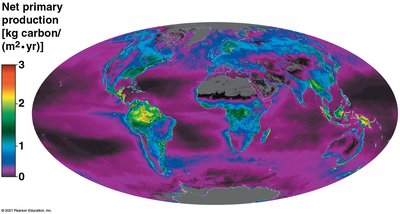
Tropical rain forests, estuaries, and coral reefs are highly productive per unit area.
Marine ecosystems, though less productive per unit area, contribute significantly to global NPP due to their vast size.
Limiting Factors in Aquatic and Terrestrial Ecosystems
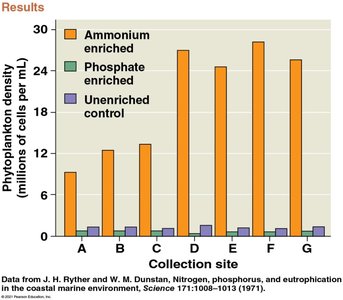
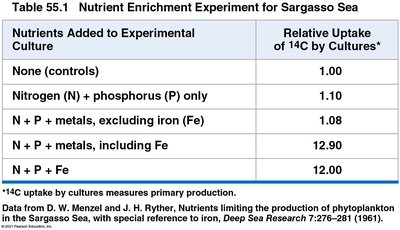
In aquatic systems, light and nutrients (especially nitrogen and phosphorus) limit primary production.
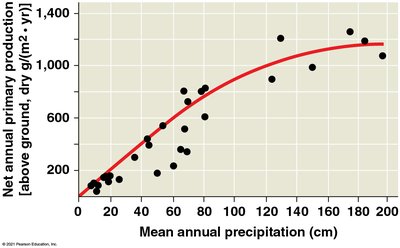
In terrestrial systems, temperature and moisture are key limiting factors; NPP increases with precipitation and temperature.
Energy Transfer and Trophic Efficiency
Production Efficiency
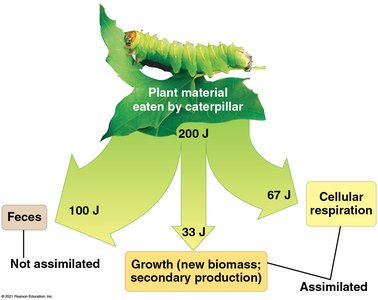
Production efficiency is the fraction of energy stored in assimilated food that is not used for respiration. It varies among organisms:
Birds and mammals: 1–3%
Fishes: ~10%
Insects and microorganisms: 40% or more
Trophic Efficiency and Ecological Pyramids
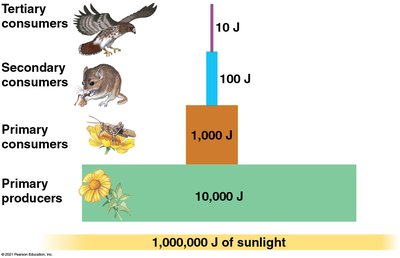
Trophic efficiency is the percentage of production transferred from one trophic level to the next, typically about 10%. This limits the length of food chains and shapes ecological pyramids.
Only about 0.1% of the chemical energy fixed by photosynthesis reaches tertiary consumers.
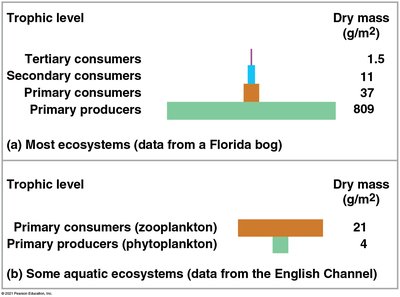
Energy pyramids and biomass pyramids illustrate the decrease in energy and biomass at higher trophic levels.
Nutrient Cycling and Decomposition
Decomposition and Nutrient Cycling Rates
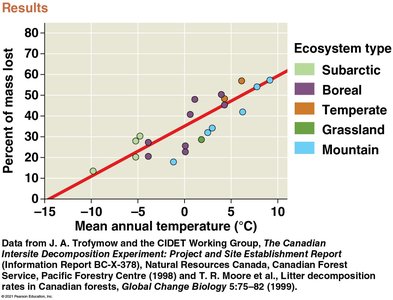
Decomposers (mainly bacteria and fungi) play a crucial role in recycling nutrients. The rate of decomposition, and thus nutrient cycling, is influenced by temperature and precipitation.
Biogeochemical Cycles
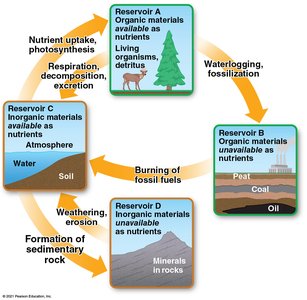
Biogeochemical cycles describe the movement of elements through biotic and abiotic reservoirs. Key cycles include the water, carbon, nitrogen, and phosphorus cycles.
Reservoirs are classified by whether materials are organic/inorganic and available/unavailable to organisms.
The Water Cycle
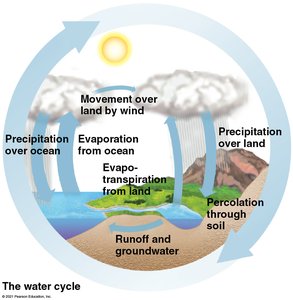
Water moves through evaporation, transpiration, condensation, precipitation, and runoff.
Oceans hold the majority of Earth's water.
The Carbon Cycle
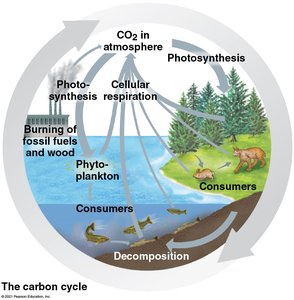
Carbon is cycled through photosynthesis, respiration, decomposition, and combustion of fossil fuels.
Main reservoirs: atmosphere, oceans, fossil fuels, living organisms, and sedimentary rocks.
The Nitrogen Cycle
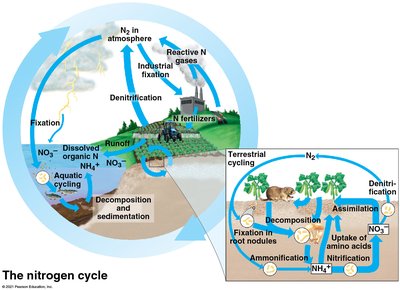
Nitrogen fixation by bacteria converts N2 to forms usable by plants (NH4+, NO3-).
Other processes: ammonification, nitrification, denitrification.
Restoration Ecology
Restoring Degraded Ecosystems
Restoration ecology aims to return degraded ecosystems to a more natural state. Strategies include:
Bioremediation: Using organisms to detoxify polluted environments.
Biological augmentation: Adding essential materials or organisms to restore ecosystem function.
Summary Table: Trophic Levels and Energy Flow
Trophic Level | Role | Example Organisms |
|---|---|---|
Primary Producers | Convert solar/inorganic energy to organic matter | Plants, algae, cyanobacteria |
Primary Consumers | Eat primary producers | Herbivores (insects, deer) |
Secondary Consumers | Eat primary consumers | Carnivores (frogs, small mammals) |
Tertiary Consumers | Eat secondary consumers | Top predators (hawks, wolves) |
Decomposers | Break down dead organic matter | Bacteria, fungi |
