 Back
BackEcosystem Structure, Energy Flow, and Biogeochemical Cycles
Study Guide - Smart Notes
 Tailored notes based on your materials, expanded with key definitions, examples, and context.
Ecosystems: Structure and Function
Definition and Components
Ecosystems are integrated units consisting of all living organisms (biotic factors) in a given area and the nonliving (abiotic) factors with which they interact. The study of ecosystems encompasses the flow of energy and cycling of matter, governed by physical laws.
Biotic factors: All living organisms, including plants, animals, fungi, and microorganisms.
Abiotic factors: Nonliving components such as sunlight, water, temperature, and soil nutrients.
Interactions: Organisms interact with each other and their environment, forming complex networks.
Physical Laws in Ecosystems
Ecosystems obey the laws of thermodynamics and conservation of mass.
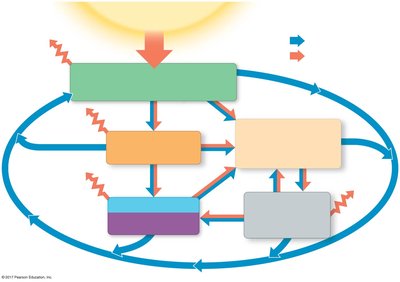
First Law of Thermodynamics: Energy cannot be created or destroyed, only transformed.
Second Law of Thermodynamics: Energy transfers increase entropy; some energy is lost as heat.
Law of Conservation of Mass: Matter is neither created nor destroyed; it cycles through ecosystems.
Energy Flow and Trophic Levels
Autotrophs and Heterotrophs
Energy enters ecosystems primarily through autotrophs, which convert solar energy into chemical energy. Heterotrophs obtain energy by consuming other organisms.
Autotrophs: Organisms (e.g., plants, algae) that produce their own food via photosynthesis.
Heterotrophs: Organisms (e.g., animals, fungi) that consume other organisms for energy.
Detritivores: Heterotrophs that obtain energy from detritus (nonliving organic matter).
Primary Production
Primary production is the rate at which autotrophs convert light energy to chemical energy.
Gross Primary Production (GPP): Total energy captured by autotrophs.
Net Primary Production (NPP): Energy remaining after autotrophs' respiration; available to consumers.
Formula:
Units: or

Global Patterns of Primary Production
Primary production varies across ecosystems, with grasslands, tropical rainforests, estuaries, and coral reefs being highly productive. 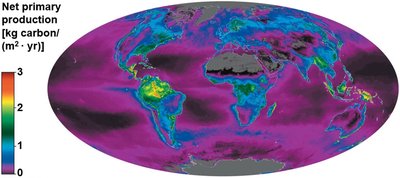
Factors Limiting Primary Production
Terrestrial Ecosystems
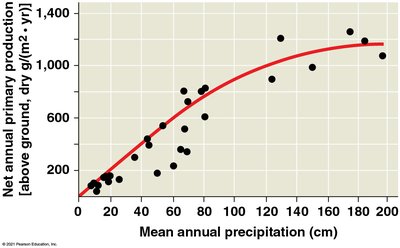
Primary production in terrestrial ecosystems is influenced by temperature, solar energy, and soil nutrients.
Key limiting nutrients: Nitrogen and phosphorus.
Adaptations: Some plants form symbiotic relationships with nitrogen-fixing bacteria (e.g., Rhizobium).

Energy Transfer and Trophic Efficiency
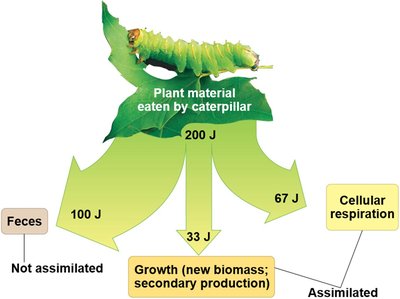
Production Efficiency
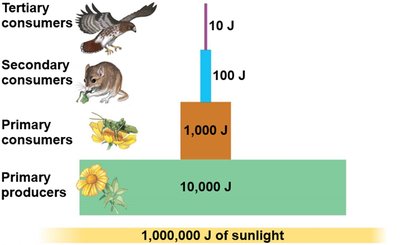
Energy transfer between trophic levels is typically only about 10% efficient.
Production efficiency:
Birds and mammals: 1–3% efficiency
Fishes: 10% efficiency
Insects and microorganisms: ~40% efficiency
Nutrient Cycling and Decomposition
Decomposers and Cycling Rates
Decomposers (fungi, bacteria) play a critical role in recycling nutrients. Decomposition rates vary with climate; warm climates accelerate decomposition, while cold/wet ecosystems slow it.
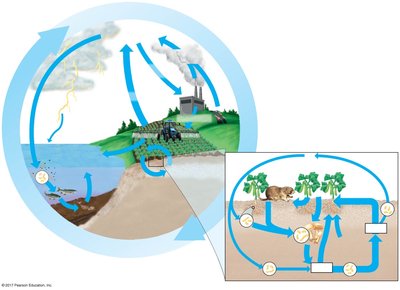
Biogeochemical Cycles
Nutrient cycles, called biogeochemical cycles, involve both biotic and abiotic components.
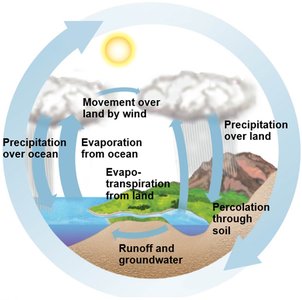
Water Cycle: Movement of water through evaporation, precipitation, runoff, and transpiration.
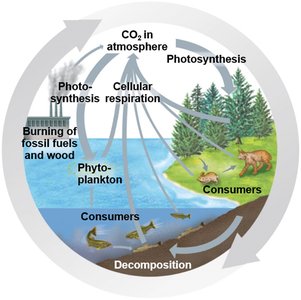
Carbon Cycle: Exchange of carbon among atmosphere, organisms, and geological processes.
Nitrogen Cycle: Transformation of nitrogen through fixation, assimilation, nitrification, and denitrification.
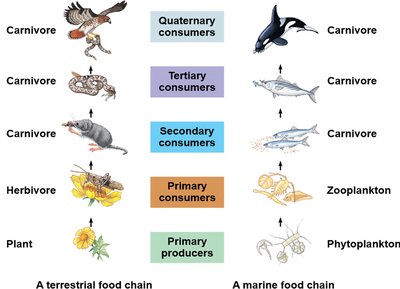
Summary Table: Trophic Levels and Energy Flow
Trophic Level | Role | Example |
|---|---|---|
Primary Producers | Autotrophs, convert solar energy | Plants, phytoplankton |
Primary Consumers | Herbivores, eat producers | Insects, zooplankton |
Secondary Consumers | Carnivores, eat primary consumers | Rodents, fish |
Tertiary Consumers | Carnivores, eat secondary consumers | Birds, larger fish |
Quaternary Consumers | Top predators | Hawks, orcas |
Key Equations
Net Primary Production:
Production Efficiency:
Conclusion
Ecosystems are dynamic systems governed by physical laws, with energy flowing through trophic levels and matter cycling via biogeochemical processes. Understanding these principles is essential for studying ecosystem function, productivity, and sustainability. Additional info: Some explanations and context were inferred to ensure completeness and clarity for exam preparation.
