 Back
BackEcosystems and Energy: Dynamics, Productivity, and Nutrient Cycling
Study Guide - Smart Notes
 Tailored notes based on your materials, expanded with key definitions, examples, and context.
Chapter 42: Ecosystems and Energy
What Are the Dynamics of Energy and Matter in an Ecosystem?
Ecosystems are dynamic systems where energy flows in one direction and matter cycles among living and nonliving components. Understanding these processes is fundamental to ecology and environmental biology.
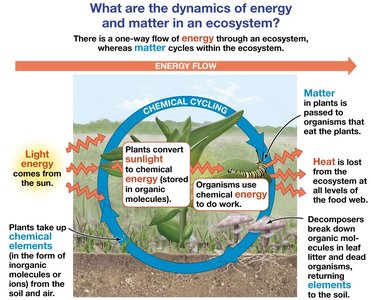
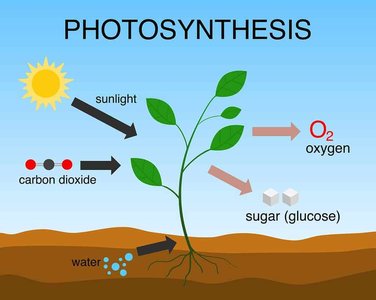
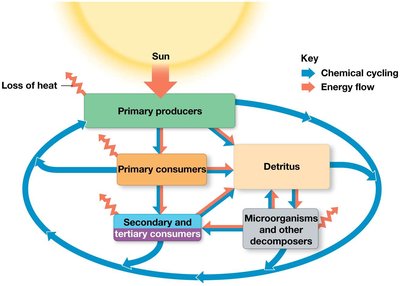
Energy Flow: Light energy from the sun is converted by plants into chemical energy, which is then used by organisms to perform work. Energy is eventually lost as heat at each trophic level, increasing the entropy of the universe.
Matter Cycling: Chemical elements are taken up by plants as inorganic molecules or ions and are cycled through the ecosystem as organisms consume plants and decomposers break down organic matter, returning elements to the soil.
Physical Laws Governing Energy Flow and Chemical Cycling
Energy and matter transformations in ecosystems are governed by the laws of thermodynamics and conservation of mass.
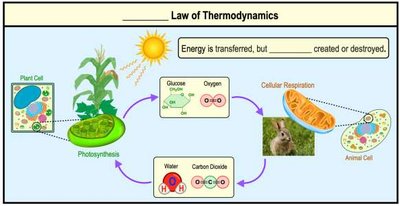
First Law of Thermodynamics: Energy cannot be created or destroyed, only transferred or transformed. Autotrophs convert solar energy into chemical energy, but the total energy remains constant.
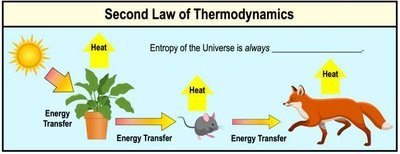
Second Law of Thermodynamics: Every energy transfer increases the entropy (disorder) of the universe. Energy conversions are not completely efficient; some energy is always lost as heat.
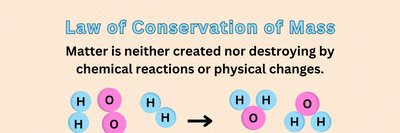
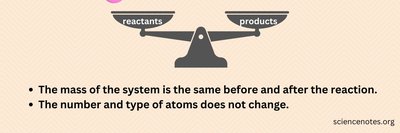
Law of Conservation of Mass: Matter cannot be created or destroyed. Elements are recycled within ecosystems, but can be gained or lost through processes such as leaching, atmospheric loss, or deposition.
Open, Closed, and Isolated Systems
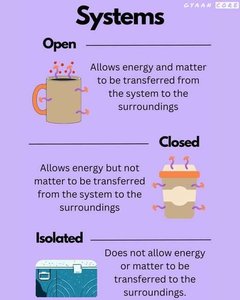
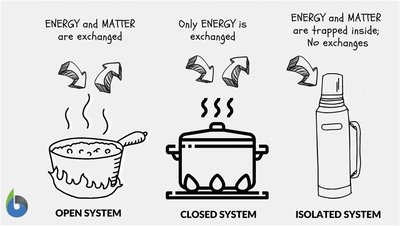
Ecosystems are considered open systems because they exchange both energy and matter with their surroundings. This openness is essential for the maintenance of life and ecological processes.
Open System: Exchanges both energy and matter with the environment (e.g., ecosystems).
Closed System: Exchanges only energy, not matter.
Isolated System: Exchanges neither energy nor matter.
Energy, Mass, and Trophic Levels
Trophic Structure of Ecosystems
Ecologists classify organisms into trophic levels based on their feeding relationships, which determine the flow of energy and cycling of matter.
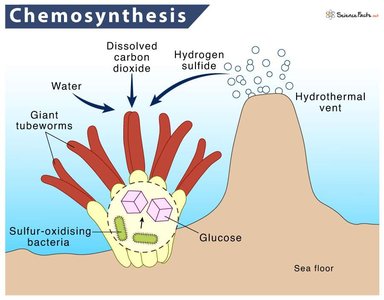
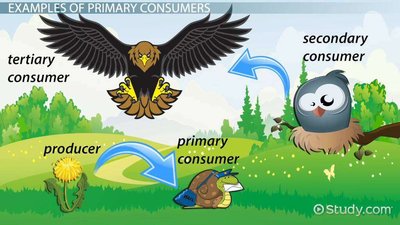
Primary Producers (Autotrophs): Organisms that produce organic molecules from inorganic substances. Most are photosynthetic (plants, algae), but some are chemosynthetic (e.g., bacteria at hydrothermal vents).
Primary Consumers: Herbivores that eat primary producers.
Secondary Consumers: Carnivores that eat herbivores.
Tertiary Consumers: Carnivores that eat other carnivores.
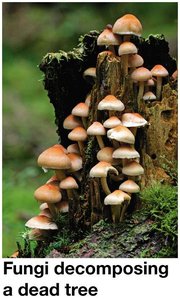
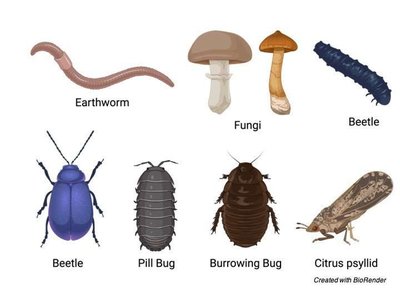
Detritivores (Decomposers): Heterotrophs that obtain energy from detritus (dead organic matter), including prokaryotes, fungi, and some animals. They are essential for recycling nutrients back to primary producers.
Primary Production in Ecosystems
Primary Production and Limiting Factors
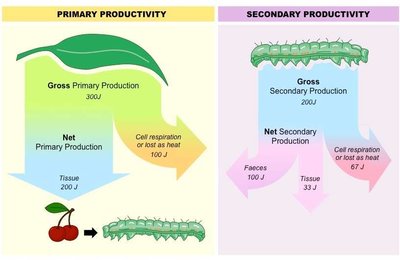
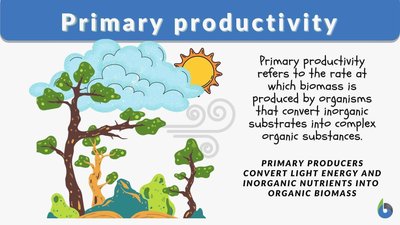
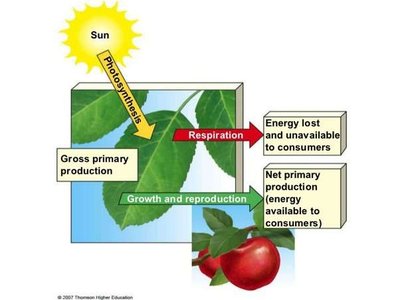
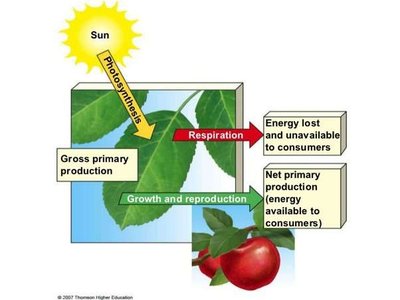
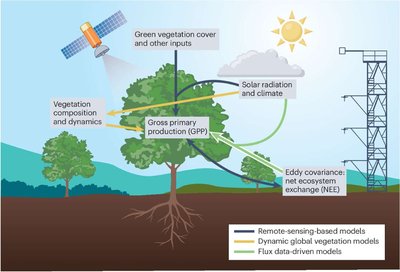
Primary production is the amount of light energy converted to chemical energy by autotrophs in a given period. It sets the energy budget for the entire ecosystem.
Gross Primary Production (GPP): Total energy captured by autotrophs.
Net Primary Production (NPP): Energy remaining after autotrophs use some for respiration. (where R is energy used in respiration)
Limiting Factors: In aquatic systems, light and nutrients (especially nitrogen, phosphorus, and sometimes iron) limit primary production. In terrestrial systems, temperature, moisture, and soil nutrients (mainly nitrogen and phosphorus) are limiting.
Energy Transfer and Ecological Efficiency
Energy Transfer Between Trophic Levels
Energy transfer between trophic levels is inefficient, with only about 10% of the energy at one level being passed to the next. This inefficiency limits the number of trophic levels and the abundance of top-level consumers.
Production Efficiency (PE): The percentage of energy stored in assimilated food that is not used for respiration and is available to the next trophic level.
Trophic Efficiency: The percentage of production transferred from one trophic level to the next, typically 5–20% (average ~10%).
Ecological Pyramids: Energy pyramids and biomass pyramids visually represent the loss of energy and biomass at each trophic level.
Biogeochemical Cycles
Major Nutrient Cycles
Biogeochemical cycles describe the movement of chemical elements between living (biotic) and nonliving (abiotic) reservoirs. These cycles are essential for ecosystem function and include:
Water Cycle: Involves evaporation, condensation, precipitation, and flow through organisms and the environment.
Carbon Cycle: Involves photosynthesis, respiration, decomposition, and combustion of fossil fuels.
Nitrogen Cycle: Involves nitrogen fixation, nitrification, denitrification, and assimilation by organisms.
Phosphorus Cycle: Involves weathering of rocks, uptake by organisms, and return to the environment through decomposition.
Decomposers play a critical role in recycling nutrients, and the rates of decomposition are influenced by temperature, moisture, and nutrient availability.
Restoration Ecology
Restoring Degraded Ecosystems
Restoration ecology aims to return degraded ecosystems to a more natural state. This may involve physical restoration, bioremediation (using organisms to detoxify environments), and biological augmentation (adding essential materials or organisms).
Bioremediation: Use of organisms such as plants, fungi, or bacteria to remove or neutralize pollutants.
Biological Augmentation: Addition of organisms or nutrients to restore ecosystem function.
Summary Table: Key Concepts in Ecosystem Ecology
Concept | Definition | Example |
|---|---|---|
Energy Flow | One-way movement of energy through trophic levels | Sunlight → Plants → Herbivores → Carnivores |
Matter Cycling | Recycling of chemical elements within the ecosystem | Carbon, nitrogen, phosphorus cycles |
Primary Production | Conversion of solar/chemical energy to organic matter by autotrophs | Photosynthesis in plants |
Production Efficiency | Fraction of assimilated energy stored as new biomass | Insects: ~40%, Mammals: 1–3% |
Biogeochemical Cycle | Movement of elements between biotic and abiotic reservoirs | Nitrogen cycle, water cycle |
