 Back
Back55
Study Guide - Smart Notes
 Tailored notes based on your materials, expanded with key definitions, examples, and context.
Chapter 55: Ecosystems and Restoration Ecology
55.1: Physical Laws Govern Energy Flow and Chemical Cycling in Ecosystems
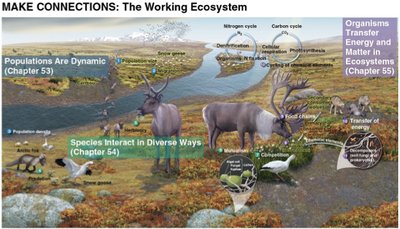
Ecosystems consist of all living organisms in a given area, interacting with each other and with abiotic factors such as sunlight, water, and minerals. The dynamics of ecosystems are driven by two main processes: energy flow and chemical cycling.
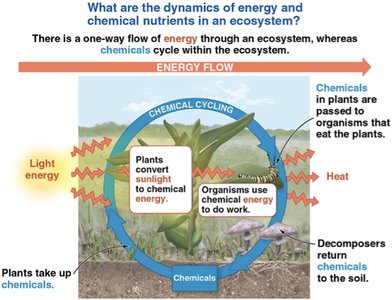
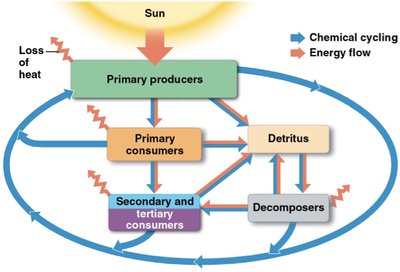
Energy Flow: Energy enters ecosystems as sunlight, is converted to chemical energy by autotrophs (primary producers), passed to heterotrophs (consumers and decomposers), and eventually dissipates as heat.
Chemical Cycling: Elements like carbon and nitrogen cycle between biotic (living) and abiotic (nonliving) components. Photosynthetic and chemosynthetic organisms incorporate inorganic chemicals into organic compounds, which are then transferred through the food web.
Law of Conservation of Mass: Matter cannot be created or destroyed; chemical elements are continually recycled within ecosystems.
Open Systems: Ecosystems absorb energy and mass and release heat and waste products.
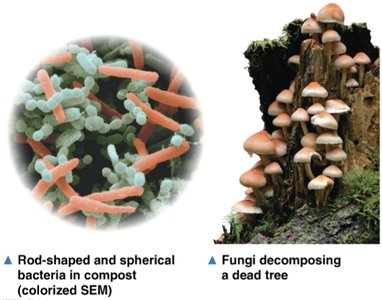
Trophic Structure: Primary producers (autotrophs) build organic molecules; herbivores (primary consumers) eat producers; carnivores (secondary and tertiary consumers) eat other animals; decomposers (mainly prokaryotes and fungi) obtain energy from detritus (nonliving organic matter).
55.2: Energy and Other Limiting Factors Control Primary Production in Ecosystems
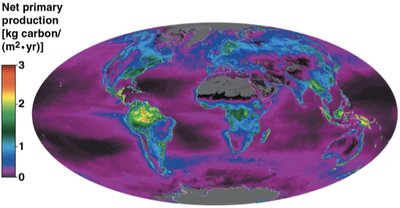
Primary production is the amount of light energy converted to chemical energy by autotrophs in a given time period. This process sets the energy budget for ecosystems.
Gross Primary Production (GPP): Total primary production in an ecosystem.
Net Primary Production (NPP): GPP minus the energy used by autotrophs for respiration ().
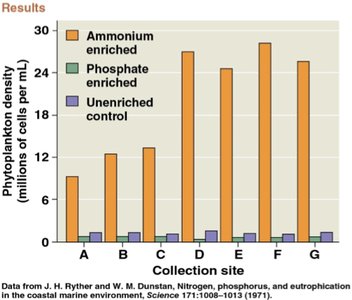
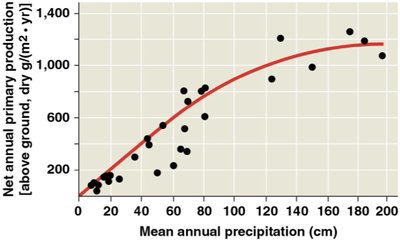
Limiting Factors: In aquatic systems, light and nutrients (especially nitrogen and phosphorus) limit primary production. In terrestrial systems, temperature, moisture, and sunlight are key factors.
Eutrophication: The process by which primary production increases as an ecosystem becomes nutrient-rich, often leading to algal blooms and oxygen depletion.
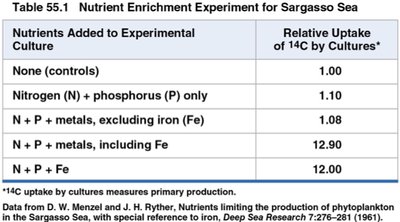
Nutrients Added to Experimental Culture | Relative Uptake of 14C by Cultures |
|---|---|
None (controls) | 1.00 |
Nitrogen (N) + phosphorus (P) only | 1.10 |
N + P + metals, excluding iron (Fe) | 1.08 |
N + P + metals, including Fe | 12.90 |
N + P + Fe | 12.00 |
55.3: Energy Transfer Between Trophic Levels Is Typically Only 10% Efficient
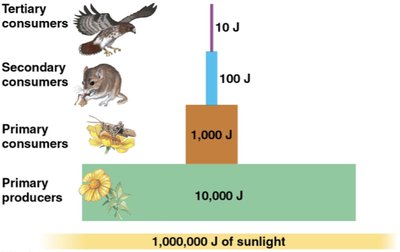
Energy transfer between trophic levels is inefficient, with only about 10% of the energy at one level being passed to the next. This is known as the 10% rule.
Secondary Production: The amount of chemical energy in food converted to new biomass by consumers.
Production Efficiency: The fraction of energy stored in assimilated food that is not used for respiration. Birds and mammals have low efficiencies (1–3%) due to energy used for maintaining body temperature.
Trophic Efficiency: The percentage of production transferred from one trophic level to the next, usually around 10%.
Biomass Pyramid: Each tier represents the dry mass of all organisms at one trophic level, with a sharp decrease at higher levels.
55.4: Biogeochemical Cycles: Nutrient Circulation in Ecosystems
Essential chemical elements are recycled in ecosystems through biogeochemical cycles, which involve both biotic and abiotic components. Decomposers play a critical role in recycling nutrients.
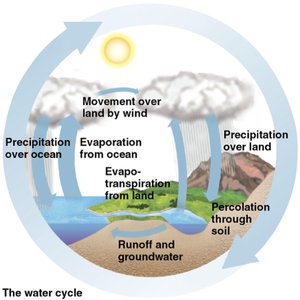
Water Cycle: Involves evaporation, condensation, precipitation, and runoff, moving water between the atmosphere, land, and oceans.
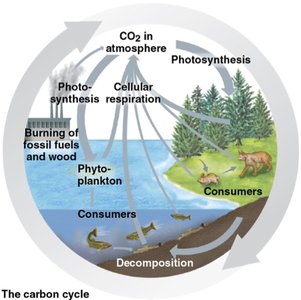
Carbon Cycle: Involves photosynthesis, respiration, decomposition, and combustion, cycling carbon between the atmosphere and living organisms.
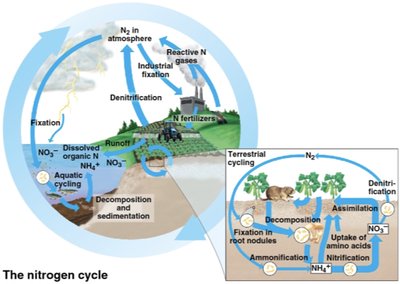
Nitrogen Cycle: Includes nitrogen fixation, nitrification, assimilation, ammonification, and denitrification, cycling nitrogen through the atmosphere, soil, and living organisms.
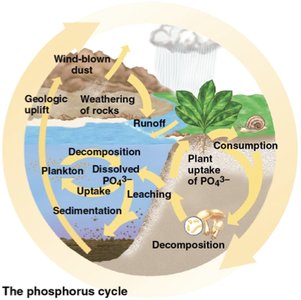
Phosphorus Cycle: Involves weathering of rocks, uptake by plants, consumption, decomposition, and sedimentation, cycling phosphorus mainly through soil and water.
55.5: Restoration Ecology: Recovering Degraded Ecosystems
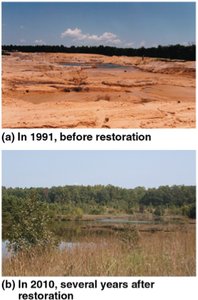
Restoration ecology aims to initiate or accelerate the recovery of degraded ecosystems. Given enough time, biological communities can recover from many types of disturbances.
Bioremediation: The use of organisms (mainly prokaryotes, fungi, or plants) to detoxify polluted ecosystems.
Biological Augmentation: The use of organisms to add essential materials to a degraded ecosystem (e.g., nitrogen-fixing plants to improve soil quality).
Example: Restoration of a degraded landscape over several years, resulting in increased vegetation and ecosystem function.
Additional info: Restoration ecology is an applied science that integrates knowledge from ecology, soil science, hydrology, and other disciplines to restore ecosystem structure and function.
