 Back
Ecosystems, Biogeochemical Cycles, and Conservation Biology
Study Guide - Smart Notes
 Tailored notes based on your materials, expanded with key definitions, examples, and context.
Ecosystems and Energy Flow
Introduction to Ecosystems
An ecosystem consists of all the organisms living in a community as well as the abiotic factors with which they interact. Ecosystem ecology examines the flow of energy and cycling of nutrients among organisms and their environment.
Energy Flow: Energy enters ecosystems as sunlight and is converted to chemical energy by autotrophs (producers), then transferred to heterotrophs (consumers).
Nutrient Cycling: Elements such as carbon, nitrogen, and phosphorus are recycled within ecosystems.
Key Processes: Energy input, transfer, and cycling of nutrients.
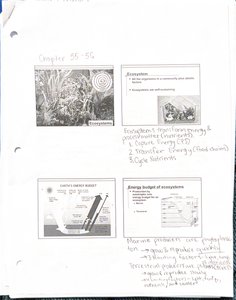
Energy Budget of Ecosystems
The energy budget of an ecosystem describes the input, storage, and output of energy. Primary producers capture solar energy, which is then passed through trophic levels.
Gross Primary Production (GPP): Total energy captured by producers.
Net Primary Production (NPP): Energy available to consumers after producers' respiration.
Energy Transfer: Only about 10% of energy is transferred from one trophic level to the next.
Equation:
Biogeochemical Cycles
Carbon Cycle
The carbon cycle describes the movement of carbon among the atmosphere, biosphere, hydrosphere, and geosphere. Carbon is essential for all life forms and is cycled through processes such as photosynthesis, respiration, and decomposition.
Photosynthesis: Plants convert CO2 into organic molecules.
Respiration: Organisms release CO2 back into the atmosphere.
Decomposition: Decomposers break down dead matter, releasing carbon.
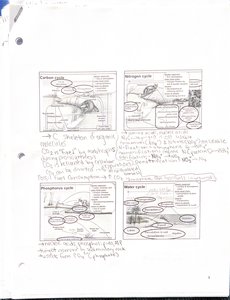
Nitrogen Cycle
The nitrogen cycle involves the transformation of nitrogen among its various chemical forms. Nitrogen is required for amino acids and nucleic acids.
Nitrogen Fixation: Conversion of atmospheric N2 to ammonia by bacteria.
Nitrification: Ammonia is converted to nitrate by bacteria.
Denitrification: Nitrate is converted back to N2 gas.
Phosphorus Cycle
The phosphorus cycle describes the movement of phosphorus through the lithosphere, hydrosphere, and biosphere. Phosphorus is a key component of nucleic acids and ATP.
Weathering: Rocks release phosphate ions into soil and water.
Assimilation: Plants absorb phosphate, which moves through food webs.
Decomposition: Returns phosphorus to soil and water.
Water Cycle
The water cycle involves the continuous movement of water on, above, and below the surface of the Earth.
Evaporation and Transpiration: Water moves from surfaces and plants to the atmosphere.
Condensation and Precipitation: Water returns to Earth as rain or snow.
Runoff and Infiltration: Water moves into bodies of water or underground.
Global Change: Greenhouse Effect and Ozone Depletion
The Greenhouse Effect
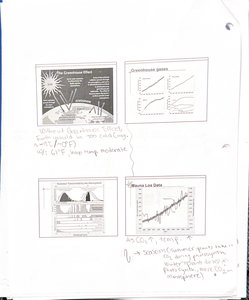
The greenhouse effect is the warming of Earth's surface due to atmospheric gases that trap heat. Key greenhouse gases include CO2, methane, and water vapor.
Solar Radiation: Some energy is absorbed by Earth, some is reflected, and some is trapped by greenhouse gases.
Human Impact: Increased CO2 from fossil fuels enhances the greenhouse effect, leading to global warming.
Ozone Depletion
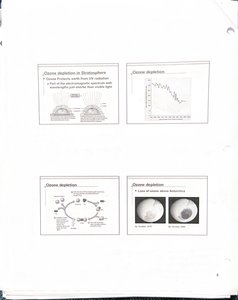
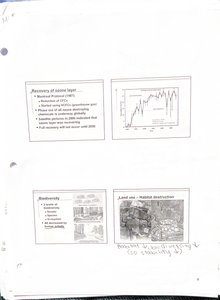
Ozone (O3) in the stratosphere protects life by absorbing harmful UV radiation. Human-made chemicals, especially chlorofluorocarbons (CFCs), have caused ozone depletion.
Ozone Destruction: CFCs release chlorine atoms that break down ozone molecules.
Ozone Hole: Seasonal thinning of the ozone layer, especially over Antarctica.
Consequences: Increased UV exposure leads to higher risks of skin cancer and ecosystem disruption.
Biodiversity and Conservation Biology
Biodiversity
Biodiversity refers to the variety of life in all its forms, including genetic, species, and ecosystem diversity. High biodiversity increases ecosystem resilience and productivity.
Threats: Habitat destruction, invasive species, overexploitation, pollution, and climate change.
Conservation: Efforts to protect species, habitats, and ecosystem functions.
Threats to Biodiversity
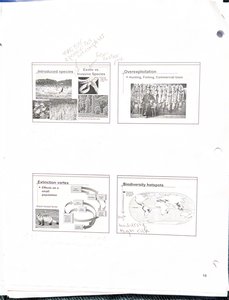
Major threats include the introduction of non-native species, overexploitation, habitat loss, and climate change. These factors contribute to increased extinction rates and loss of biodiversity hotspots.
Invasive Species: Non-native species that disrupt local ecosystems.
Overexploitation: Unsustainable harvesting of resources.
Biodiversity Hotspots: Regions with high levels of endemic species under threat.
Additional info: Conservation biology integrates ecology, physiology, molecular biology, genetics, and evolutionary biology to conserve biological diversity at all levels.
