 Back
Electron Transport Chain and Chemiosmosis: Cellular Respiration Study Guide
Study Guide - Smart Notes
 Tailored notes based on your materials, expanded with key definitions, examples, and context.
Electron Transport Chain and Chemiosmosis
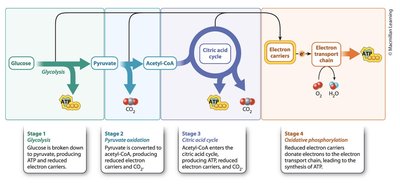
Overview of Cellular Respiration
Cellular respiration is a multi-step process by which cells extract energy from glucose and other organic molecules. The process involves glycolysis, pyruvate oxidation, the citric acid cycle, and oxidative phosphorylation (electron transport chain and chemiosmosis). Each stage contributes to the production of ATP, the cell's energy currency.
Glycolysis: Glucose is broken down into pyruvate, producing ATP and NADH.
Pyruvate Oxidation: Pyruvate is converted to Acetyl-CoA, generating NADH and CO2.
Citric Acid Cycle: Acetyl-CoA enters the cycle, producing ATP, NADH, FADH2, and CO2.
Oxidative Phosphorylation: NADH and FADH2 donate electrons to the electron transport chain, leading to ATP synthesis.
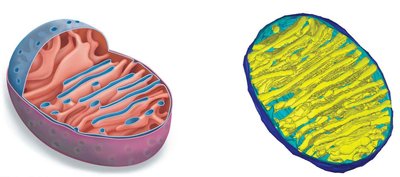
Structure of the Mitochondrion
The mitochondrion is the site of the electron transport chain (ETC) and chemiosmosis. It consists of an outer membrane, an inner membrane (with folds called cristae), an intermembrane space, and a matrix. The ETC is embedded in the inner membrane.
Inner membrane: Location of ETC complexes and ATP synthase.
Intermembrane space: Where protons (H+) accumulate during ETC.
Matrix: Contains enzymes for the citric acid cycle.
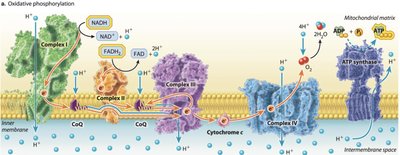
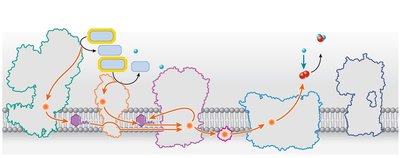
Electron Transport Chain (ETC)
The ETC is a series of protein complexes (I-IV) and mobile carriers (CoQ, cytochrome c) that transfer electrons from NADH and FADH2 to oxygen, the final electron accepp[;/tor. This process creates a proton gradient across the inner mitochondrial membrane.
Electron donors: NADH and FADH2 (from glycolysis and citric acid cycle).
Electron acceptor: Oxygen (O2), which is reduced to water (H2O).
Proton pumping: Energy from electron transfer is used to pump H+ from the matrix to the intermembrane space.
Electronegativity: Each complex holds electrons tighter than the previous, facilitating energy release.
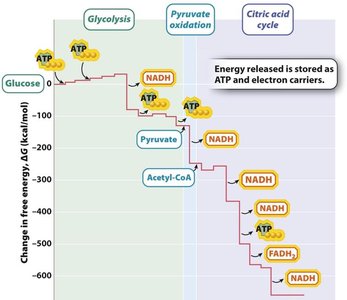
Energy Conversion Steps
As electrons move through the ETC, their energy is released in steps, which is used to pump protons and generate ATP. The change in free energy (ΔG) is negative, indicating an exergonic process.
Stepwise energy release: Prevents loss of energy as heat and allows efficient ATP production.
ATP yield: Most ATP is produced during oxidative phosphorylation.
Chemiosmosis and ATP Synthesis
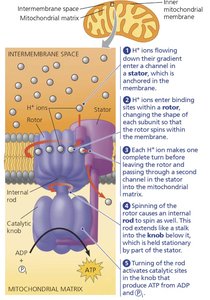
Chemiosmosis is the process by which the energy stored in the proton gradient is used to synthesize ATP via ATP synthase. Protons flow back into the matrix through ATP synthase, driving the phosphorylation of ADP to ATP.
ATP synthase: Enzyme that uses the proton gradient to make ATP.
Potential energy: The proton gradient represents stored energy, similar to water behind a dam.
Direction of proton flow: From intermembrane space to matrix, with their concentration gradient.
Fundamental Concepts and Key Terms
Oxidation: Loss of electrons (e.g., NADH → NAD+).
Reduction: Gain of electrons (e.g., O2 → H2O).
Electron carriers: NADH and FADH2 transport high-energy electrons.
ATP: Adenosine triphosphate, the main energy currency of the cell.
Cellular Respiration Equation
The overall equation for cellular respiration is:
Glucose is oxidized to CO2.
Oxygen is reduced to H2O.
Regulation and Inhibition
ETC can be inhibited by substances such as cyanide, which blocks complex IV, preventing oxygen from accepting electrons and halting ATP production. DNP (dinitrophenol) uncouples chemiosmosis by making the inner membrane permeable to protons, reducing ATP yield and increasing heat production.
Cyanide: Inhibits complex IV, stopping electron flow and ATP synthesis.
DNP: Disrupts proton gradient, decreasing ATP production.
Comparison: Mitochondrial vs. Chloroplast Electron Transport Chains
Both mitochondria and chloroplasts use electron transport chains to generate proton gradients and synthesize ATP, but differ in electron donors, energy sources, and acceptors.
Mitochondria: Electron donor is NADH/FADH2, acceptor is O2.
Chloroplasts: Electron donor is water, acceptor is NADP+.
Summary Table: Electron Transport Chain Components
Component | Function | Location |
|---|---|---|
Complex I | Accepts electrons from NADH, pumps H+ | Inner membrane |
Complex II | Accepts electrons from FADH2, does not pump H+ | Inner membrane |
CoQ (Ubiquinone) | Mobile electron carrier | Inner membrane |
Complex III | Transfers electrons, pumps H+ | Inner membrane |
Cytochrome c | Mobile electron carrier | Inner membrane |
Complex IV | Transfers electrons to O2, pumps H+ | Inner membrane |
ATP Synthase | Synthesizes ATP using proton gradient | Inner membrane |
Energy Flow Analogy
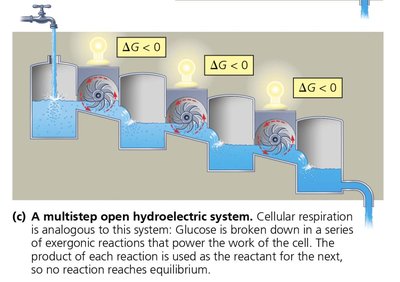
The stepwise release of energy in the ETC is analogous to a multistep hydroelectric system, where water flows through turbines, generating energy at each step. This prevents equilibrium and allows continuous ATP production.
Key Questions for Review
What are the electron donors and acceptors in the mitochondrial ETC?
How does the ETC create a proton gradient?
What is the role of ATP synthase in chemiosmosis?
How do inhibitors like cyanide and DNP affect cellular respiration?
Additional info: The notes expand on brief points from the original materials, providing definitions, examples, and context for General Biology students. Images included are directly relevant to the explanation of each paragraph, visually reinforcing key concepts.
