 Back
Electron Transport Chain and Chemiosmosis: Mitochondrial Energy Conversion
Study Guide - Smart Notes
 Tailored notes based on your materials, expanded with key definitions, examples, and context.
Electron Transport Chain and Chemiosmosis
Overview of Cellular Respiration
Cellular respiration is a multi-step process by which cells convert glucose into usable energy in the form of ATP. The process involves glycolysis, pyruvate oxidation, the citric acid cycle, and oxidative phosphorylation (electron transport chain and chemiosmosis). - Glycolysis: Glucose is broken down into pyruvate, producing ATP and NADH. - Pyruvate Oxidation: Pyruvate is converted to Acetyl-CoA, generating NADH and CO2. - Citric Acid Cycle: Acetyl-CoA enters the cycle, producing ATP, NADH, FADH2, and CO2. - Oxidative Phosphorylation: NADH and FADH2 donate electrons to the electron transport chain, leading to ATP synthesis. 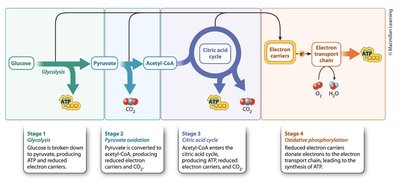
Mitochondrial Structure and Function
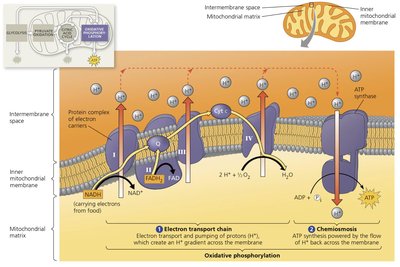
The mitochondrion is the site of oxidative phosphorylation. Its inner membrane contains the electron transport chain (ETC) and ATP synthase. - Matrix: Innermost compartment, site of the citric acid cycle. - Inner Membrane: Location of ETC and ATP synthase. - Intermembrane Space: Area where protons accumulate during ETC. 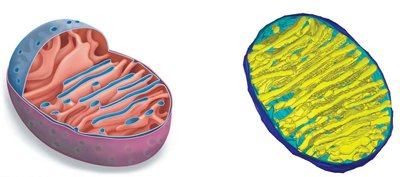
Electron Transport Chain (ETC)
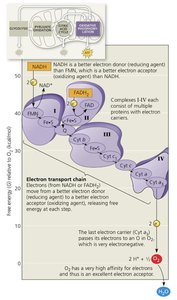
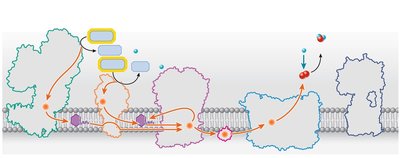
The ETC is a series of protein complexes (I-IV) embedded in the inner mitochondrial membrane. It transfers electrons from NADH and FADH2 to oxygen, the final electron acceptor, while pumping protons (H+) into the intermembrane space. - Electron Donors: NADH and FADH2 provide high-energy electrons. - Electron Acceptors: Oxygen (O2) accepts electrons, forming water (H2O). - Proton Gradient: Energy from electron transfer is used to pump H+ across the membrane, creating a gradient. 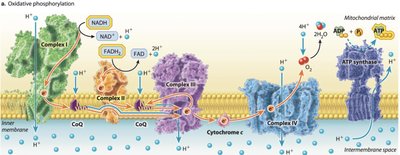
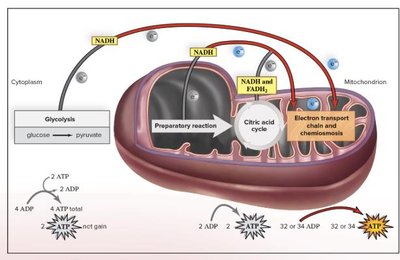
Energy Conversion Steps
As electrons move through the ETC, energy is released and stored as ATP and electron carriers. The change in free energy (ΔG) is negative, indicating an exergonic process. - ATP and Electron Carriers: Energy is captured in ATP, NADH, and FADH2. - Stepwise Energy Release: Each complex in the ETC holds electrons tighter, releasing energy at each step. 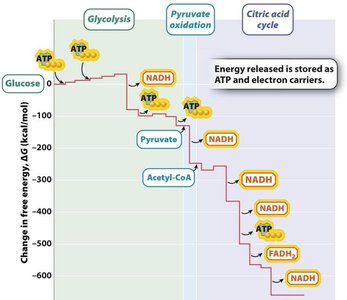
Proton Movement and Chemiosmosis
The ETC pumps protons from the matrix to the intermembrane space, creating a concentration gradient. Chemiosmosis is the process by which ATP synthase uses this gradient to synthesize ATP. - ATP Synthase: Enzyme that converts ADP and inorganic phosphate (Pi) into ATP as protons flow back into the matrix. - Potential Energy: The proton gradient represents stored potential energy, similar to water behind a dam. - Direction of Movement: Protons move with their gradient through ATP synthase, powering ATP production. 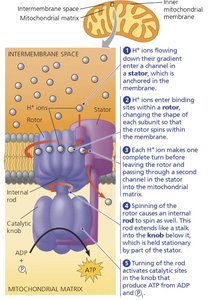
Analogies for Energy Conversion
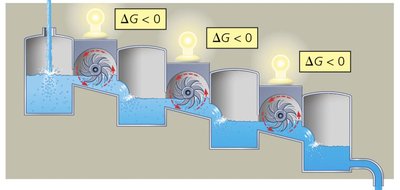
Cellular respiration can be compared to a multistep hydroelectric system, where each reaction releases energy to power cellular work. - Hydroelectric Analogy: Water flowing through turbines is analogous to protons moving through ATP synthase. - Open System: Cellular respiration is a multistep open system; products of one reaction are reactants for the next, preventing equilibrium. 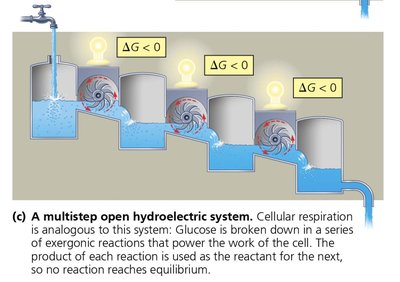
Key Terms and Definitions
- Oxidation: Loss of electrons from a molecule. - Reduction: Gain of electrons by a molecule. - Electron Carrier: Molecule that transports electrons (e.g., NADH, FADH2). - ATP Synthase: Enzyme that synthesizes ATP using the proton gradient. - Chemiosmosis: Movement of ions across a membrane, generating ATP.
Cellular Respiration Equation
The overall equation for cellular respiration is:
Summary Table: Electron Transport Chain Components
Component | Function | Location |
|---|---|---|
NADH/FADH2 | Electron donors | Matrix |
Complex I-IV | Electron transfer & proton pumping | Inner membrane |
CoQ (Coenzyme Q) | Mobile electron carrier | Inner membrane |
Cytochrome c | Electron carrier | Inner membrane |
O2 | Final electron acceptor | Matrix |
ATP Synthase | ATP production | Inner membrane |
Additional info:
- The ETC and chemiosmosis are essential for aerobic energy production in eukaryotic cells. - Inhibitors like cyanide block complex IV, preventing O2 from accepting electrons and halting ATP synthesis. - DNP (dinitrophenol) uncouples the proton gradient, reducing ATP production and increasing heat generation.
