 Back
BackElectronic Structure of Atoms and Quantum Numbers: Chemistry Foundations for Biology
Study Guide - Smart Notes
 Tailored notes based on your materials, expanded with key definitions, examples, and context.
Chemistry Foundations: Electronic Structure of Atoms
Electromagnetic Radiation and Its Properties
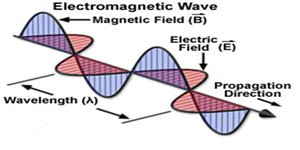
Understanding the electronic structure of atoms requires knowledge of electromagnetic radiation (ER), a form of energy emitted by moving charged particles. ER behaves as a wave, consisting of oscillating electric and magnetic fields, and is fundamental to the study of atomic and molecular matter.
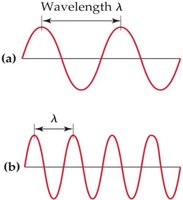
Wavelength (\lambda): The distance between corresponding points on adjacent waves.
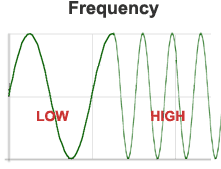
Frequency (\nu): The number of waves passing a point per unit time, measured in s-1 or Hertz (Hz).
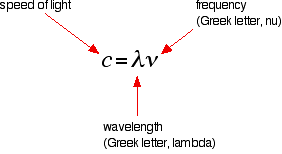
Speed of Light (c): All ER travels at m/s.
Relationship:
The Electromagnetic Spectrum
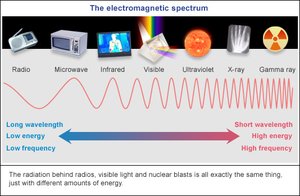
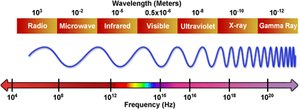
Different types of electromagnetic radiation (radio waves, microwaves, infrared, visible light, ultraviolet, X-rays, gamma rays) vary in wavelength, frequency, and energy. All travel at the speed of light but differ in their applications and energy levels.
Long wavelength: Low energy, low frequency (e.g., radio waves).
Short wavelength: High energy, high frequency (e.g., gamma rays).
Quantization of Energy
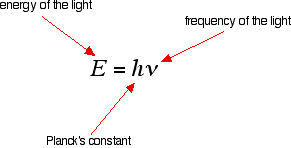
Energy is quantized, meaning only certain energy values are allowed. Max Planck explained that heated objects emit electromagnetic radiation in discrete amounts (quanta), proportional to frequency.
Planck's constant (h): J·s
Energy equation:
As frequency increases, energy increases; as wavelength decreases, energy increases.

Photoelectric Effect and Photons
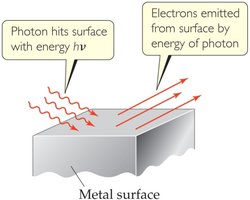
Einstein used the concept of quanta to explain the photoelectric effect, showing that light has particle-like properties. Photons are packets of energy, and electrons are emitted from metal surfaces only if the light's frequency (energy) is high enough.
Photon energy:
Frequency-wavelength relationship:
Wave Properties of Electrons: de Broglie Hypothesis
Louis de Broglie proposed that particles such as electrons exhibit wave-like properties. Any particle with momentum (p) has a corresponding wavelength.
de Broglie equation:
Electrons behave like waves, which is fundamental to quantum mechanics.
Quantum Mechanics and Atomic Orbitals
Erwin Schrödinger developed quantum mechanics, a mathematical framework that incorporates both wave and particle nature of matter. Solving the wave equation yields orbitals, spatial distributions of electron density described by quantum numbers.
Orbitals: Regions in space where electrons are likely to be found.
Each orbital is defined by a set of quantum numbers.
Quantum Numbers and Atomic Structure
Principal Quantum Number (n)
The principal quantum number (n) describes the energy level and size of the atom. Higher n means larger atomic size and less stable orbitals.
Allowed values: integers > 0
Energy levels closer to the nucleus have lower energy.
Angular Momentum Quantum Number (\ell)
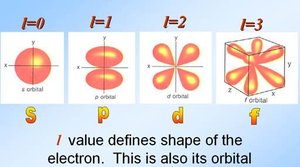
The angular momentum quantum number (\ell) defines the shape of the orbital. Allowed values are integers from 0 to n-1.
s orbital: \ell = 0 (spherical)
p orbital: \ell = 1 (dumbbell)
d orbital: \ell = 2 (cloverleaf)
f orbital: \ell = 3 (complex)
Magnetic Quantum Number (m\ell)
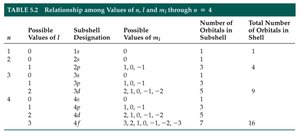
The magnetic quantum number (m\ell) describes the three-dimensional orientation of the orbital. Values range from -\ell to +\ell.
For \ell = 0: m\ell = 0 (1 value)
For \ell = 1: m\ell = -1, 0, +1 (3 values)
For \ell = 2: m\ell = -2, -1, 0, +1, +2 (5 values)
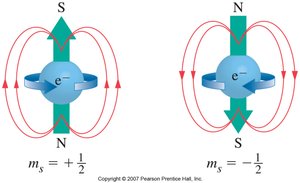
Spin Quantum Number (ms)
The spin quantum number (ms) describes the spin of an electron in an orbital. Values are +1/2 or -1/2, and electrons in the same orbital must have opposite spins.
Shells, Subshells, and Orbitals
Orbitals with the same value of n form a shell. Different orbital types within a shell are subshells. Each shell contains n2 orbitals.
Maximum Number of Electrons in Each Sublevel
Sublevel | Number of Orbitals | Maximum Number of Electrons |
|---|---|---|
s | 1 | 2 |
p | 3 | 6 |
d | 5 | 10 |
f | 7 | 14 |
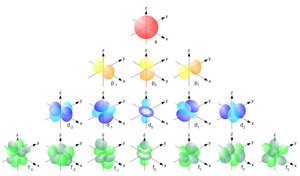
Shapes of Atomic Orbitals
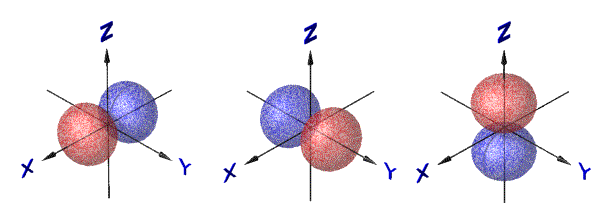
Each orbital type has a characteristic shape:
s-orbitals: Spherical, radius increases with n.
p-orbitals: Three orientations (px, py, pz), dumbbell-shaped.
d-orbitals: Five orientations, four with four lobes, one with a doughnut shape.
f-orbitals: Seven orientations, complex shapes.
Practice and Application
Sample Calculations and Exercises
Calculate frequency from wavelength:
Calculate energy of a photon:
Use de Broglie relationship:
Determine quantum numbers for given orbitals and electron configurations.
Summary Table: Quantum Numbers and Orbitals
Quantum Number | Symbol | Meaning | Allowed Values |
|---|---|---|---|
Principal | n | Energy level, size | 1, 2, 3, ... |
Angular Momentum | \ell | Shape | 0 to n-1 |
Magnetic | m\ell | Orientation | -\ell to +\ell |
Spin | ms | Spin direction | +1/2, -1/2 |
Example Applications
Biological Relevance: Understanding atomic structure is foundational for studying biomolecules, cell components, and metabolic processes in biology.
Practice: Assign quantum numbers to electrons in various orbitals, calculate photon energies, and relate atomic structure to chemical properties.
Additional info: These notes expand on the original syllabus and lecture points to provide a self-contained, exam-ready summary for students in biology and chemistry courses.
