 Back
BackEmbryology: Early Development in Vertebrates (Frog and Chick)
Study Guide - Smart Notes
 Tailored notes based on your materials, expanded with key definitions, examples, and context.
Embryology: Early Development in Vertebrates
Introduction to Embryology
Embryology is the branch of biology that studies the formation and early development of living organisms, from fertilization to the establishment of the basic body plan. This field is essential for understanding how a single cell, the zygote, gives rise to a complex, multicellular organism through a series of regulated developmental stages.
Key Concepts and Definitions
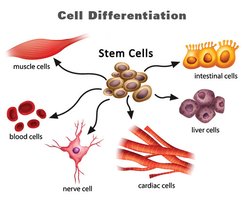
Cell Differentiation: The process by which unspecialized cells become specialized into one of the many cell types that make up the body. Differentiation is crucial for forming tissues and organs with distinct functions.
Development: The series of changes by which cells become specialized and organized into tissues, organs, and organ systems.
Cleavage: Rapid cell divisions following fertilization that transform the zygote into a multicellular embryo. Cleavage partitions the cytoplasm of the large fertilized egg into many smaller cells called blastomeres.
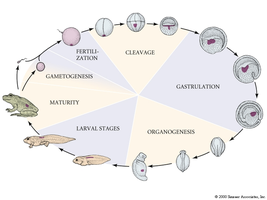
Overview of Vertebrate Developmental Stages
Vertebrate embryonic development proceeds through several key stages:
Fertilization: Fusion of sperm and egg to form a zygote.
Cleavage: Series of mitotic divisions producing a multicellular embryo.
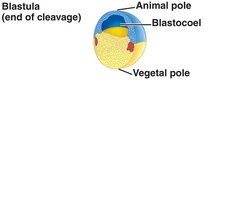
Blastula Formation: Formation of a hollow ball of cells (blastula) with a fluid-filled cavity (blastocoel).
Gastrulation: Dramatic cell movements that generate the three primary germ layers (ectoderm, mesoderm, endoderm) and establish the body axes.
Organogenesis: Formation of organs from the germ layers.
Larval Stages and Maturity: Further development and growth to reach the adult form.
Frog (Amphibian) Development
Egg Structure and Cleavage
Frog eggs are mesolecithal, containing a moderate amount of yolk. The yolk is concentrated at the vegetal pole, while the animal pole contains less yolk and is more pigmented. Cleavage in frogs is complete but unequal due to the presence of yolk, resulting in smaller blastomeres at the animal pole and larger ones at the vegetal pole.
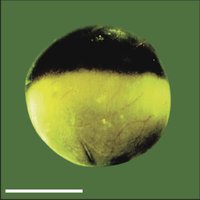
Complete Cleavage: Each cell division produces two complete daughter cells, but the divisions are unequal due to yolk distribution.
Blastula: The embryo forms a ball of cells with a central cavity (blastocoel). Different regions of the blastula are destined to form specific tissues and organs.
Gastrulation in Frogs
Gastrulation transforms the blastula into a three-layered embryo with distinct body axes. This process involves the inward movement of cells at the blastopore, forming the archenteron (primitive gut) and establishing the three germ layers:
Ectoderm: Forms skin and nervous tissue.
Mesoderm: Forms muscles, bones, and the circulatory system.
Endoderm: Forms the digestive tract and associated organs.
Spemann's organizer is a region that plays a critical role in organizing the body plan during gastrulation.
Neurulation and Organogenesis
Neurulation is the formation of the neural tube, which will develop into the central nervous system. The sequence includes:
Primitive Groove
Neural Plate
Neural Groove and Neural Fold
Neural Crest
Neural Tube
Somites, block-like segments of mesoderm, form alongside the neural tube and give rise to muscles, vertebrae, and dermis.
Chick (Avian) Development
Egg Structure and Cleavage
Chick eggs are macrolecithal, containing a large amount of yolk. Cleavage is incomplete and restricted to a small region called the blastodisc at the animal pole. The embryo develops as a disk of cells sitting atop the yolk mass.
Albumen: The egg white, a watery mixture that surrounds the yolk and provides protection and nutrients.
Chalazae: Twisted cords of albumen that anchor the yolk in the center of the egg, allowing the embryo to rotate.
Gastrulation in Chicks
Gastrulation in chicks is organized around the primitive streak, a thickening of the blastodisc. Cells migrate through the primitive streak to form the three germ layers. The primitive groove is a depression along the streak, and Hensen’s node acts as the primary organizer for axis formation.
Epiblast: The upper layer of the blastodisc, gives rise to all three germ layers.
Endoderm and Mesoderm: Formed by migration of epiblast cells through the primitive streak.
Neurulation and Organogenesis in Chicks
Neurulation follows a similar sequence as in frogs, with the formation of the neural plate, groove, folds, and tube. Somites also form and differentiate into muscle, bone, and dermis. The chick embryo develops extraembryonic membranes for protection and nutrient exchange.
Comparative Table: Frog vs. Chick Development
Feature | Frog | Chick |
|---|---|---|
Egg Type | Mesolecithal (moderate yolk) | Macrolecithal (large yolk) |
Cleavage | Complete, unequal | Incomplete, restricted to blastodisc |
Blastula | Ball of cells with blastocoel | Blastodisc atop yolk |
Gastrulation | Involution at blastopore | Primitive streak and groove |
Extraembryonic Membranes | Absent | Present (amniote) |
Key Terms and Concepts
Spiral Cleavage: Oblique cell divisions, characteristic of protostomes (e.g., annelids, mollusks), leading to determinate development.
Radial Cleavage: Symmetrical, stacked cell divisions, characteristic of deuterostomes (e.g., vertebrates), leading to indeterminate development.
Morphogen: Signaling molecules that pattern tissues by forming concentration gradients and inducing cell fate decisions.
Somite: Segmental blocks of mesoderm that give rise to skeletal muscle, vertebrae, and dermis.
Summary of Learning Objectives
Understand the process of differentiation from a zygote to a fully developed animal, including the establishment of body axes and germ layers.
Recognize the effects of yolk amount on cleavage and embryonic development.
Identify and describe the stages of vertebrate embryonic development: cleavage, blastula, gastrulation, and organogenesis.
Compare and contrast frog and chick development, focusing on cleavage patterns, gastrulation mechanisms, and egg structure.
