 Back
Emergent Properties of Water and Their Biological Significance
Study Guide - Smart Notes
 Tailored notes based on your materials, expanded with key definitions, examples, and context.
Water and Its Properties
Structure and Polarity of Water
Water is a unique molecule with properties essential for life. Its structure consists of two hydrogen atoms covalently bonded to an oxygen atom, forming a polar molecule. - Polarity: The oxygen atom is more electronegative, causing electrons to spend more time near it, resulting in a partial negative charge on oxygen and partial positive charges on hydrogen. - Hydrogen Bonding: Water molecules form hydrogen bonds with each other due to their polarity, leading to many of water's emergent properties.
Four Emergent Properties of Water
Water exhibits four key properties that make it suitable for life:
Cohesion: Water molecules stick together due to hydrogen bonding, resulting in high surface tension.
Moderation of Temperature: Water can absorb or release large amounts of heat with minimal temperature change, due to its high specific heat.
Expansion Upon Freezing: Water is less dense as a solid than as a liquid, allowing ice to float and preventing bodies of water from freezing solid.
Versatility as a Solvent: Water's polarity enables it to dissolve a wide range of substances, making it the solvent of life.
Cohesion and Surface Tension
Cohesion refers to the attraction between water molecules, which is responsible for surface tension—the resistance of water's surface to being broken. - Example: Some insects can walk on water due to high surface tension. 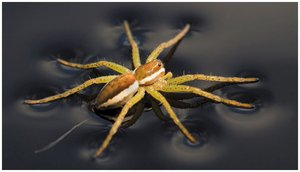
Adhesion
Adhesion is the attraction between water molecules and other substances, such as plant cell walls. This property is important for processes like capillary action in plants.
Moderation of Temperature
Water's high specific heat allows it to stabilize temperatures in organisms and environments. - Specific Heat: The amount of heat required to change the temperature of 1 g of water by 1ºC is 1 cal/(g·ºC). - Heat Absorption and Release: Water absorbs heat when hydrogen bonds break and releases heat when they form. - Environmental Impact: Large bodies of water moderate coastal temperatures, keeping climates stable. 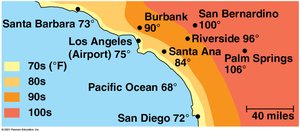
Expansion Upon Freezing
Water expands when it freezes because hydrogen bonds form a crystalline lattice, making ice less dense than liquid water. - Biological Importance: Floating ice insulates aquatic life and prevents entire bodies of water from freezing solid.
Water as a Solvent
Water's polarity makes it an excellent solvent for ionic and polar substances. - Solution: A homogeneous mixture of substances. - Solvent: The dissolving agent (water in aqueous solutions). - Solute: The substance dissolved. - Hydration Shell: Water molecules surround dissolved ions, stabilizing them in solution.
Hydrophilic and Hydrophobic Substances
- Hydrophilic: Substances with an affinity for water (e.g., salts, sugars). - Hydrophobic: Substances that repel water (e.g., oils), often forming the basis of cell membranes.
Acidification and Ocean Chemistry
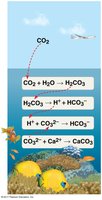
Human activities, such as burning fossil fuels, increase atmospheric CO2, which dissolves in oceans and forms carbonic acid, leading to ocean acidification. - Ocean Acidification: CO2 + H2O → H2CO3 (carbonic acid) - Impact: Increased H+ ions combine with carbonate ions, reducing carbonate availability for marine organisms to form calcium carbonate (CaCO3). - Biological Consequence: Reduced calcification affects coral reefs and other marine life. 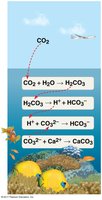
Summary Table: Emergent Properties of Water
Property | Description | Biological Importance |
|---|---|---|
Cohesion | Hydrogen bonds hold water molecules together | Surface tension, transport in plants |
Moderation of Temperature | High specific heat stabilizes temperature | Climate regulation, homeostasis |
Expansion Upon Freezing | Ice is less dense than liquid water | Insulates aquatic life, prevents freezing |
Solvent Properties | Polarity allows dissolution of many substances | Biochemical reactions, transport of nutrients |
Equations Related to Water Chemistry
- Formation of carbonic acid: - Dissociation of carbonic acid: - Formation of calcium carbonate:
Application Questions
What are the four emergent properties of water important for life? Answer: Cohesion, moderation of temperature, expansion upon freezing, solvent properties.
What would happen if skin lacked hydrophobic glycolipids? Answer: Water would be lost from skin cells more quickly, and skin would swell when swimming.
How does increased atmospheric CO2 affect coral reefs? Answer: More CO2 causes a decrease in the amount of CO32– in seawater, leading to slower reef growth.
Additional info: Expanded explanations and context were added to ensure completeness and clarity for exam preparation.
