 Back
Endocrine Regulation of Homeostasis, Stress, and Blood Sugar Part 2
Study Guide - Smart Notes
 Tailored notes based on your materials, expanded with key definitions, examples, and context.
Endocrine Glands and Homeostasis
Overview of Endocrine Signaling
Endocrine glands secrete hormones that regulate homeostasis, development, and behavior in multicellular organisms. Hormones are chemical messengers released into the bloodstream, affecting distant target organs and tissues.
Homeostasis: Maintenance of stable internal conditions (e.g., blood calcium, glucose levels).
Development: Regulation of growth and differentiation.
Behavior: Influence on physiological and behavioral responses.
Parathyroid Hormone and Vitamin D: Control of Blood Calcium
Homeostatic Regulation of Calcium (Ca2+)
Calcium ion concentration in the blood is tightly regulated by hormones to ensure proper functioning of muscles, nerves, and other physiological processes.
Parathyroid Hormone (PTH): Released by parathyroid glands when blood Ca2+ levels fall below a set point.
PTH Actions:
Stimulates release of Ca2+ from bones.
Promotes reabsorption of Ca2+ in kidneys.
Induces production of active vitamin D, which increases Ca2+ absorption in intestines.
Calcitonin: Hormone that decreases blood Ca2+ levels by stimulating Ca2+ deposition in bones and secretion by kidneys.
Example: When blood Ca2+ levels drop, PTH is released, leading to increased Ca2+ in blood via bone resorption, kidney reabsorption, and enhanced intestinal absorption. 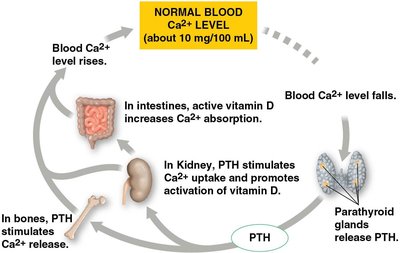
Adrenal Hormones: Response to Stress
Structure and Function of Adrenal Glands
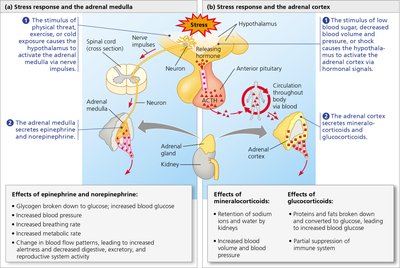
The adrenal glands, located atop the kidneys, consist of two distinct regions: the adrenal medulla (inner) and adrenal cortex (outer). Each region produces different hormones in response to stress and homeostatic needs.
Adrenal Medulla: Secretes epinephrine (adrenaline) and norepinephrine (noradrenaline), collectively known as catecholamines.
Adrenal Cortex: Produces corticosteroids—glucocorticoids (e.g., cortisol) and mineralocorticoids (e.g., aldosterone).
Adrenal Medulla: Fight-or-Flight Response
Catecholamines coordinate the body's rapid response to stress, known as the "fight-or-flight" response.
Increase breakdown of glycogen in liver cells, raising blood glucose.
Trigger release of glucose and fatty acids into the blood.
Raise oxygen delivery to cells.
Direct blood flow toward heart, brain, and skeletal muscles; away from skin, digestive system, and kidneys.
Adrenal Cortex: Long-Term Stress Response
Glucocorticoids (e.g., cortisol): Influence glucose metabolism and suppress the immune system.
Mineralocorticoids (e.g., aldosterone): Regulate salt and water balance, affecting blood volume and pressure.
Hormonal Regulation of Blood Sugar
Pancreatic Hormones and Blood Glucose Homeostasis
The pancreas produces hormones that regulate blood sugar levels:
Insulin: Lowers blood glucose by promoting uptake into cells.
Glucagon: Raises blood glucose by stimulating glycogen breakdown and glucose release from the liver.
Example: The interaction of insulin and glucagon helps maintain a balanced internal environment (homeostasis). 
Epinephrine’s Multiple Effects: Target Cell Responses
Cellular Mechanisms of Epinephrine Action
Epinephrine exerts different effects depending on the target cell type and receptor present:
Liver Cells: Epinephrine binds to β receptors, activating protein kinase A and stimulating glycogen breakdown, increasing blood glucose.
Smooth Muscle Cells (Skeletal Muscle Blood Vessels): Epinephrine causes vasodilation, increasing blood flow to muscles.
Smooth Muscle Cells (Intestinal Blood Vessels): Epinephrine causes vasoconstriction, reducing blood flow to intestines.
Example: The same hormone can produce different physiological effects depending on the receptor and intracellular signaling pathway. 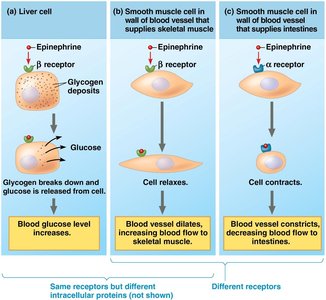
Summary Table: Hormones and Their Effects
Hormone | Source | Main Effect |
|---|---|---|
Parathyroid Hormone (PTH) | Parathyroid glands | Raises blood Ca2+ by bone resorption, kidney reabsorption, and vitamin D activation |
Calcitonin | Thyroid gland | Lowers blood Ca2+ by bone deposition and kidney excretion |
Epinephrine/Norepinephrine | Adrenal medulla | Fight-or-flight response: increases blood glucose, heart rate, blood flow to muscles |
Glucocorticoids (e.g., cortisol) | Adrenal cortex | Long-term stress response: increases glucose metabolism, suppresses immune system |
Mineralocorticoids (e.g., aldosterone) | Adrenal cortex | Regulates salt and water balance |
Insulin | Pancreas | Lowers blood glucose |
Glucagon | Pancreas | Raises blood glucose |
Key Equations
Blood Calcium Regulation:
Blood Glucose Regulation:
Additional info:
Glucocorticoids also play a role in anti-inflammatory responses.
Mineralocorticoids are essential for maintaining electrolyte balance and blood pressure.
