Back
BackEndocrine System Study Guide: Functions, Interactions, and Regulation
Study Guide - Smart Notes
 Tailored notes based on your materials, expanded with key definitions, examples, and context.
Q1. The main function of the endocrine system is
Background
Topic: Endocrine System Overview
This question tests your understanding of the primary role of the endocrine system in the body, which involves communication and regulation through chemical messengers called hormones.
Key Terms:
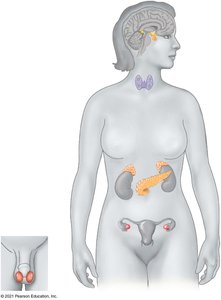
Endocrine system: A network of glands that secrete hormones to regulate bodily functions.
Hormones: Chemical messengers that travel through the bloodstream to target cells.
Communication: The process of transmitting signals between cells and organs.
Chemical signaling: The use of molecules (like hormones) to send messages within the body.
Step-by-Step Guidance
Recall that the endocrine system is made up of glands, cells, and tissues that secrete hormones.
Think about how hormones act as chemical messengers, circulating throughout the body to stimulate specific cells.
Consider whether the endocrine system's main function is limited to chemical signaling, communication, or both.
Review the options and decide which best describes the overall function of the endocrine system based on your knowledge.
Try solving on your own before revealing the answer!
Q2. Which system does the endocrine system work most closely with to maintain homeostasis?
Background
Topic: Homeostasis and System Interactions
This question is about how the endocrine system interacts with other organ systems to keep the body's internal environment stable (homeostasis).
Key Terms:
Homeostasis: The maintenance of a stable internal environment.
Nervous system: The system responsible for rapid communication and control via electrical signals.
Endocrine system: Uses hormones for slower, longer-lasting regulation.
Step-by-Step Guidance
Recall that homeostasis involves both rapid and long-term regulation of body functions.
Think about which system provides fast responses (like reflexes) and which provides slower, sustained regulation.
Consider how the endocrine system and another system might coordinate to maintain homeostasis.
Review the options and identify which system is most closely linked to the endocrine system in this context.
Try solving on your own before revealing the answer!
Q3. Most endocrine processes are regulated by
Background
Topic: Feedback Regulation in Endocrine Pathways
This question tests your understanding of how hormone levels are controlled in the body, specifically through feedback mechanisms.
Key Terms and Concepts:
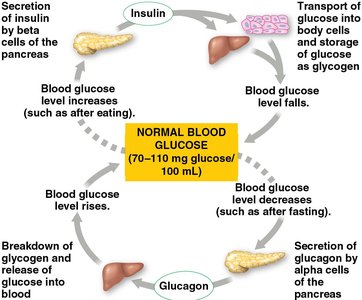
Feedback regulation: Mechanisms that adjust hormone secretion based on the body's needs.
Negative feedback: A process where the response reduces the initial stimulus.
Positive feedback: A process where the response reinforces the stimulus.
Step-by-Step Guidance
Recall the definitions of negative and positive feedback.
Think about examples of each type of feedback in endocrine regulation (e.g., insulin and glucagon for blood glucose, oxytocin for milk secretion).
Consider which type of feedback is more common in endocrine processes.
Review the options and decide which best fits most endocrine regulation scenarios.
Try solving on your own before revealing the answer!
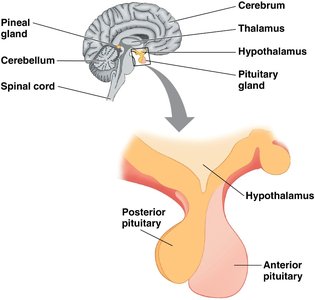
Q4. The hypothalamus influences the function of only one lobe of the pituitary gland. True or False?
Background
Topic: Hypothalamus and Pituitary Gland Relationship
This question tests your knowledge of how the hypothalamus interacts with the pituitary gland, which has two distinct lobes (anterior and posterior).
Key Terms:
Hypothalamus: A brain region that regulates the pituitary gland.
Pituitary gland: Has two lobes—anterior and posterior—that release different hormones.
Step-by-Step Guidance
Recall the anatomical structure of the pituitary gland and its two lobes.
Think about how the hypothalamus communicates with each lobe (directly or via releasing hormones).
Review the statement and decide whether the hypothalamus influences both lobes or just one.
Try solving on your own before revealing the answer!
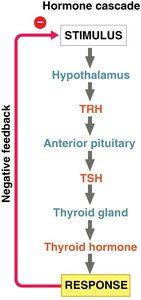
Q5. In human hormone cascades, what is the correct sequence in which these structures become involved, starting with the organ at the beginning of the cascade?
Background
Topic: Hormone Cascade Pathways
This question tests your understanding of the order in which organs and glands participate in hormone signaling cascades, such as the hypothalamic-pituitary-endocrine axis.
Key Terms:
Hormone cascade: A series of events where one hormone stimulates the release of another.
Hypothalamus: Initiates the cascade.
Pituitary gland: Receives signals from the hypothalamus and releases hormones to target glands.
Endocrine gland: Responds to pituitary hormones and releases its own hormones.
Nonendocrine target: The final organ or tissue affected by the hormone.
Step-by-Step Guidance
Recall the typical sequence: hypothalamus → pituitary gland → endocrine gland → target tissue.
Match the numbered options to each step in the cascade.
Review the answer choices and identify the sequence that starts with the hypothalamus and ends with the nonendocrine target.
Try solving on your own before revealing the answer!