 Back
Energy and Enzymes: An Introduction to Metabolism
Study Guide - Smart Notes
 Tailored notes based on your materials, expanded with key definitions, examples, and context.
Energy in Biological Systems
Types of Energy
Biological systems utilize two main types of energy: kinetic and potential. Understanding these forms is essential for grasping how cells perform work and drive chemical reactions.
Kinetic Energy: The energy of motion, including thermal energy (energy from moving molecules).
Potential Energy: Energy stored in position or configuration, such as chemical energy stored in molecular bonds.
Energy Transformation: Energy can be converted from one form to another, but is never created or destroyed (law of conservation of energy).
Example: Water at the top of a waterfall has potential energy, which is converted to kinetic energy as it falls, and then to other forms as it reaches the bottom.

System and Surroundings
In thermodynamics, a system is the part of the universe under study, while the surroundings are everything else. The boundary between them determines what can be exchanged.
Open System: Can exchange both energy and matter with the environment.
Closed System: Can exchange energy but not matter.
Isolated System: Cannot exchange either energy or matter.

Gibbs Free Energy and Chemical Reactions
Gibbs Free Energy (G)
Gibbs Free Energy is the energy available to do work in a closed system. It is a central concept in understanding whether a reaction will occur spontaneously.
Formula: Where: = change in free energy = change in enthalpy (total energy) = temperature in Kelvins = change in entropy (disorder)
Biological Importance: Cells strive to use available energy efficiently and minimize disorder.

Spontaneity and Reaction Types
The sign and value of determine whether a reaction is spontaneous:
Exergonic Reaction: ; energy is released, reaction is spontaneous.
Endergonic Reaction: ; energy is absorbed, reaction is non-spontaneous.
Equilibrium: ; no net change occurs.
Exothermic Reaction: ; heat is released.
Endothermic Reaction: ; heat is absorbed.

Energetic Coupling and ATP
Coupling Reactions
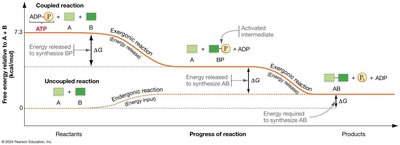
Biological systems often couple exergonic reactions (which release energy) to endergonic reactions (which require energy) to drive processes that would not occur spontaneously.
Energetic Coupling: The energy released from an exergonic reaction is used to power an endergonic reaction.
ATP: Adenosine triphosphate is a molecule with high potential energy due to its phosphate groups. It is the primary energy currency of the cell.
Example: ATP hydrolysis is exergonic and can be coupled to endergonic reactions to make them proceed.


Enzymes and Activation Energy
Role of Enzymes
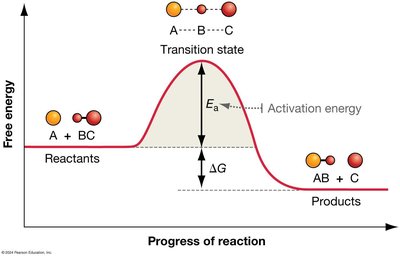
Enzymes are biological catalysts that speed up chemical reactions by lowering the activation energy required. They are essential for cellular metabolism and energy management.
Activation Energy (): The minimum energy required to start a reaction.
Enzyme Function: Enzymes bring substrates together and stabilize the transition state, making reactions faster.
Enzyme Naming: Most enzyme names end with "-ase" and indicate their function (e.g., protease breaks down proteins).

Coupling and Catalysis in Biological Systems
Cells use two main strategies to drive reactions forward:
Coupling to High-Energy Molecules: Reactions are paired with molecules like ATP to provide necessary energy.
Enzyme Catalysis: Enzymes lower activation energy, increasing reaction rates.
Key Vocabulary
Term | Definition |
|---|---|
Entropy | Measure of disorder in a system |
Gibbs Free Energy | Energy available to do work |
Potential Energy | Energy stored in position or bonds |
Enzyme | Protein catalyst for reactions |
Activation Energy | Minimum energy to start a reaction |
Endergonic Reaction | Non-spontaneous, absorbs energy |
Exergonic Reaction | Spontaneous, releases energy |
Endothermic Reaction | Absorbs heat |
Exothermic Reaction | Releases heat |
Summary Table: Types of Systems
System Type | Energy Exchange | Matter Exchange |
|---|---|---|
Open | Yes | Yes |
Closed | Yes | No |
Isolated | No | No |
Summary Table: Reaction Types
Reaction Type | Spontaneity | |
|---|---|---|
Exergonic | < 0 | Spontaneous |
Endergonic | > 0 | Non-spontaneous |
Equilibrium | = 0 | No net change |
Conclusion
Energy flow and enzyme activity are fundamental to cellular metabolism. Understanding Gibbs free energy, reaction coupling, and the role of enzymes provides a foundation for studying biological processes and metabolic pathways.
