 Back
Energy and Enzymes: An Introduction to Metabolism (Chapter 8 Study Notes)
Study Guide - Smart Notes
 Tailored notes based on your materials, expanded with key definitions, examples, and context.
Energy and Enzymes: An Introduction to Metabolism
Overview of Energy and Enzymes
Energy and enzymes are fundamental to cellular activity, enabling cells to respond to internal and external signals. Enzymes direct which reactions occur and when, facilitating the acquisition and use of energy through metabolic pathways—ordered series of chemical reactions that build up or break down molecules.
Types of Energy in Biological Systems
Energy exists in two primary forms within biological systems: kinetic and potential energy. Kinetic energy is the energy of motion, including thermal energy from moving molecules. Potential energy is stored in position or configuration, such as chemical energy in bonds. Energy can be transformed between these types.
Kinetic Energy: Energy of movement; includes thermal energy.
Potential Energy: Energy stored in chemical bonds; configuration and position of electrons affect potential energy.
Example: Chemical energy in glucose molecules is released during cellular respiration.
Chemical Bonds and Potential Energy
The potential energy in covalent bonds depends on the position of shared electrons relative to the nuclei of bonded atoms. Longer, weaker bonds with equally shared electrons have higher potential energy, while shorter, stronger bonds with unequally shared electrons have lower potential energy.
Bond Length and Strength: Nonpolar bonds (equal sharing) are longer and weaker; polar bonds (unequal sharing) are shorter and stronger.
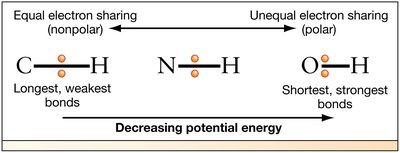
Potential Energy Storage in Molecules
Organisms store potential energy in the bonds of molecules such as carbohydrates and fats. Fats store more energy than carbohydrates due to their structure.
Carbohydrates: Store energy in C-H and C-C bonds.
Fats: Store more energy per molecule due to longer hydrocarbon chains.
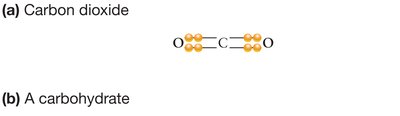

Energy Transformations in Chemical Reactions
Chemical reactions involve transformations of energy. Products typically have shorter, stronger covalent bonds than reactants, resulting in decreased potential energy and transformation of the difference into kinetic energy, thermal energy, or light.
Thermodynamics in Biological Systems
The first law of thermodynamics states that energy is conserved—it cannot be created or destroyed, only transferred or transformed. Enthalpy (H) is the total energy in a molecule, including potential energy in bonds and kinetic energy affecting pressure and volume.
Exothermic Reactions: Release heat; ΔH is negative; products have less potential energy.
Endothermic Reactions: Absorb heat; ΔH is positive; products have more potential energy.
Entropy and the Second Law of Thermodynamics
Entropy (S) measures disorder. When products of a reaction are less ordered than reactants, entropy increases (ΔS is positive). The second law of thermodynamics states that total entropy always increases in a system.
Gibbs Free Energy and Reaction Spontaneity
Gibbs free energy (G) determines whether a reaction is spontaneous or requires added energy. The change in free energy (ΔG) is calculated as:
Equation:
Spontaneous Reaction: (exergonic)
Nonspontaneous Reaction: (endergonic)
Equilibrium:

Factors Affecting Reaction Rates
Even spontaneous reactions may not occur quickly. Reaction rates depend on the breaking and forming of chemical bonds, collision orientation, concentration, and temperature. Higher concentrations and temperatures increase reaction rates.
Energetic Coupling in Cells
Cells drive nonspontaneous reactions using energetic coupling, where energy released from exergonic reactions drives endergonic reactions. This occurs via electron transfer (redox reactions) or phosphate group transfer.
Redox Reactions: Electron Transfer
Reduction–oxidation (redox) reactions involve electron transfer. Oxidation is the loss of electrons, and reduction is the gain. These always occur together, coupling exergonic and endergonic half-reactions. Electrons may be transferred alone or with protons (H+).
Electron Carriers: FAD and NAD+ accept electrons and protons, forming FADH2 and NADH, which donate electrons to other molecules.


ATP: The Energy Currency of Cells
Adenosine triphosphate (ATP) provides fuel for most cellular activities and is used in RNA synthesis. ATP stores potential energy in bonds between three negatively charged phosphate groups, which repel each other.
ATP Hydrolysis: ATP reacts with water, breaking the bond to its outermost phosphate group, forming ADP and releasing 7.3 kcal/mol of energy.


ATP Coupling of Exergonic and Endergonic Reactions
Cells use the energy from ATP hydrolysis for cellular activities. Phosphorylation adds a phosphate group to a target molecule, increasing its potential energy and coupling exergonic and endergonic reactions.

How Enzymes Work
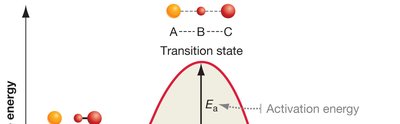
Enzymes are biological catalysts that lower the activation energy required for reactions. Activation energy is the kinetic energy needed to strain chemical bonds and reach the transition state, an intermediate with high free energy.
Enzyme Function: Enzymes bring substrates together in precise orientations, facilitating bond breaking and formation.
Induced Fit: Many enzymes undergo conformational change when substrates bind to the active site.

Enzyme Catalysis Steps
Enzyme catalysis involves three steps:
Initiation: Substrates bind to the active site in precise orientation.
Transition State Facilitation: Active site interactions lower activation energy.
Termination: Products are released from the enzyme.
Enzyme Saturation and Reaction Rates
Enzyme-catalyzed reactions show saturation kinetics. At low substrate concentrations, reaction rate increases linearly. At high concentrations, the rate plateaus because all enzyme molecules are occupied.
Saturation Kinetics: Active sites cannot accept substrates faster regardless of concentration.
Enzyme Helpers: Cofactors, Coenzymes, and Prosthetic Groups
Enzyme functionality often requires additional molecules:
Cofactors: Inorganic ions (e.g., Zn2+, Mg2+, Fe2+) that reversibly interact with enzymes.
Coenzymes: Organic molecules (e.g., NADH, FADH2) that interact with enzymes.
Prosthetic Groups: Non-amino acid atoms or molecules permanently attached to proteins.
Factors Affecting Enzyme Function
Enzyme activity is sensitive to changes in protein shape, which can be affected by temperature, pH, interactions with other molecules, and modifications of primary structure. Enzymes are optimized for particular environments.
Temperature: Affects folding, movement, and kinetic energy.
pH: Affects shape, reactivity, and charge on acidic/basic groups.
Enzyme Regulation
Regulatory molecules can activate or inactivate enzymes by changing their structure or ability to bind substrates. Regulation occurs via noncovalent interactions (competitive inhibition and allosteric regulation) or covalent modifications (e.g., phosphorylation).
Competitive Inhibition: Molecule competes with substrate for active site.
Allosteric Regulation: Molecule binds elsewhere, changing enzyme shape.
Phosphorylation: Most common reversible modification; changes shape and activity.
Metabolic Pathways and Their Regulation
Metabolic pathways are series of reactions, each catalyzed by a different enzyme, that build biological molecules. Feedback inhibition occurs when the final product inhibits an enzyme in the pathway, preventing depletion of initial substrate and allowing storage or use for other reactions.
Evolution of Metabolic Pathways
Metabolic pathways evolve through retro-evolution (backward process produces multistep pathways) and patchwork evolution (new enzymes recruited to new pathways). Pathways are vital for cell function, with catabolic pathways breaking down molecules for energy and carbon, and anabolic pathways synthesizing molecules using energy and carbon building blocks.
Type of Pathway | Function |
|---|---|
Catabolic | Break down molecules for energy and carbon |
Anabolic | Synthesize molecules using energy and carbon |
