 Back
Energy and Enzymes: An Introduction to Metabolism (Chapter 8) - General Biology Study Notes
Study Guide - Smart Notes
 Tailored notes based on your materials, expanded with key definitions, examples, and context.
Energy and Enzymes: An Introduction to Metabolism
Overview of Energy and Enzymes
Energy and enzymes are fundamental to cellular activity, enabling cells to respond to internal and external signals. Enzymes direct which reactions occur and when, facilitating the acquisition and utilization of energy through metabolic pathways, which are ordered series of chemical reactions that build up or break down molecules.
Types of Energy in Biological Systems
Energy exists in two primary forms:
Kinetic energy: The energy of motion, including thermal energy (energy of molecules moving).
Potential energy: Energy stored in position or configuration, such as chemical energy stored in chemical bonds.
Energy can be transformed from one type to another during cellular processes.
Chemical Reactions and Energy Transformations
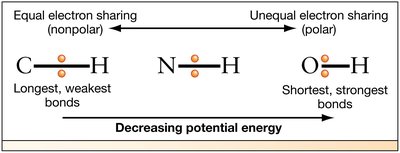
The potential energy in covalent bonds depends on the position of shared electrons relative to the nuclei of bonded atoms. Longer, weaker bonds with equally shared electrons have higher potential energy, while shorter, stronger bonds with unequally shared electrons have lower potential energy.
Exergonic reactions: Release energy; products have less potential energy than reactants.
Endergonic reactions: Require energy input; products have more potential energy than reactants.
Energy Storage in Biological Molecules
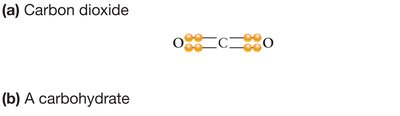
Organisms store potential energy in the bonds of molecules such as carbohydrates and fats. Fats store more energy than carbohydrates due to their longer hydrocarbon chains and more nonpolar bonds.

Thermodynamics in Biological Systems
The first law of thermodynamics states that energy is conserved; it cannot be created or destroyed, only transferred or transformed. Enthalpy (H) is the total energy in a molecule, including potential energy in bonds and kinetic energy affecting pressure and volume.
Exothermic reactions: Release heat; ΔH is negative.
Endothermic reactions: Absorb heat; ΔH is positive.
Entropy and the Second Law of Thermodynamics
Entropy (S) measures the amount of disorder in a system. When products of a chemical reaction are less ordered than reactants, entropy increases (ΔS is positive). The second law of thermodynamics states that total entropy always increases in a system.
Gibbs Free Energy and Reaction Spontaneity
Gibbs free energy (G) determines whether a reaction is spontaneous or requires added energy. The change in free energy (ΔG) is calculated as:
ΔG < 0: Reaction is spontaneous (exergonic).
ΔG > 0: Reaction is nonspontaneous (endergonic).
ΔG = 0: Reaction is at equilibrium.
Factors Affecting Reaction Rates
Even spontaneous reactions may not occur quickly. For most reactions, chemical bonds must break and form, and substances must collide in specific orientations. Higher concentrations and temperatures increase reaction rates by increasing collision frequency.
Energetic Coupling in Cells
Cells drive nonspontaneous reactions using energetic coupling, where exergonic reactions provide energy for endergonic reactions. This occurs through:
Transfer of electrons (redox reactions)
Transfer of phosphate groups
Redox Reactions: Electron Transfer
Reduction–oxidation (redox) reactions involve electron transfer:
Oxidation: Loss of electrons (exergonic)
Reduction: Gain of electrons (endergonic)
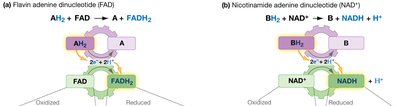
Redox reactions always occur together, coupling the two half-reactions. Electrons may be transferred as new covalent bonds form, often accompanied by protons (H+).


Electron Carriers in Metabolism
Electron carriers such as FAD and NAD+ accept electrons and protons, forming FADH2 and NADH, respectively. These carriers have "reducing power" and readily donate electrons to other molecules.
ATP: The Energy Currency of Cells
Adenosine triphosphate (ATP) provides fuel for most cellular activities and is used for RNA synthesis. ATP contains three negatively charged phosphate groups, whose repulsion stores a large amount of potential energy.

ATP Hydrolysis and Energy Release
ATP hydrolysis breaks the bond between the outermost phosphate group and its neighbor, forming ADP and releasing 7.3 kilocalories of energy per mole of ATP. This highly exergonic reaction provides energy for cellular processes.

ATP and Coupling Endergonic Reactions
Cells use the energy from ATP hydrolysis for cellular activity by phosphorylation, which adds a phosphate group to a target molecule, increasing its potential energy. Phosphorylation couples exergonic and endergonic reactions, creating activated intermediates.

Enzyme Function and Activation Energy
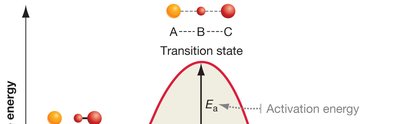
Enzymes are biological catalysts that lower the activation energy required for reactions. Activation energy is the kinetic energy needed to strain chemical bonds so they can react. The transition state is the intermediate point between breaking old bonds and forming new ones, with high free energy.

How Enzymes Accelerate Reactions
Enzymes help reactions clear two hurdles:
Reactants must collide in precise orientation.
Reactants must have enough kinetic energy to overcome the activation energy barrier.
Enzymes bring substrates together in their active site, facilitating precise collisions and bond formation. Many enzymes undergo conformational change (induced fit) when substrates bind.
Enzyme Catalysis: Three-Step Process
Initiation: Substrates bind to the active site in precise orientation.
Transition state facilitation: Interactions between substrate and active site lower activation energy.
Termination: Products are released from the enzyme.
Enzyme Saturation and Reaction Rates
Enzyme-catalyzed reactions show saturation kinetics:
At low substrate concentrations, reaction rate increases linearly.
At intermediate concentrations, rate increase slows.
At high concentrations, rate plateaus as all enzyme molecules are used.
Enzyme Regulation and Cofactors
Enzyme function often requires additional molecules:
Cofactors: Inorganic ions (e.g., Zn2+, Mg2+, Fe2+) that reversibly interact with enzymes.
Coenzymes: Organic molecules (e.g., NADH, FADH2) that interact with enzymes.
Prosthetic groups: Non-amino acid atoms or molecules permanently attached to proteins.
Factors Affecting Enzyme Function
Enzyme activity is sensitive to:
Temperature (affects folding, movement, and kinetic energy)
pH (affects shape, reactivity, and charge on acidic/basic groups)
Interactions with other molecules
Modifications of primary structure
Enzyme Regulation Mechanisms
Competitive inhibition: Molecule competes with substrate for active site.
Allosteric regulation: Molecule binds elsewhere, changing enzyme shape and activity.
Covalent modifications: Changes in primary structure, often reversible (e.g., phosphorylation).
Metabolic Pathways and Regulation
Metabolic pathways are series of reactions, each catalyzed by a different enzyme, that build biological molecules. Feedback inhibition occurs when the final product of a pathway inhibits an enzyme earlier in the pathway, preventing depletion of initial substrates and allowing regulation of pathway activity.
Evolution of Metabolic Pathways
Metabolic pathways evolve through retro-evolution and patchwork evolution, allowing cells to adapt to changing substrate availability. Pathways are vital for cell function:
Catabolic pathways: Break down molecules for energy and carbon building blocks.
Anabolic pathways: Use energy and carbon building blocks to synthesize molecules.
Summary Table: Types of Enzyme Regulation
Type | Description | Effect |
|---|---|---|
Competitive Inhibition | Regulator binds active site | Blocks substrate binding |
Allosteric Regulation | Regulator binds elsewhere | Changes enzyme shape/activity |
Covalent Modification | Primary structure altered | Activates/deactivates enzyme |
Summary Table: Types of Metabolic Pathways
Pathway Type | Function |
|---|---|
Catabolic | Breaks down molecules for energy |
Anabolic | Synthesizes molecules using energy |
