 Back
Energy and Enzymes: Cellular Respiration, Metabolism, and Thermodynamics Study Guide
Study Guide - Smart Notes
 Tailored notes based on your materials, expanded with key definitions, examples, and context.
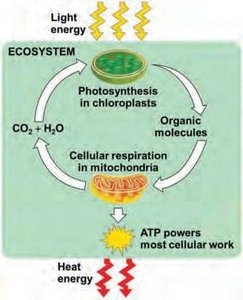
Q1. Using figure 7.2, describe photosynthesis and how it makes the macromolecules that are in your food.
Background
Topic: Photosynthesis and Energy Flow in Ecosystems
This question tests your understanding of how photosynthesis converts light energy into chemical energy, producing organic molecules that serve as food for organisms.
Key Terms:
Photosynthesis: The process by which plants, algae, and some bacteria convert light energy, water, and carbon dioxide into glucose and oxygen.
Macromolecules: Large molecules such as carbohydrates, proteins, and lipids that are built from smaller units.
Chloroplast: Organelle in plant cells where photosynthesis occurs.
Key Formula:
Step-by-Step Guidance
Examine figure 7.2 to identify the flow of energy and matter in an ecosystem.
Notice that photosynthesis in chloroplasts uses light energy to convert carbon dioxide and water into organic molecules (such as glucose).
These organic molecules are the building blocks for macromolecules found in food (carbohydrates, proteins, lipids).
Think about how these macromolecules are synthesized from glucose and other products of photosynthesis.
Try solving on your own before revealing the answer!
Final Answer:
Photosynthesis in chloroplasts captures light energy and uses it to convert CO2 and H2O into glucose and other organic molecules. These molecules are then used to build macromolecules (carbohydrates, proteins, lipids) that make up the food you eat.
Figure 7.2 shows how energy enters the ecosystem as light, is stored in organic molecules, and is later released as heat during cellular respiration.
Q2. Using figure 7.2 again, describe how photosynthesis is related to cellular respiration.
Background
Topic: Relationship between Photosynthesis and Cellular Respiration
This question tests your understanding of how the products of photosynthesis are used in cellular respiration and how these processes are interconnected.
Key Terms:
Cellular Respiration: The process by which cells break down organic molecules to release energy (ATP).
Photosynthesis: Produces glucose and oxygen, which are used in cellular respiration.
Key Formula:
Step-by-Step Guidance
Look at figure 7.2 and identify the cycle between photosynthesis and cellular respiration.
Photosynthesis produces glucose and oxygen, which are then used as reactants in cellular respiration.
Cellular respiration breaks down glucose to release energy (ATP), producing CO2 and H2O as byproducts.
Consider how the products of one process are the reactants for the other, forming a cycle in the ecosystem.
Try solving on your own before revealing the answer!
Final Answer:
Photosynthesis and cellular respiration are interconnected. Photosynthesis produces glucose and oxygen, which are used in cellular respiration to generate ATP. Cellular respiration releases CO2 and H2O, which are then used in photosynthesis, creating a cycle of energy and matter in ecosystems.
Q3. Describe how metabolic pathways break down macromolecules to get energy (using the word catabolic).
Background
Topic: Metabolic Pathways and Catabolism
This question tests your understanding of how catabolic pathways break down macromolecules to release energy.
Key Terms:
Catabolic Pathways: Metabolic pathways that break down molecules into smaller units, releasing energy.
Macromolecules: Large molecules such as carbohydrates, proteins, and lipids.
Key Formula:
Step-by-Step Guidance
Recall that catabolic pathways involve breaking down macromolecules (like glucose, fats, proteins) into smaller molecules.
These breakdown processes release energy, which is captured in the form of ATP.
Think about examples such as glycolysis (breakdown of glucose) and cellular respiration.
Consider how enzymes facilitate these reactions and how energy is transferred to ATP.
Try solving on your own before revealing the answer!
Final Answer:
Catabolic metabolic pathways break down macromolecules into smaller units, releasing energy that is used to produce ATP. For example, glycolysis breaks down glucose, and cellular respiration further extracts energy from its products.
Q4. Below is the equation for cellular respiration. In the table, list where each component of the reaction comes from.
Background
Topic: Inputs and Outputs of Cellular Respiration
This question tests your ability to identify the sources of reactants and products in cellular respiration.
Key Formula:
Step-by-Step Guidance
Identify the reactants: glucose and oxygen.
Determine where glucose comes from (photosynthesis, food intake).
Determine where oxygen comes from (photosynthesis, atmosphere).
Identify the products: carbon dioxide, water, and ATP.
Think about where each product is released or used in the cell.
Try solving on your own before revealing the answer!
Final Answer:
Glucose comes from food or photosynthesis; oxygen comes from the atmosphere (produced by photosynthesis). Carbon dioxide and water are released as waste products, and ATP is used for cellular work.
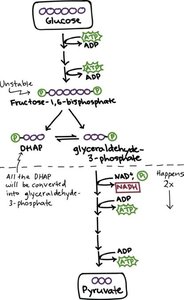
Q9. What is the overall purpose of glycolysis? What are the end products of glycolysis?
Background
Topic: Glycolysis
This question tests your understanding of the function and outcomes of glycolysis in cellular respiration.
Key Terms:
Glycolysis: The metabolic pathway that breaks down glucose into pyruvate, producing ATP and NADH.
ATP: Energy currency of the cell.
NADH: Electron carrier.
Key Formula:
Step-by-Step Guidance
Recall that glycolysis is the first step in cellular respiration and occurs in the cytoplasm.
Glycolysis breaks down one molecule of glucose into two molecules of pyruvate.
During this process, a net gain of ATP and NADH is produced.
Think about how these products are used in subsequent steps of cellular respiration.
Try solving on your own before revealing the answer!
Final Answer:
The overall purpose of glycolysis is to break down glucose into pyruvate, generating a small amount of ATP and NADH. The end products are 2 pyruvate, 2 ATP (net), and 2 NADH per glucose molecule.
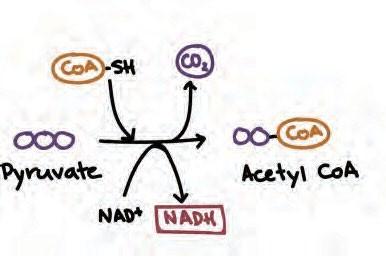
Q12. Describe the oxidation of pyruvate. What occurs and why is this necessary? Be sure to include where in the cell this occurs and what are the byproducts.
Background
Topic: Pyruvate Oxidation
This question tests your understanding of the conversion of pyruvate to acetyl CoA, a key step linking glycolysis to the citric acid cycle.
Key Terms:
Pyruvate: End product of glycolysis.
Acetyl CoA: Molecule that enters the citric acid cycle.
Oxidation: Loss of electrons.
NADH: Electron carrier.
Key Formula:
Step-by-Step Guidance
Recall that pyruvate oxidation occurs in the mitochondria.
Pyruvate is converted to acetyl CoA, releasing CO2 and producing NADH.
This step is necessary to link glycolysis to the citric acid cycle.
Think about the importance of NADH as an electron carrier and the role of acetyl CoA in the next stage.
Try solving on your own before revealing the answer!
Final Answer:
Pyruvate is oxidized in the mitochondria to form acetyl CoA, CO2, and NADH. This step is essential for entering the citric acid cycle and for generating electron carriers for the electron transport chain.
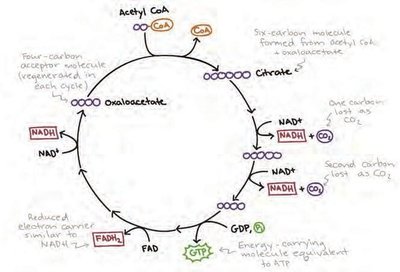
Q13. Describe the overall purpose of the Citric Acid Cycle.
Background
Topic: Citric Acid Cycle (Krebs Cycle)
This question tests your understanding of the function of the citric acid cycle in cellular respiration.
Key Terms:
Citric Acid Cycle: Series of reactions that generate electron carriers and ATP from acetyl CoA.
NADH, FADH2: Electron carriers.
ATP/GTP: Energy currency.
Key Formula:
Step-by-Step Guidance
Recall that the citric acid cycle occurs in the mitochondria.
Acetyl CoA enters the cycle and is broken down, releasing CO2.
Electron carriers (NADH and FADH2) are produced, which will be used in the electron transport chain.
ATP (or GTP) is generated as a direct energy product.
Try solving on your own before revealing the answer!
Final Answer:
The citric acid cycle's main purpose is to generate electron carriers (NADH, FADH2) and ATP by oxidizing acetyl CoA. These carriers are essential for the electron transport chain and ATP production.
Q15. Describe the purpose of the electron transport chain. What conditions are needed to arrive at the ETC?
Background
Topic: Electron Transport Chain (ETC)
This question tests your understanding of the ETC's role in cellular respiration and the requirements for its function.
Key Terms:
Electron Transport Chain: Series of protein complexes that transfer electrons and create a proton gradient.
ATP Synthase: Enzyme that uses the proton gradient to make ATP.
NADH, FADH2: Electron donors.
Key Formula:
Step-by-Step Guidance
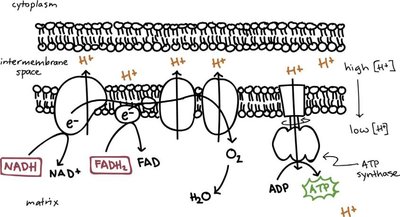
Recall that the ETC is located in the inner mitochondrial membrane.
Electron carriers (NADH, FADH2) donate electrons to the chain.
Electrons are passed through complexes, creating a proton gradient across the membrane.
ATP synthase uses this gradient to produce ATP.
Oxygen is required as the final electron acceptor.
Try solving on your own before revealing the answer!
Final Answer:
The electron transport chain's purpose is to transfer electrons from NADH and FADH2 to oxygen, creating a proton gradient that powers ATP synthesis. The ETC requires NADH, FADH2, and oxygen to function.
Q21. Describe the purpose of oxidative phosphorylation and chemiosmosis.
Background
Topic: Oxidative Phosphorylation and Chemiosmosis
This question tests your understanding of how ATP is produced using the energy from electron transport and the proton gradient.
Key Terms:
Oxidative Phosphorylation: ATP production using energy from electron transport and oxygen.
Chemiosmosis: Movement of protons across a membrane to drive ATP synthesis.
ATP Synthase: Enzyme that synthesizes ATP.
Key Formula:
Step-by-Step Guidance
Recall that oxidative phosphorylation occurs in the mitochondria.
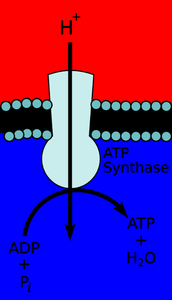
Electron transport creates a proton gradient across the inner mitochondrial membrane.
Protons flow back through ATP synthase, driving the synthesis of ATP.
Oxygen is required as the final electron acceptor.
Try solving on your own before revealing the answer!
Final Answer:
Oxidative phosphorylation uses the energy from electron transport and the proton gradient to produce ATP via chemiosmosis. ATP synthase is the enzyme responsible for this process.
Q10. After completing Glycolysis there are two fates of the glucose molecule. Where in the cell can the pyruvate molecules go and what determines this?
Background
Topic: Pyruvate Fate after Glycolysis
This question tests your understanding of the possible pathways for pyruvate depending on cellular conditions.
Key Terms:
Pyruvate: End product of glycolysis.
Fermentation: Anaerobic pathway.
Aerobic Respiration: Requires oxygen.
Key Formula:
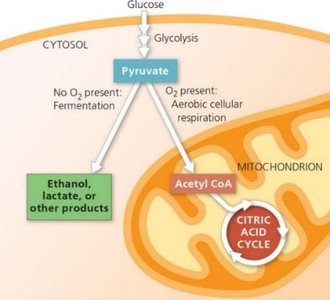
Pyruvate can enter mitochondria for aerobic respiration or remain in the cytosol for fermentation.
Step-by-Step Guidance
Recall that glycolysis produces pyruvate in the cytosol.
If oxygen is present, pyruvate enters the mitochondria for aerobic respiration.
If oxygen is absent, pyruvate undergoes fermentation in the cytosol.
Think about how the presence or absence of oxygen determines the pathway.
Try solving on your own before revealing the answer!
Final Answer:
Pyruvate can either enter the mitochondria for aerobic respiration (if oxygen is present) or remain in the cytosol for fermentation (if oxygen is absent). The presence of oxygen determines which pathway is taken.
