 Back
Energy and Enzymes: Cellular Respiration, Metabolism, and Regulation
Study Guide - Smart Notes
 Tailored notes based on your materials, expanded with key definitions, examples, and context.
Q1. Using figure 7.2, describe photosynthesis and how it makes the macromolecules that are in your food.
Background
Topic: Photosynthesis and Energy Flow
This question tests your understanding of how photosynthesis converts light energy into chemical energy, producing organic molecules that serve as the building blocks for macromolecules in food.
Key Terms and Concepts:
Photosynthesis: The process by which plants, algae, and some bacteria convert light energy, carbon dioxide, and water into glucose and oxygen.
Macromolecules: Large molecules (carbohydrates, proteins, lipids, nucleic acids) built from smaller organic molecules.
Chloroplast: Organelle where photosynthesis occurs.
Key Formula:
Step-by-Step Guidance
Identify the main reactants in photosynthesis: carbon dioxide (), water (), and light energy.
Explain how chloroplasts capture light energy and use it to drive the synthesis of glucose from and .
Describe how glucose and other organic molecules produced by photosynthesis are used to build macromolecules (such as starch, cellulose, proteins, and lipids).
Connect the process to the food you eat: plants synthesize these macromolecules, which are then consumed by animals (including humans).
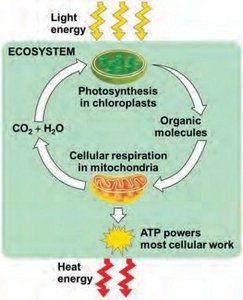
Try solving on your own before revealing the answer!
Final Answer:
Photosynthesis in chloroplasts uses light energy to convert and into glucose and oxygen. The glucose is then used to build macromolecules such as carbohydrates, proteins, and lipids, which make up the food you eat. These macromolecules are essential for energy and cellular structure in living organisms.
Q2. Using figure 7.2 again, describe how photosynthesis is related to cellular respiration.
Background
Topic: Relationship between Photosynthesis and Cellular Respiration
This question tests your understanding of how the products of photosynthesis are used in cellular respiration, and how these processes are interconnected in the ecosystem.
Key Terms and Concepts:
Cellular Respiration: The process by which cells break down glucose to produce ATP, releasing carbon dioxide and water.
ATP: The energy currency of the cell.
Energy Flow: The transfer of energy from sunlight to chemical energy and then to usable cellular energy.
Key Formulas:
Step-by-Step Guidance
Recall that photosynthesis produces glucose and oxygen as end products.
Explain how these products are used as reactants in cellular respiration within mitochondria.
Describe how cellular respiration breaks down glucose to produce ATP, releasing and as byproducts.
Discuss the cyclical nature: the and released are then used again in photosynthesis.
Try solving on your own before revealing the answer!
Final Answer:
Photosynthesis and cellular respiration are interconnected. Photosynthesis produces glucose and oxygen, which are used in cellular respiration to generate ATP. Cellular respiration releases and , which are then used in photosynthesis, creating a cycle of energy and matter in ecosystems.
Q3. Describe how metabolic pathways break down macromolecules to get energy (using the word catabolic).
Background
Topic: Catabolic Pathways and Energy Release
This question tests your understanding of how catabolic pathways break down macromolecules to release energy for cellular processes.
Key Terms and Concepts:
Catabolic Pathways: Metabolic pathways that break down molecules into smaller units, releasing energy.
Macromolecules: Large molecules such as carbohydrates, proteins, and fats.
ATP: The main energy carrier in cells.
Step-by-Step Guidance
Define catabolic pathways and their role in metabolism.
Explain how macromolecules (like glucose, fatty acids, and amino acids) are broken down through catabolic reactions.
Describe how the breakdown of these molecules releases energy, which is captured in the form of ATP.
Connect this process to cellular respiration, where glucose is broken down to produce ATP.
Try solving on your own before revealing the answer!
Final Answer:
Catabolic pathways break down macromolecules such as carbohydrates, fats, and proteins into smaller molecules, releasing energy. This energy is used to produce ATP, which powers cellular activities. Cellular respiration is a key catabolic pathway that breaks down glucose to generate ATP.
Q4. Below is the equation for cellular respiration. In the table, list where each component of the reaction comes from.
Background
Topic: Inputs and Outputs of Cellular Respiration
This question tests your ability to identify the sources of reactants and products in the cellular respiration equation.
Key Formula:
Step-by-Step Guidance
Identify the reactants: glucose () and oxygen ().
Determine where glucose comes from (photosynthesis in plants, food in animals).
Determine where oxygen comes from (photosynthesis, atmospheric oxygen).
Identify the products: carbon dioxide (), water (), and ATP.
Determine where each product goes (CO_2 exhaled, H_2O used or excreted, ATP used for cellular work).
Try solving on your own before revealing the answer!
Final Answer:
Glucose comes from food (or photosynthesis in plants), oxygen from the atmosphere, carbon dioxide is released as a waste product, water is produced and used or excreted, and ATP is used for cellular work.
