 Back
Energy and Enzymes: Cellular Respiration, Photosynthesis, and Metabolic Pathways Study Guide
Study Guide - Smart Notes
 Tailored notes based on your materials, expanded with key definitions, examples, and context.
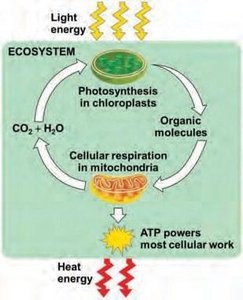
Q1. Using figure 7.2, describe photosynthesis and how it makes the macromolecules that are in your food.
Background
Topic: Photosynthesis and Energy Flow in Ecosystems
This question tests your understanding of how photosynthesis converts light energy into chemical energy, producing organic molecules that serve as the building blocks for macromolecules in food.
Key Terms:
Photosynthesis: The process by which plants, algae, and some bacteria convert light energy, carbon dioxide, and water into glucose and oxygen.
Macromolecules: Large molecules such as carbohydrates, proteins, and lipids, which are synthesized from smaller organic molecules.
Chloroplast: The organelle where photosynthesis occurs.
Step-by-Step Guidance
Examine figure 7.2 to identify the flow of energy and matter in an ecosystem.
Note that photosynthesis in chloroplasts uses light energy, CO2, and H2O to produce organic molecules (such as glucose).
Understand that these organic molecules are the starting materials for building macromolecules (carbohydrates, proteins, lipids) in food.
Consider how these macromolecules are synthesized from glucose and other products of photosynthesis.
Try solving on your own before revealing the answer!
Final Answer:
Photosynthesis in chloroplasts captures light energy and uses it to convert CO2 and H2O into glucose and other organic molecules. These molecules serve as the building blocks for macromolecules found in food, such as carbohydrates, proteins, and lipids. The energy stored in these molecules is later used by organisms for cellular work.
Q2. Using figure 7.2 again, describe how photosynthesis is related to cellular respiration.
Background
Topic: Relationship Between Photosynthesis and Cellular Respiration
This question tests your ability to connect the processes of photosynthesis and cellular respiration, showing how they form a cycle of energy and matter in ecosystems.
Key Terms:
Cellular Respiration: The process by which cells break down organic molecules to release energy (ATP), carbon dioxide, and water.
Photosynthesis: Produces the organic molecules and oxygen used in cellular respiration.
Step-by-Step Guidance
Identify the products of photosynthesis (organic molecules and O2) in figure 7.2.
Recognize that these products are used as reactants in cellular respiration.
Understand that cellular respiration releases CO2 and H2O, which are then used again in photosynthesis.
Think about how energy flows from sunlight to ATP through these interconnected processes.
Try solving on your own before revealing the answer!
Final Answer:
Photosynthesis produces organic molecules and oxygen, which are used in cellular respiration to generate ATP, CO2, and H2O. The CO2 and H2O released by cellular respiration are then recycled by photosynthesis, forming a cycle that sustains life and energy flow in ecosystems.
Q3. Describe how metabolic pathways break down macromolecules to get energy (using the word catabolic).
Background
Topic: Catabolic Pathways and Energy Release
This question tests your understanding of how catabolic pathways break down macromolecules to release energy for cellular processes.
Key Terms:
Catabolic Pathways: Metabolic pathways that break down complex molecules into simpler ones, releasing energy.
ATP: The main energy currency of the cell.
Step-by-Step Guidance
Recall that catabolic pathways involve the breakdown of macromolecules (such as carbohydrates, proteins, and fats).
Understand that these pathways release energy stored in chemical bonds, which is captured as ATP.
Think about examples of catabolic pathways, such as glycolysis and cellular respiration.
Consider how the energy released is used for cellular work.
Try solving on your own before revealing the answer!
Final Answer:
Catabolic pathways break down macromolecules into smaller molecules, releasing energy that is captured in ATP. This energy is then used to power cellular activities. Examples include glycolysis, the citric acid cycle, and oxidative phosphorylation.
Q4. Below is the equation for cellular respiration. In the table, list where each component of the reaction comes from.
Background
Topic: Inputs and Outputs of Cellular Respiration
This question tests your ability to identify the sources of reactants and products in the cellular respiration equation.
Key Terms and Formula:
Cellular Respiration Equation:
Glucose, Oxygen, Carbon Dioxide, Water, ATP
Step-by-Step Guidance
Identify the reactants: glucose and oxygen.
Determine where glucose comes from (photosynthesis, food intake).
Determine where oxygen comes from (photosynthesis, atmosphere).
Identify the products: carbon dioxide, water, and ATP.
Think about where each product is released or used in the cell.
Try solving on your own before revealing the answer!
Final Answer:
Glucose comes from food (or photosynthesis in plants), oxygen from the atmosphere, carbon dioxide is released as a waste product, water is produced during respiration, and ATP is used for cellular work.
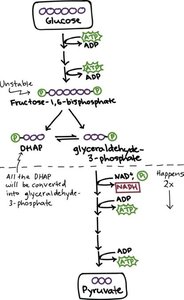
Q9. What is the overall purpose of glycolysis? What are the end products of glycolysis?
Background
Topic: Glycolysis
This question tests your understanding of the role of glycolysis in cellular respiration and its products.
Key Terms:
Glycolysis: The metabolic pathway that breaks down glucose into pyruvate, producing ATP and NADH.
ATP, NADH, Pyruvate
Step-by-Step Guidance
Recall that glycolysis occurs in the cytoplasm and is the first step in cellular respiration.
Understand that glycolysis breaks down one molecule of glucose into two molecules of pyruvate.
Identify the energy carriers produced (ATP and NADH).
Think about the net gain of ATP and NADH from glycolysis.
Try solving on your own before revealing the answer!
Final Answer:
The overall purpose of glycolysis is to break down glucose into pyruvate, generating a small amount of ATP and NADH. The end products are 2 pyruvate, 2 ATP (net gain), and 2 NADH per glucose molecule.
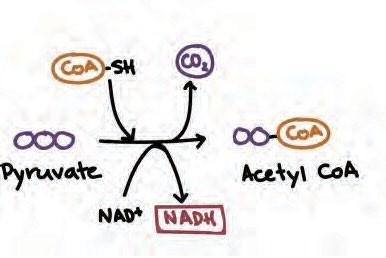
Q12. Describe the oxidation of pyruvate. What occurs and why is this necessary? Be sure to include where in the cell this occurs and what are the byproducts.
Background
Topic: Pyruvate Oxidation
This question tests your understanding of the conversion of pyruvate to acetyl CoA, a key step linking glycolysis to the citric acid cycle.
Key Terms and Formula:
Pyruvate Oxidation: The process that converts pyruvate into acetyl CoA, releasing CO2 and producing NADH.
Occurs in the mitochondrial matrix.
Step-by-Step Guidance
Recall that pyruvate is produced in glycolysis and transported into the mitochondria.
Understand that pyruvate is oxidized, releasing CO2 and transferring electrons to NAD+ to form NADH.
Recognize that the resulting acetyl CoA enters the citric acid cycle.
Identify the byproducts: CO2 and NADH.
Try solving on your own before revealing the answer!
Final Answer:
Pyruvate oxidation occurs in the mitochondrial matrix, converting pyruvate into acetyl CoA, releasing CO2, and producing NADH. This step is necessary to link glycolysis to the citric acid cycle and to generate energy carriers for the next stage of cellular respiration.
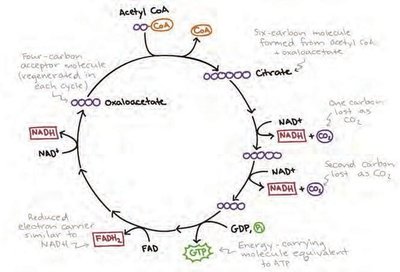
Q13. Describe the overall purpose of the Citric Acid Cycle.
Background
Topic: Citric Acid Cycle (Krebs Cycle)
This question tests your understanding of the role of the citric acid cycle in cellular respiration.
Key Terms:
Citric Acid Cycle: A series of reactions that oxidize acetyl CoA to CO2, producing NADH, FADH2, and ATP (or GTP).
NADH, FADH2, ATP
Step-by-Step Guidance
Recall that acetyl CoA enters the citric acid cycle in the mitochondrial matrix.
Understand that the cycle releases CO2 and transfers electrons to NAD+ and FAD, forming NADH and FADH2.
Recognize that the energy carriers produced are used in the electron transport chain.
Identify the small amount of ATP (or GTP) produced directly in the cycle.
Try solving on your own before revealing the answer!
Final Answer:
The citric acid cycle's overall purpose is to oxidize acetyl CoA, releasing CO2 and producing NADH, FADH2, and ATP (or GTP). These energy carriers are essential for the electron transport chain and ATP production.
Q15. Describe the purpose of the electron transport chain. What conditions are needed to arrive at the ETC?
Background
Topic: Electron Transport Chain (ETC)
This question tests your understanding of the ETC's role in cellular respiration and the requirements for its function.
Key Terms:
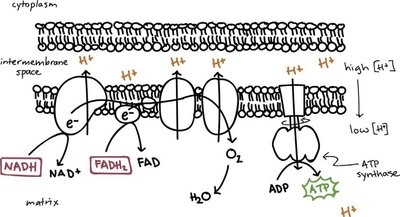
Electron Transport Chain: A series of protein complexes in the mitochondrial membrane that transfer electrons from NADH and FADH2 to oxygen, generating a proton gradient.
Oxidative Phosphorylation, ATP Synthase
Step-by-Step Guidance
Recall that NADH and FADH2 produced in earlier steps donate electrons to the ETC.
Understand that the ETC requires oxygen as the final electron acceptor.
Recognize that the ETC creates a proton gradient across the mitochondrial membrane.
Think about how this gradient drives ATP synthesis via ATP synthase.
Try solving on your own before revealing the answer!
Final Answer:
The purpose of the electron transport chain is to transfer electrons from NADH and FADH2 to oxygen, creating a proton gradient that powers ATP synthesis. Oxygen and energy carriers (NADH, FADH2) are required for the ETC to function.
Q26. What enzyme is responsible for making ATP?
Background
Topic: ATP Synthesis
This question tests your knowledge of the enzyme that catalyzes the formation of ATP during cellular respiration.
Key Terms:
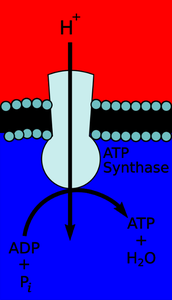
ATP Synthase: The enzyme that synthesizes ATP from ADP and inorganic phosphate, powered by the flow of protons across the mitochondrial membrane.
Step-by-Step Guidance
Recall that ATP is produced during oxidative phosphorylation.
Understand that the enzyme responsible is embedded in the mitochondrial membrane.
Recognize that ATP synthase uses the proton gradient to drive ATP formation.
Try solving on your own before revealing the answer!
Final Answer:
ATP synthase is the enzyme responsible for making ATP during oxidative phosphorylation. It uses the energy from the proton gradient to convert ADP and inorganic phosphate into ATP.
