 Back
BackEnergy and Enzymes: Foundations of Cellular Metabolism
Study Guide - Smart Notes
 Tailored notes based on your materials, expanded with key definitions, examples, and context.
Energy and Enzymes: An Introduction to Metabolism
Forms of Energy in Biological Systems
Biological systems utilize various forms of energy to drive cellular processes. Understanding these energy types is fundamental to studying metabolism.
Kinetic Energy: The energy of motion, including thermal energy (movement of molecules).
Potential Energy: Stored energy due to position or configuration, such as chemical energy in bonds.
Chemical Energy: Energy stored in chemical bonds, released during reactions.
Example: A compressed spring or a ball held at height has potential energy, which can be converted to kinetic energy when released.


Potential Energy in Chemical Bonds
The potential energy in chemical bonds depends on how electrons are shared between atoms. Nonpolar bonds (equal sharing) have higher potential energy than polar bonds (unequal sharing).
Nonpolar Bonds: Electrons are shared equally (e.g., C-H), resulting in longer, weaker bonds with higher potential energy.
Polar Bonds: Electrons are shared unequally (e.g., O-H), resulting in shorter, stronger bonds with lower potential energy.
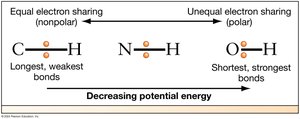
Energy Conversion: Potential to Kinetic
Energy can be converted from potential to kinetic forms in biological systems, such as muscle movement or cellular reactions.
Climbing increases potential energy; diving converts it to kinetic energy.

Laws of Thermodynamics in Biology
Energy transformations in cells are governed by the laws of thermodynamics:
First Law: Energy cannot be created or destroyed, only converted (Law of Conservation of Energy).
Second Law: Energy transformations are inefficient; some energy is lost as heat, increasing entropy (disorder).
Free Energy and Chemical Reactions
The change in free energy () determines whether a reaction is spontaneous or requires energy input.
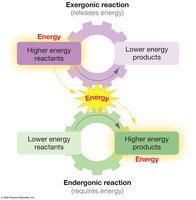
Exergonic Reactions: Release energy; ; spontaneous.
Endergonic Reactions: Require energy input; ; non-spontaneous.
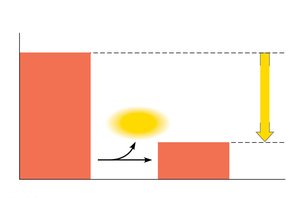
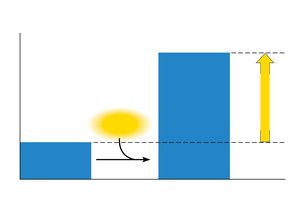
Energetic Coupling in Cells
Cells couple exergonic and endergonic reactions to drive processes that require energy. Energetic coupling allows endergonic reactions to proceed using energy released from exergonic reactions.
Redox Reactions and Electron Carriers
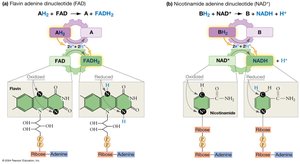
Redox reactions involve the transfer of electrons, often accompanied by protons. These reactions are central to cellular energy transformations.
Oxidation: Loss of electrons.
Reduction: Gain of electrons.
Electron carriers (e.g., NAD+, FAD) facilitate these transfers.
Energy Coupling via Phosphate Groups
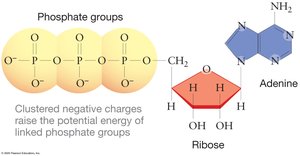
ATP is a key molecule in energy coupling. Phosphorylation (addition of phosphate group) increases the potential energy of target molecules, making them more reactive.
Cells use about 7.3 kcal/mol for cellular activity.
Phosphorylation forms high-energy intermediates.
Enzymes: Structure and Function
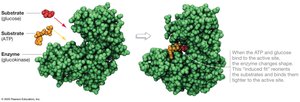
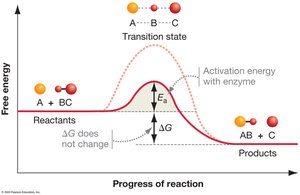
Enzymes are biological catalysts, usually proteins, that speed up chemical reactions by lowering activation energy. They are essential for life, as most reactions would occur too slowly without them.
Enzymes are not consumed in the reaction.
They facilitate precise substrate orientation and strain bonds.
Activation Energy and Transition State
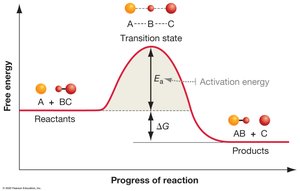
Every reaction requires a minimum amount of energy, called activation energy, to reach the transition state where old bonds break and new bonds form.
How Enzymes Lower Activation Energy
Enzymes lower activation energy by:
Orienting substrates correctly
Straining substrate bonds
Providing a favorable microenvironment
Factors Affecting Enzyme Function
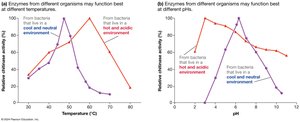
Enzyme activity is influenced by:
Cofactors: Inorganic ions (e.g., Zn2+, Mg2+) or organic molecules that assist enzymes.
Temperature: Affects kinetic energy and enzyme folding.
pH: Alters enzyme shape and charge properties.
Regulators: Activators and inhibitors modulate enzyme activity.
Enzyme Regulation Mechanisms
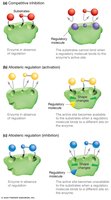
Cells regulate enzyme activity through several mechanisms:
Competitive Inhibition: Molecule competes with substrate for active site.
Allosteric Regulation: Molecule binds elsewhere, changing enzyme shape and activity (can activate or inhibit).
Phosphorylation: Addition of phosphate group alters enzyme shape and activity.
Metabolic Pathways and Feedback Inhibition
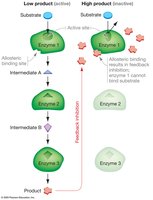
Metabolic pathways are sequences of enzyme-catalyzed reactions. Feedback inhibition occurs when the final product inhibits an enzyme early in the pathway, preventing overproduction.
Ensures efficient use of resources.
Regulates pathway activity based on cellular needs.
Summary Table: Exergonic vs Endergonic Reactions
Type of Reaction | ΔG | Energy Flow | Spontaneity |
|---|---|---|---|
Exergonic | < 0 | Releases energy | Spontaneous |
Endergonic | > 0 | Requires energy input | Non-spontaneous |
Summary Table: Enzyme Regulation Mechanisms
Mechanism | Location | Effect |
|---|---|---|
Competitive Inhibition | Active site | Blocks substrate binding |
Allosteric Regulation | Other site | Changes enzyme shape; can activate or inhibit |
Phosphorylation | Specific amino acids | Alters enzyme activity |
Additional info: Academic context was added to clarify the role of electron carriers, ATP, and enzyme regulation mechanisms, as well as to provide summary tables for comparison.
