 Back
BackEnergy and Enzymes: Foundations of Metabolism and Cellular Function
Study Guide - Smart Notes
 Tailored notes based on your materials, expanded with key definitions, examples, and context.
Energy and Enzymes: An Introduction to Metabolism
Metabolism: Catabolic and Anabolic Reactions
Metabolism encompasses all chemical reactions within an organism that are essential for life. These reactions are classified as either catabolic or anabolic:
Catabolic reactions: Breakdown complex molecules into simpler ones, releasing energy. Example: cellular respiration.
Anabolic reactions: Use energy to build complex molecules from simpler ones. Example: protein synthesis.

Forms of Energy
Energy is the capacity to do work and exists in various forms:
Kinetic energy: Energy of motion, including thermal energy (random movement of molecules).
Potential energy: Stored energy due to position or structure, such as chemical energy in food molecules.
Energy Transformation and Thermodynamics
Biological systems obey the laws of thermodynamics:
First Law: Energy can be transferred or transformed but cannot be created or destroyed (Principle of Conservation of Energy).
Second Law: Every energy transfer increases the entropy (disorder) of the universe.
Entropy is a measure of disorder; biological systems increase local order but overall entropy increases due to energy loss as heat.
Free Energy, Stability, and Equilibrium
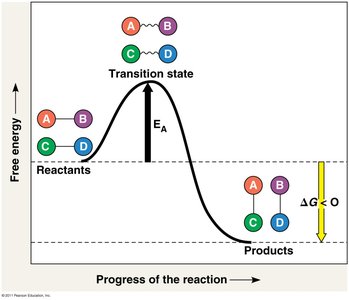
Gibbs Free Energy (G) is the portion of a system's energy available to do work. The change in free energy () determines whether a reaction is spontaneous:
If : Exergonic reaction (energy released, spontaneous).
If : Endergonic reaction (energy required, nonspontaneous).
Equilibrium is the state of maximum stability; systems do not spontaneously move away from equilibrium.
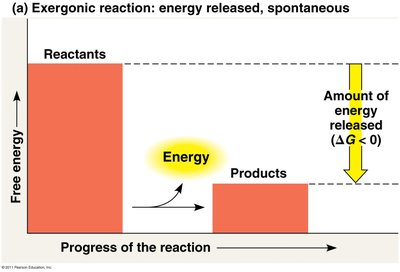
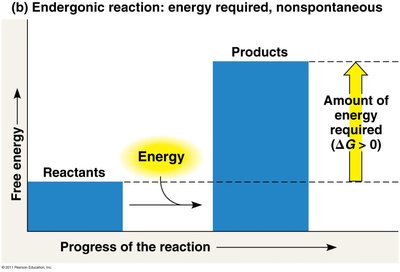
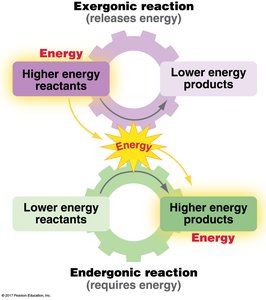
Note: Exergonic/endergonic are not interchangeable with exothermic/endothermic, as the former considers entropy changes.
Energy Coupling in Cells
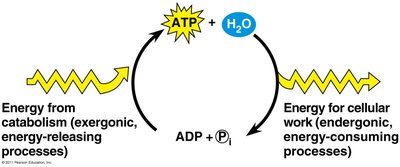
Cells couple exergonic reactions (energy-releasing) to drive endergonic reactions (energy-consuming), often via transfer of electrons or phosphate groups.
Redox Reactions
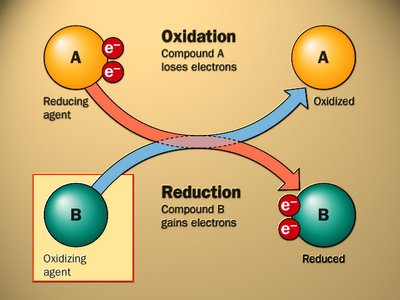
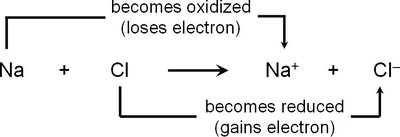
Redox reactions involve the transfer of electrons:
Oxidation: Loss of electrons (LEO: Lose Electrons = Oxidation).
Reduction: Gain of electrons (GER: Gain Electrons = Reduction).
Adding electrons reduces the positive charge of an atom.
Adenosine Triphosphate (ATP): Structure and Function
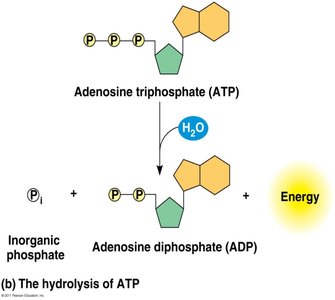
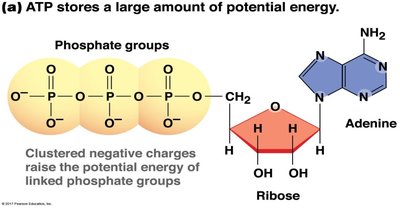
ATP is the primary energy carrier in cells. The bonds between phosphate groups are high-energy and can be broken by hydrolysis:
ATP + H2O → ADP + Pi
kcal/mol (exergonic reaction)
Products have less potential energy than reactants.
ATP Regeneration
The reverse reaction (ADP + Pi → ATP + H2O) is endergonic and requires energy input from cellular respiration or light energy. ATP is continuously regenerated in cells.
Role of Enzymes in Metabolism
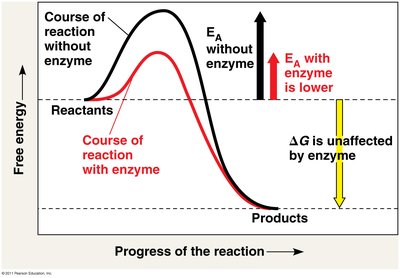
Enzymes are proteins that act as catalysts, speeding up reactions by lowering activation energy (EA) without being consumed. Spontaneous reactions may still occur slowly without enzymes.
Enzyme Specificity and Mechanism
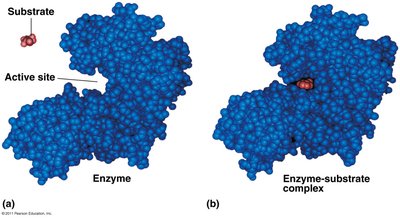
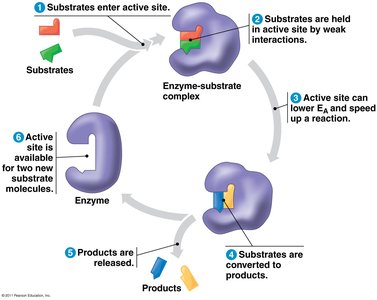
Enzymes are highly specific for their substrates, which bind to the enzyme's active site. Binding induces a conformational change (induced fit), optimizing the reaction.
Enzymes bring reactants together, stretch bonds, provide favorable microenvironments, and may participate directly in reactions.
Cofactors, Coenzymes, and Prosthetic Groups
Enzymes often require additional molecules for activity:
Cofactors: Inorganic ions (e.g., Fe, Zn, Mg).
Coenzymes: Organic molecules (e.g., NAD, B vitamins).
Prosthetic groups: Permanently attached molecules (e.g., retinal, metal ions).
Factors Affecting Enzyme Activity
Enzyme activity is influenced by:
Temperature: Increasing temperature generally increases activity up to an optimal point, after which activity declines.
pH: Most human enzymes function best at neutral pH, though some are optimized for acidic or basic conditions.
Enzyme Regulation
Enzyme function is tightly regulated:
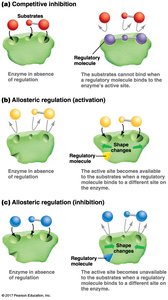
Competitive inhibition: Molecule resembles substrate and binds to active site, blocking substrate.
Allosteric regulation: Regulatory molecule binds away from active site, causing shape change that can activate or inhibit enzyme.
Toxins, poisons, and drugs often act as enzyme inhibitors.
Other Methods of Enzyme Regulation
Cleavage: Enzyme is activated by cutting (e.g., trypsinogen to trypsin).
Phosphorylation: Addition of phosphate group causes conformational change, turning enzyme on or off.
Regulating Metabolic Pathways: Feedback Inhibition
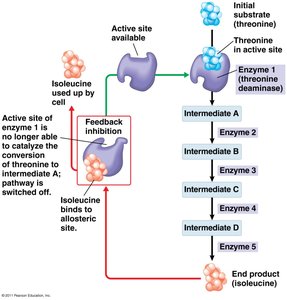
Enzymes often catalyze a series of reactions (metabolic pathway). Feedback inhibition occurs when the end product inhibits an enzyme early in the pathway, preventing excess product formation and conserving energy.
Type | Description | Example |
|---|---|---|
Catabolic | Breakdown, energy release | Cellular respiration |
Anabolic | Build-up, energy consumption | Protein synthesis |
Exergonic | Energy released, spontaneous | ATP hydrolysis |
Endergonic | Energy required, nonspontaneous | ATP synthesis |
Additional info: Academic context was added to clarify the distinction between exergonic/endergonic and exothermic/endothermic, and to provide examples of metabolic regulation and enzyme mechanisms.
