 Back
Energy and Metabolism: Study Notes for General Biology
Study Guide - Smart Notes
 Tailored notes based on your materials, expanded with key definitions, examples, and context.
Energy and Metabolism
Energy and Enzymes in Cellular Activity
Cellular activity is driven by energy transformations and the action of enzymes, which direct and regulate biochemical reactions. Enzymes enable cells to acquire and utilize energy efficiently, responding to signals from other cells and the environment.
Enzymes are biological catalysts that determine which reactions occur and when.
Cellular activity is continuous and responsive to internal and external signals.
Types of Energy in Biological Systems
Energy is essential for chemical reactions in cells and exists in two primary forms:
Kinetic energy: Energy of motion, such as cell division or molecular movement.
Thermal energy: Energy from the movement of molecules.
Potential energy: Energy stored in position or configuration, including chemical energy in bonds (e.g., glucose) or electrochemical gradients.
Chemical Reactions and Energy Transformations
Chemical reactions involve changes in potential energy, which is reflected in the bonds between atoms. The nature of these bonds determines their stability and energy content.
Longer, weaker bonds have higher potential energy and are easier to break.
Shorter, stronger bonds have lower potential energy and are more stable.
Enthalpy and Heat Exchange in Reactions
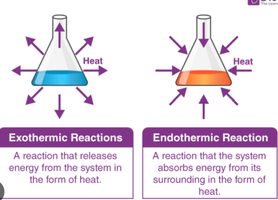
The total potential energy in a molecule's bonds and its kinetic energy affecting pressure is called enthalpy (H). Changes in enthalpy are associated with heat exchange:
Exothermic reactions: Release heat to the surroundings (e.g., cellular respiration).
Endothermic reactions: Absorb heat from the surroundings (e.g., photosynthesis).
Entropy and Disorder
Entropy is the measure of disorder in a system. Systems naturally progress toward higher entropy (more disorder) unless energy is used to maintain order.
Ordered states (low entropy) require energy to maintain.
Disordered states (high entropy) occur spontaneously.
Exergonic and Endergonic Reactions
Reactions can be classified based on their energy requirements:
Exergonic reactions: Release energy.
Endergonic reactions: Require energy input.
Energetic coupling links exergonic and endergonic reactions, often via electron transfer (redox reactions) or phosphate group transfer (e.g., ATP hydrolysis).
ATP: The Cellular Energy Currency
Structure and Function of ATP
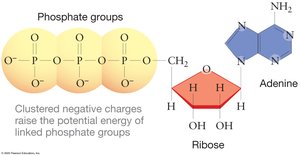
Adenosine triphosphate (ATP) is the primary energy carrier in cells, fueling most cellular activities. Its structure includes three negatively charged phosphate groups, ribose, and adenine.
High potential energy is stored in the bonds between phosphate groups.
ATP is used for cellular work, including biosynthesis, transport, and movement.
ATP Hydrolysis and Energy Release
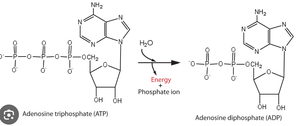
ATP is broken down by hydrolysis, releasing energy and forming adenosine diphosphate (ADP) and a phosphate ion.
Hydrolysis involves adding water to break the bond between the outermost phosphate group.
The released energy drives endergonic cellular reactions.
ATP Synthase: Enzyme for ATP Formation
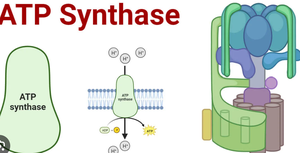
ATP synthase is an enzyme that catalyzes the formation of ATP from ADP and inorganic phosphate, using energy from proton gradients across membranes.
ATP synthase is essential for cellular energy production, especially during cellular respiration and photosynthesis.
Enzymes: Biological Catalysts
Mechanism of Enzyme Action
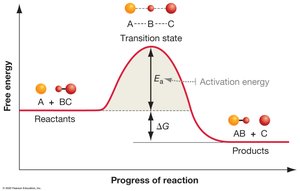
Enzymes lower the activation energy required for reactions, facilitating the formation of products. The transition state is the peak energy point between breaking old bonds and forming new ones.
Activation energy is the energy needed to initiate a reaction.
Enzymes stabilize the transition state, making reactions more likely to occur.
Enzyme Specificity and Substrate Binding
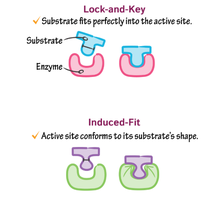
Enzymes are highly specific, bringing substrates together in the correct orientation for reaction. Substrates bind to the enzyme's active site, often causing a conformational change known as induced fit.
Lock-and-key model: Substrate fits perfectly into the active site.
Induced-fit model: Active site changes shape to accommodate the substrate.
Enzyme-Substrate Interaction and Transition State
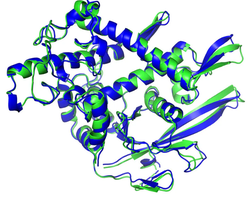
Substrates are held in place by hydrogen bonds and weak interactions with amino acid residues in the active site. The enzyme destabilizes substrate bonds to facilitate the transition state.
Steps of Enzyme Catalysis
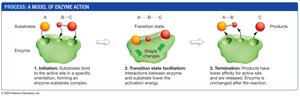
Enzyme-catalyzed reactions proceed through three main steps:
Initiation: Substrates bind to the active site in a precise orientation.
Transition state facilitation: Interactions lower the activation energy.
Termination: Products are released, and the enzyme is unchanged.
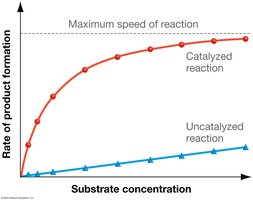
Enzyme Saturation and Reaction Rates
Enzymes exhibit saturation kinetics, meaning that at high substrate concentrations, the reaction rate plateaus because all active sites are occupied.
At low substrate concentrations, reaction rate increases.
At high substrate concentrations, reaction rate levels off (saturation).
Enzyme Cofactors, Coenzymes, and Prosthetic Groups
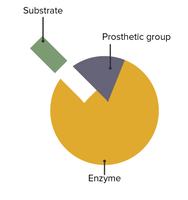
Enzyme activity often requires additional molecules:
Cofactors: Inorganic ions (e.g., Zn2+, Mg2+, Fe2+).
Coenzymes: Organic molecules (e.g., NADH, FADH2).
Prosthetic groups: Non-amino acid molecules permanently attached to proteins.
Factors Affecting Enzyme Activity
Enzyme function depends on optimal conditions:
Temperature: Influences enzyme folding and substrate movement.
pH: Affects enzyme shape, reactivity, and charge.
Interactions with other molecules and modifications to primary structure can alter activity.
Regulation of Enzyme Activity
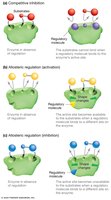
Enzymes are regulated by molecules that alter their structure or ability to bind substrates, activating or inactivating their function.
Types of Regulatory Molecules
Competitive inhibition: Molecule competes with substrate for the active site.
Allosteric regulation: Molecule binds elsewhere, changing enzyme shape and activity.
Covalent Modifications
Irreversible: Cleavage of peptide bonds.
Reversible: Phosphorylation alters enzyme shape and activity.
Metabolic Pathways and Feedback Inhibition
Metabolic Pathways
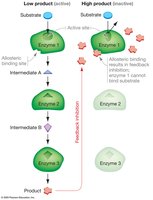
Metabolic pathways are series of reactions, each catalyzed by a different enzyme, that build biological molecules.
Feedback Inhibition
Feedback inhibition occurs when the end product of a pathway inhibits an enzyme early in the pathway, preventing overproduction.
Allosteric binding can make the active site unavailable, stopping the cascade of reactions.
Summary
Energy and enzymes are fundamental to cellular metabolism. Enzymes catalyze reactions, regulate metabolic pathways, and are influenced by various factors and regulatory mechanisms. ATP serves as the primary energy currency, linking exergonic and endergonic reactions to sustain life.
Additional info: Academic context was added to clarify enzyme structure, regulation, and metabolic pathway concepts, as well as to provide definitions and examples for key terms.
