 Back
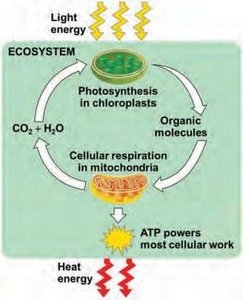
BackEnergy Flow and Chemical Recycling in Ecosystems (Figure 7.2)
Study Guide - Smart Notes
 Tailored notes based on your materials, expanded with key definitions, examples, and context.
Q1. Using figure 7.2, describe photosynthesis and how it makes the macromolecules that are in your food.
Background
Topic: Photosynthesis and Energy Flow in Ecosystems
This question is testing your understanding of how energy from sunlight is captured by plants and converted into chemical energy, which is then used to build macromolecules (like carbohydrates, proteins, and lipids) that serve as food for other organisms.
Key Terms and Concepts:
Photosynthesis: The process by which plants, algae, and some bacteria convert light energy, carbon dioxide, and water into glucose and oxygen.
Macromolecules: Large molecules such as carbohydrates, proteins, and lipids that are essential for life and are built from smaller organic molecules.
Chloroplasts: Organelles in plant cells where photosynthesis occurs.
Equation for Photosynthesis:
Step-by-Step Guidance
Start by identifying the source of energy for photosynthesis: sunlight. Plants capture this light energy in their chloroplasts.
Recognize that plants use carbon dioxide () from the atmosphere and water () from the soil as raw materials.
Understand that through a series of chemical reactions, the energy from sunlight is used to convert and into glucose (), a simple sugar.
Glucose and other simple sugars produced by photosynthesis are then used by the plant to build larger macromolecules (such as starch, cellulose, proteins, and lipids) that make up the structure and stored energy of the plant.
Try solving on your own before revealing the answer!
Final Answer:
Photosynthesis in chloroplasts uses light energy to convert carbon dioxide and water into glucose and oxygen. The glucose produced is used to build macromolecules (carbohydrates, proteins, and lipids) that make up the food you eat. These macromolecules store energy and provide the building blocks for growth and cellular functions.
