 Back
BackEnergy Flow and Trophic Dynamics in Ecosystems
Study Guide - Smart Notes
 Tailored notes based on your materials, expanded with key definitions, examples, and context.
Energy Flow in Ecosystems
Introduction to Energy Flow
Energy flow in ecosystems describes how energy enters, moves through, and exits biological communities. The sun is the primary energy source, and energy is transferred through various trophic levels, from producers to consumers and decomposers.
Primary producers (autotrophs) convert solar energy into chemical energy via photosynthesis.
Consumers (heterotrophs) obtain energy by eating other organisms.
Decomposers break down dead organic matter, recycling nutrients.
Gross and Net Primary Productivity
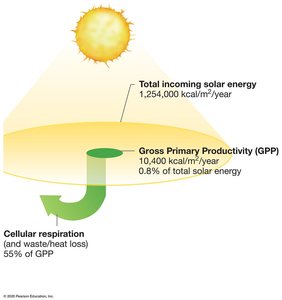
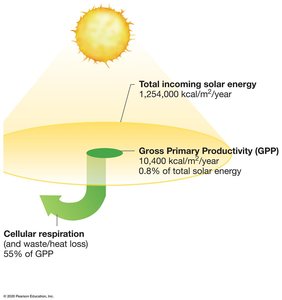
Primary productivity quantifies the rate at which energy is converted by autotrophs into organic substances.
Gross Primary Productivity (GPP): The total amount of chemical energy produced by autotrophs in a given area and time period.
Net Primary Productivity (NPP): The energy remaining after accounting for autotrophic respiration and heat loss. NPP represents the energy available to consumers.
The relationship is given by:
Spatial Variation in Productivity
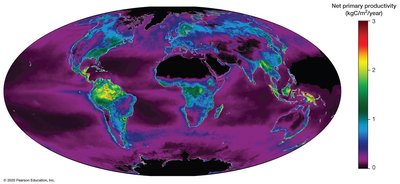
Net primary productivity varies across the globe, influenced by environmental factors such as temperature, water, CO2 availability, seasonality, and nutrients.
Highest NPP is found in wet tropical regions and on land compared to oceans.
Productivity is limited by abiotic factors that affect photosynthesis.
Trophic Levels and Food Webs
Trophic Structure
Trophic levels describe the feeding positions in an ecosystem:
Primary producers: Plants and other autotrophs
Primary consumers: Herbivores that eat producers
Secondary consumers: Carnivores that eat herbivores
Tertiary consumers: Higher-level carnivores
Energy flows from one trophic level to the next, but only a small fraction is transferred upward.

Food Chains and Food Webs
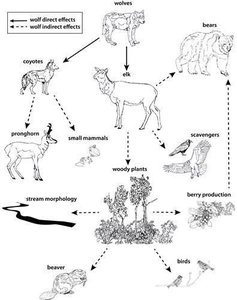
Food chains show linear energy flow, while food webs illustrate complex feeding relationships among organisms in a community.
Most consumers feed on multiple species, creating interconnected food webs.
Energy Transfer Efficiency
Energy transfer between trophic levels is inefficient. Typically, only about 10% of the energy at one level is passed to the next; the rest is lost as heat or used for metabolic processes.
Efficiency: Fraction of biomass transferred from one trophic level to the next.
Most energy is used for cellular respiration, not growth or reproduction.
Bottom-Up and Top-Down Controls
Bottom-Up Control
Bottom-up control occurs when the abundance of organisms at each trophic level is determined by the availability of resources such as nutrients, sunlight, and water.
Changes in lower trophic levels affect all levels above them.
Top-Down Control and Trophic Cascades
Top-down control occurs when consumers at higher trophic levels regulate the abundance of organisms at lower levels. A trophic cascade is a phenomenon where changes at the top of the food web cause effects that cascade down two or more trophic levels.
Example: Removal of top predators can increase herbivore populations, reducing plant biomass.
Decomposers and Nutrient Cycling
Role of Decomposers
Decomposers (detritivores) feed on dead organic matter (detritus), breaking it down into simpler compounds. This process is essential for recycling nutrients such as carbon, nitrogen, and phosphorus, making them available to primary producers.
Without decomposers, nutrient cycling would halt, and net primary productivity would decline.
Bioaccumulation and Biomagnification
Pollutant Dynamics in Food Webs
Certain pollutants, especially persistent organic pollutants (POPs), become concentrated at higher trophic levels through two processes:
Bioaccumulation: The buildup of pollutants in an organism over time as it consumes contaminated food.
Biomagnification: The increase in pollutant concentration as it moves up the food chain, with top predators having the highest levels.
Primary producers absorb pollutants, which are then transferred and concentrated at each successive trophic level.
Summary Table: Energy Flow and Trophic Levels
Trophic Level | Role | Example |
|---|---|---|
Primary Producer | Converts solar energy to chemical energy | Grass, trees |
Primary Consumer | Eats producers (herbivore) | Deer, grasshopper |
Secondary Consumer | Eats primary consumers (carnivore) | Wolf, bird |
Tertiary Consumer | Eats secondary consumers | Hawk, large carnivore |
Decomposer | Breaks down dead matter | Fungi, bacteria |
