 Back
BackEnergy Requirements and Bioenergetics in Animals
Study Guide - Smart Notes
 Tailored notes based on your materials, expanded with key definitions, examples, and context.
Energy Requirements in Animals
Bioenergetics: The Flow and Transformation of Energy
Bioenergetics is the study of how energy flows through living organisms. In animals, energy is required for growth, repair, activity, and reproduction. The way animals acquire, transform, and use energy determines their nutritional needs and is closely related to their size, activity level, and environment.
Autotrophs (e.g., plants) use light energy to synthesize organic molecules.
Heterotrophs (e.g., animals) obtain energy by consuming organic molecules produced by other organisms.
Animals digest food, absorb nutrients, and use cellular respiration and fermentation to produce ATP, which powers cellular work and biosynthesis.
Energy transformations are not 100% efficient; some energy is lost as heat at each step.
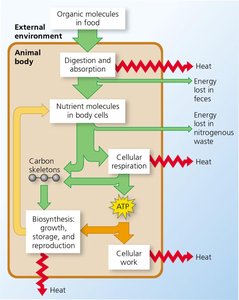
Additional info: The production and use of ATP in animals is coupled with heat generation, which is a consequence of the second law of thermodynamics. This heat must be dissipated to the environment to maintain homeostasis.
Quantifying Energy Use: Metabolic Rate
Measuring Metabolic Rate
The metabolic rate is the sum of all energy used by an animal in a given time interval. It can be measured in joules, calories, or kilocalories. Physiologists use several methods to determine metabolic rate:
Direct calorimetry: Measuring heat loss using a calorimeter.
Indirect calorimetry: Measuring oxygen consumption or carbon dioxide production.
Food intake analysis: Calculating energy from food consumed and waste produced.
Basal and Standard Metabolic Rates
Animals must maintain a minimum metabolic rate for basic life functions:
Basal Metabolic Rate (BMR): The minimum metabolic rate of a nongrowing endotherm at rest, with an empty stomach, under comfortable temperature conditions.
Standard Metabolic Rate (SMR): The minimum metabolic rate of a fasting, nonstressed ectotherm at rest at a specific temperature.
Endotherms (e.g., mammals, birds) generally have higher minimum metabolic rates than ectotherms (e.g., reptiles, amphibians) due to the energy cost of maintaining body temperature.
Influences on Metabolic Rate
Size and Metabolic Rate
Metabolic rate is influenced by several factors, including age, sex, size, activity, temperature, and nutrition. Body size has a profound effect:
Larger animals have higher overall metabolic rates but lower metabolic rates per gram of tissue.
The relationship between metabolic rate (MR) and body mass (M) is approximately:
Smaller animals have higher metabolic rates per gram, requiring more oxygen and higher heart and breathing rates relative to their size.
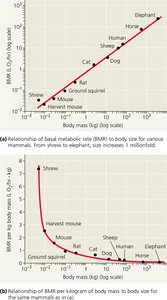
Additional info: As body size increases, the proportion of tissue dedicated to exchange, support, and locomotion also increases, affecting energy allocation.
Activity and Metabolic Rate
Physical activity significantly increases metabolic rate above the basal or standard level. Maximum metabolic rates are achieved during intense activities such as sprinting or flying. The maximum sustainable metabolic rate is inversely related to the duration of activity.
Average daily energy expenditure is typically 2–4 times BMR (endotherms) or SMR (ectotherms).
Humans in developed countries often have lower average daily metabolic rates due to sedentary lifestyles.
Energy Budgets in Animals
Animals allocate energy to various functions, including metabolism, activity, growth, reproduction, and thermoregulation. The relative allocation varies by species, size, and lifestyle.
Animal | Basal/Standard Metabolism | Activity | Reproduction | Growth | Thermoregulation |
|---|---|---|---|---|---|
Adélie penguin | Large | Moderate | Small | Small | Large |
Deer mouse | Moderate | Large | Small | Small | Moderate |
Ball python | Large | Small | Small | Small | Small |
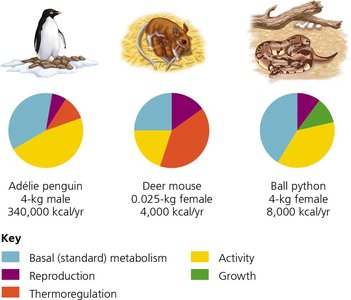
Additional info: Endotherms devote more energy to thermoregulation, while ectotherms allocate more to growth and reproduction.
Torpor, Hibernation, and Energy Conservation
Torpor
Torpor is a physiological state of decreased activity and metabolism, allowing animals to conserve energy during periods of unfavorable environmental conditions (e.g., cold, food scarcity).
Daily torpor is common in small birds and mammals, such as bats and hummingbirds.
Endotherms that undergo torpor are typically small and have high metabolic rates when active.
Hibernation
Hibernation is a long-term form of torpor adapted to survive winter cold and food scarcity. During hibernation, body temperature and metabolic rate drop significantly.
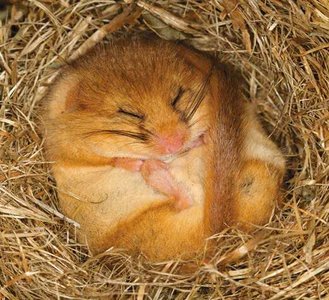
Additional info: Some mammals can reduce their body temperature to near ambient levels during hibernation, greatly reducing energy expenditure.
Circadian Rhythms and Hibernation
Research shows that the molecular components of the circadian clock (e.g., Per2 and Bmal1 genes) stop oscillating during deep hibernation, indicating that the biological clock ceases operation in this state.
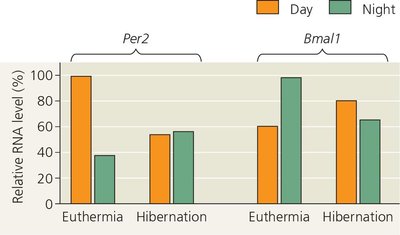
Additional info: This finding suggests that hibernation involves a suspension of normal daily biological rhythms, which may be essential for energy conservation.
Summary Table: Factors Affecting Animal Metabolic Rate
Factor | Effect on Metabolic Rate |
|---|---|
Body Size | Larger animals have higher total MR, but lower MR per gram |
Activity Level | Increases MR above basal/standard levels |
Thermoregulation | Endotherms have higher MR due to heat production |
Environmental Temperature | Alters MR, especially in ectotherms |
Nutrition | Affects energy available for metabolism |
Key Terms and Concepts
Bioenergetics: The study of energy flow and transformation in living organisms.
Metabolic Rate: The total energy used by an organism per unit time.
BMR (Basal Metabolic Rate): Minimum metabolic rate of a resting endotherm.
SMR (Standard Metabolic Rate): Minimum metabolic rate of a resting ectotherm at a specific temperature.
Torpor: Short-term state of reduced metabolic activity.
Hibernation: Long-term torpor for surviving cold and food scarcity.
