 Back
BackEnvironmental Policy and Legislation in the United States
Study Guide - Smart Notes
 Tailored notes based on your materials, expanded with key definitions, examples, and context.
Environmental Policy
Definition and Purpose
Environmental policy refers to formal guidelines established by governing organizations to address human interactions with the environment. These policies are designed to protect human well-being and publicly-held resources, aiming to prevent issues such as the tragedy of the commons and address external costs associated with environmental degradation.
Policy: A set of rules or guidelines for managing specific situations.
Environmental Policy: Focuses on regulating human impact on the environment.
Tragedy of the Commons: A situation where shared resources are overused and depleted due to individual self-interest.
External Costs: Costs of environmental damage not reflected in market prices.
Science and Policy
Ideally, scientific research forms the basis for environmental policy. However, policy decisions are ultimately made by politicians, which can lead to discrepancies between scientific recommendations and enacted laws. The United States has historically been a leader in environmental policy, with many of its legislative models adopted by other nations and states.
Scientific Basis: Policies should be informed by scientific evidence.
Political Process: Lawmakers enact and interpret policies.
Federal Policy Structure in the US
Branches of Government
The federal government consists of three branches, each playing a distinct role in environmental policy:
Legislative: Creates laws.
Executive: Signs laws into effect or vetoes them; issues executive orders.
Judicial: Interprets laws during disputes.
Once laws are enacted, federal agencies develop specific rules, monitor compliance, and enforce regulations.
Federal Administrative Agencies Influencing Environmental Policy
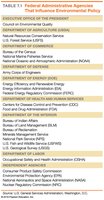
Numerous federal agencies are involved in environmental policy, each with specific responsibilities. The following table summarizes key agencies:
Department/Agency | Relevant Offices |
|---|---|
Executive Office of the President | Council on Environmental Quality |
Department of Agriculture (USDA) | Natural Resources Conservation Service, U.S. Forest Service |
Department of Commerce | National Oceanic and Atmospheric Administration (NOAA), National Marine Fisheries Service |
Department of Defense | Army Corps of Engineers |
Department of Energy (DOE) | Energy Efficiency and Renewable Energy, National Energy Technology Laboratory |
Department of Health and Human Services | Centers for Disease Control and Prevention (CDC), National Institutes of Health (NIH) |
Department of the Interior | Bureau of Land Management (BLM), National Park Service, U.S. Fish and Wildlife Service |
Department of Labor | Occupational Safety and Health Administration (OSHA) |
Environmental Protection Agency (EPA) | Office of Air and Radiation, Office of Water, Office of Solid Waste and Emergency Response |
History of U.S. Environmental Legislation
First Wave: Conservation and Preservation
The first wave of environmental legislation in the United States began in the late 1800s and early 1900s, focusing on conservation and the establishment of protected areas.
Yellowstone National Park: Created in 1872, the first national park.
Theodore Roosevelt: Set aside millions of acres for National Forests, parks, monuments, and wildlife refuges.
Systems Established: National Park System, National Forest System, National Wildlife Refuge System.
Second Wave: Pollution Control and Environmental Protection
After World War II, increased industrialization led to greater pollution, prompting a second wave of environmental legislation. Key events included Rachel Carson's "Silent Spring" (1962) and the first Earth Day (1970).
Silent Spring: Raised awareness about pesticide impacts on birds.
Earth Day: Mobilized public support for environmental protection.
Major Laws: Enacted in the 1960s and 1970s to address pollution and protect species.
Major U.S. Environmental Protection Laws (1969–1980)
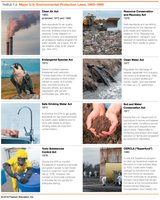
The following table summarizes key environmental laws enacted during this period:
Law | Purpose |
|---|---|
Clean Air Act | Regulates air emissions from stationary and mobile sources. |
Resource Conservation and Recovery Act | Controls hazardous waste from creation to disposal. |
Endangered Species Act | Protects endangered and threatened species and their habitats. |
Clean Water Act | Regulates discharge of pollutants into U.S. waters. |
Safe Drinking Water Act | Ensures the quality of Americans' drinking water. |
Soil and Water Conservation Act | Promotes conservation of soil and water resources. |
Toxic Substances Control Act | Regulates the introduction of new or already existing chemicals. |
CERCLA (Superfund) | Cleans up hazardous waste sites. |
Landmark Legislation
National Environmental Policy Act (NEPA)
NEPA, enacted in 1970, requires environmental assessments for federal projects that may impact the environment. If significant impacts are identified, an Environmental Impact Statement (EIS) must be produced, including alternatives and a "no action" option. NEPA also mandates public input and has influenced similar laws in other states and countries.
Environmental Assessment: Initial review of potential environmental impacts.
Environmental Impact Statement (EIS): Detailed analysis of impacts and alternatives.
Public Input: Stakeholders can participate in the decision-making process.

Endangered Species Act (ESA)
The ESA, enacted in 1973, requires the U.S. Fish and Wildlife Service (USFWS) and National Marine Fisheries Service to maintain lists of endangered and threatened species. Any person or organization can propose species for listing, followed by a vetting process. Once listed, recovery plans are developed, and critical habitat is protected. The ESA was the first law to recognize the right of species other than humans to exist and the importance of habitat protection.
Listing Process: Species are proposed, vetted, and added to the endangered/threatened list.
Recovery Plans: Strategies for species recovery and habitat protection.
Critical Habitat: Areas essential for species survival are protected.

Success and Challenges of Environmental Legislation
Effectiveness of Key Acts
The Clean Air and Clean Water Acts have been highly successful in improving environmental quality. The ESA has achieved success with some species but faces challenges such as insufficient funding and a backlog of species awaiting listing. NEPA has rarely stopped projects but has led to modifications that benefit the environment.
Clean Air and Water Acts: Significant improvements in air and water quality.
ESA: Successes in species recovery, but limited by resources.
NEPA: Influences project design to reduce environmental impacts.
Additional info:
Environmental policy is closely linked to topics in ecology, conservation biology, and population/community ecology, as it governs the protection and management of biological resources and habitats.
