 Back
Enzyme Function and Environmental Effects: Bromelain in Pineapple
Study Guide - Smart Notes
 Tailored notes based on your materials, expanded with key definitions, examples, and context.
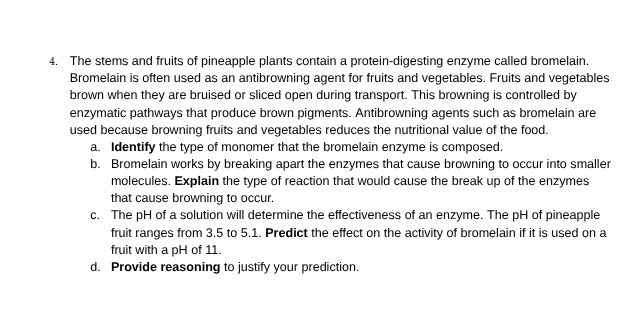
Q4. Bromelain in pineapple: enzyme structure, function, and environmental effects
Background
Topic: Enzyme structure and function, enzymatic reactions, and environmental effects on enzyme activity.
This question explores the biological role of bromelain, an enzyme found in pineapple, its molecular composition, the type of reaction it catalyzes, and how environmental factors like pH affect its activity.
Key Terms and Concepts:
Enzyme: A protein that acts as a biological catalyst, speeding up chemical reactions in living organisms.
Monomer: The basic building block of a polymer; for proteins, this is an amino acid.
Hydrolysis Reaction: A chemical reaction in which water is used to break bonds in molecules, often catalyzed by enzymes.
pH: A measure of how acidic or basic a solution is; enzymes have optimal pH ranges for activity.
Step-by-Step Guidance
Consider what type of molecule enzymes are made of. Recall that enzymes are biological catalysts and are typically composed of a specific type of monomer.
Think about how bromelain breaks down other enzymes that cause browning. What kind of reaction is involved when a protein is broken into smaller pieces? Identify the general type of reaction that splits large molecules into smaller ones using water.
Review the concept of enzyme activity and how it is affected by environmental conditions such as pH. Bromelain is most active in the pH range found in pineapple (3.5 to 5.1). Predict what would happen if bromelain is exposed to a much higher pH, such as 11.
Justify your prediction by considering how extreme pH values can affect the structure and function of enzymes. Think about what happens to proteins when they are exposed to conditions outside their optimal range.
Try solving on your own before revealing the answer!
Final Answers:
a. The monomer that bromelain is composed of is the amino acid. Enzymes are proteins, and proteins are polymers of amino acids.
b. The reaction that breaks up the enzymes causing browning is a hydrolysis reaction. Bromelain catalyzes the hydrolysis of peptide bonds in proteins, breaking them into smaller peptides or amino acids.
c. If bromelain is used on a fruit with a pH of 11, its activity would decrease significantly or it may become inactive.
d. At pH 11, which is highly basic, bromelain's structure would likely be disrupted (denatured), preventing it from functioning properly. Enzymes have an optimal pH range, and extreme pH values can alter their shape and active site, making them ineffective as catalysts.
These answers are based on the general properties of enzymes and their sensitivity to environmental conditions such as pH.
