 Back
Enzyme Structure, Function, and Cellular Energetics
Study Guide - Smart Notes
 Tailored notes based on your materials, expanded with key definitions, examples, and context.
Enzyme Structure
Overview of Enzyme Structure
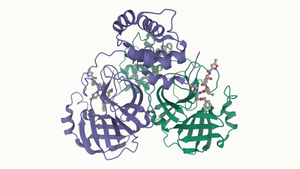
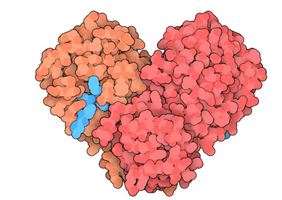
Enzymes are specialized proteins that catalyze biochemical reactions in living organisms. Their unique three-dimensional structure is essential for their function, particularly the formation of an active site where substrates bind and reactions occur.
Type of protein: Enzymes are globular proteins folded into specific shapes.
Active site: The region on the enzyme where the substrate binds and the reaction is catalyzed.
Function: The structure of the enzyme determines its specificity and catalytic activity.
Substrate Specificity of Enzymes
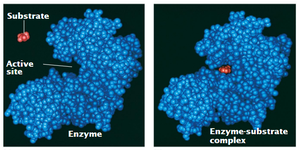
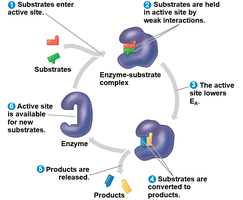
Enzymes exhibit high specificity for their substrates, which are the reactants they act upon. The enzyme-substrate complex forms when the substrate binds to the enzyme's active site, facilitating the chemical reaction.
Substrate: The specific reactant that an enzyme acts on.
Enzyme-substrate complex: The temporary association between enzyme and substrate during the reaction.
Active site: The pocket or groove on the enzyme where the substrate binds.
Enzyme Catalysis
How Enzymes Catalyze Reactions
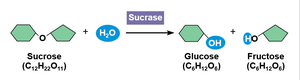
Enzymes act as biological catalysts, speeding up chemical reactions without being consumed in the process. Most enzyme names end in -ase (e.g., sucrase).
Catalyst: A substance that increases the rate of a chemical reaction without undergoing permanent change.
Example: Sucrase catalyzes the hydrolysis of sucrose into glucose and fructose.
Mechanisms of Enzyme Action
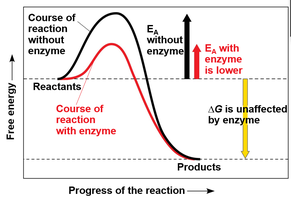
Enzymes lower the activation energy (EA) required for a reaction to proceed. They achieve this by:
Orienting substrates correctly
Straining substrate bonds
Providing a favorable microenvironment
Covalently bonding to the substrate
Enzymes Lower Activation Energy
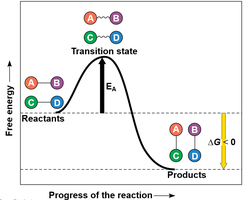
The activation energy barrier is reduced by enzymes, allowing reactions to occur more rapidly and efficiently. The overall free energy change (ΔG) of the reaction remains unchanged.
Transition state: The high-energy state that reactants must reach for the reaction to proceed.
ΔG: The change in free energy between reactants and products.
Environmental Impact on Enzyme Function
Factors Affecting Enzyme Activity
Enzyme activity is influenced by several environmental and chemical factors:
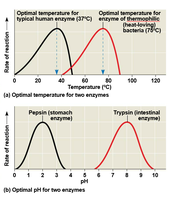
Temperature: Each enzyme has an optimal temperature for activity.
pH: Each enzyme has an optimal pH range.
Chemicals: Certain chemicals can enhance or inhibit enzyme activity.
Enzyme and substrate concentration: The rate of reaction depends on the amounts present.
Cofactors/coenzymes: Non-protein helpers required for enzyme function.
Enzyme inhibitors: Molecules that decrease enzyme activity.
Enzyme Inhibitors
Enzyme inhibitors reduce or block enzyme activity. There are two main types:
Competitive inhibitors: Bind to the active site, competing with the substrate.
Noncompetitive inhibitors: Bind to another part of the enzyme, causing a conformational change that reduces activity.
Allosteric Regulation and Cooperativity
Allosteric regulation involves the binding of regulatory molecules at sites other than the active site, affecting enzyme activity. Cooperativity is a form of allosteric regulation where substrate binding to one active site affects all subunits.
Allosteric activation: Stabilizes the active form of the enzyme.
Allosteric inhibition: Stabilizes the inactive form.
Cooperativity: Substrate binding amplifies enzyme activity across subunits.
Feedback Inhibition
Feedback inhibition occurs when the end product of a metabolic pathway inhibits an earlier step, preventing overproduction and conserving resources.
Cellular Energy and Metabolism
Energy in Living Systems
Cells require energy to perform work, which is managed through metabolic pathways. Metabolism is the sum of all chemical reactions in an organism.
Catabolic pathways: Break down complex molecules, releasing energy.
Anabolic pathways: Build complex molecules, consuming energy.
Forms of Energy
Energy exists in various forms:
Kinetic energy: Energy of motion.
Thermal energy: Kinetic energy of molecular motion.
Potential energy: Stored energy due to position or structure.
Chemical energy: Potential energy in chemical bonds.
Thermodynamics in Biology
First Law: Energy cannot be created or destroyed, only transformed (conservation of energy).
Second Law: Every energy transfer increases the entropy (disorder) of the universe.
Exergonic and Endergonic Reactions
Exergonic: Release free energy; spontaneous.
Endergonic: Absorb free energy; nonspontaneous.
Redox Reactions
Oxidation: Loss of electrons (or gain of oxygen/loss of hydrogen in organic molecules).
Reduction: Gain of electrons (or gain of hydrogen in organic molecules).
ATP: The Cell’s Energy Currency
Structure: Ribose sugar, adenine base, three phosphate groups.
Function: Hydrolysis of ATP releases energy for cellular work.
Energy coupling: ATP hydrolysis drives endergonic reactions.
Summary Table: Types of Enzyme Regulation
Type | Mechanism | Effect |
|---|---|---|
Competitive Inhibition | Inhibitor binds active site | Blocks substrate binding |
Noncompetitive Inhibition | Inhibitor binds elsewhere | Changes enzyme shape, reduces activity |
Allosteric Regulation | Regulator binds allosteric site | Stabilizes active/inactive form |
Feedback Inhibition | End product inhibits pathway | Prevents overproduction |
