 Back
BackLEC 10: Enzyme Structure, Function, and Regulation
Study Guide - Smart Notes
 Tailored notes based on your materials, expanded with key definitions, examples, and context.
Enzyme Structure, Function, and Regulation
Introduction to Enzymes and Metabolic Reactions
Enzymes are biological catalysts that accelerate chemical reactions in living organisms by lowering the activation energy required for the reaction to proceed. They are essential for sustaining life by enabling metabolic processes to occur rapidly and efficiently under physiological conditions.
Enzyme: A protein that acts as a catalyst to speed up a specific chemical reaction without being consumed in the process.
Substrate: The reactant molecule(s) upon which an enzyme acts.
Activation Energy (EA): The initial energy input required to start a chemical reaction.
Free Energy Change (ΔG): Determines whether a reaction is spontaneous (ΔG < 0) or non-spontaneous (ΔG > 0).
Coupling Exergonic and Endergonic Reactions
Cells often couple exergonic (energy-releasing) reactions to endergonic (energy-consuming) reactions to drive non-spontaneous processes. For example, the synthesis of glutamine from glutamic acid and ammonia is endergonic, but can proceed when coupled to ATP hydrolysis.
Endergonic Reaction: ΔG is positive; requires energy input.
Exergonic Reaction: ΔG is negative; releases energy.
ATP Hydrolysis: Provides energy to drive endergonic reactions.
Net ΔG: The sum of ΔG values for coupled reactions determines overall spontaneity.
Example: Synthesis of glutamine (ΔG = +14.2 kJ/mol) coupled with ATP hydrolysis (ΔG = -30.5 kJ/mol) yields a net ΔG = -16.3 kJ/mol, making the overall process spontaneous.
Enzyme-Catalyzed Reactions: The Example of Sucrose Hydrolysis
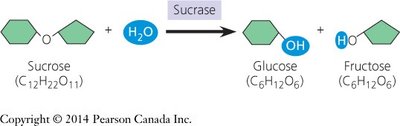
Enzymes such as sucrase catalyze the hydrolysis of sucrose into glucose and fructose, a reaction that is exergonic but occurs very slowly without enzymatic assistance.
Hydrolysis of Sucrose: Sucrose + H2O --(sucrase)→ Glucose + Fructose
ΔG for Sucrose Hydrolysis: -29.3 kJ/mol (exergonic)
Enzyme Role: Sucrase accelerates the reaction by lowering the activation energy.
Mechanism of Enzyme Action
Enzymes function by binding substrates at their active sites, forming an enzyme-substrate complex. The enzyme may change shape (induced fit) to better accommodate the substrate, facilitating the reaction.
Active Site: The region of the enzyme where substrate binding and catalysis occur.
Induced Fit: The enzyme changes shape to tightly bind the substrate, enhancing catalysis.
Transition State: An unstable intermediate state during the reaction where bonds are broken and formed.
Product Release: After the reaction, products are released and the enzyme is free to catalyze another reaction.
Key Steps:
Substrates enter the active site.
Enzyme changes shape (induced fit) to facilitate the reaction.
Substrates are converted to products.
Products are released; enzyme is available for reuse.
How Enzymes Lower Activation Energy
Enzymes lower the activation energy (EA) of reactions through several mechanisms:
Proximity and Orientation: Bringing reactants together in the correct orientation.
Induced Fit and Bond Strain: Physically stressing substrate bonds to make them easier to break.
Microenvironment: Providing a favorable environment (e.g., acidic pocket) for the reaction.
Direct Participation: Forming temporary covalent bonds with the substrate.
Factors Affecting Enzyme Activity
Enzyme activity is influenced by environmental and molecular factors:
Temperature
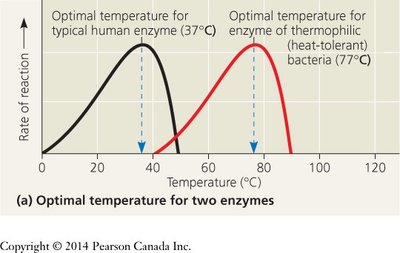
Enzyme activity generally increases with temperature up to an optimal point, beyond which activity declines due to denaturation.
Optimal Temperature: Most human enzymes function best at 35–40°C; thermophilic enzymes may function optimally at much higher temperatures.
Denaturation: High temperatures disrupt weak interactions, causing loss of enzyme structure and function.
pH
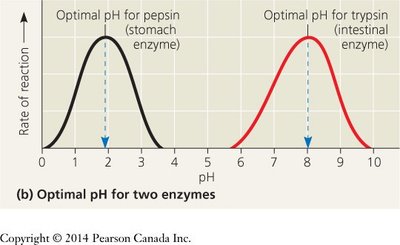
Each enzyme has an optimal pH range, typically between 6 and 8, but some function best in more extreme conditions (e.g., pepsin in the stomach at pH 2).
Pepsin: Optimal at acidic pH (stomach enzyme).
Trypsin: Optimal at basic pH (intestinal enzyme).
Cofactors and Coenzymes
Many enzymes require non-protein helpers called cofactors to function properly.
Inorganic Cofactors: Metal ions such as Mg2+, Zn2+, or iron-sulfur clusters.
Organic Cofactors (Coenzymes): Organic molecules, often derived from vitamins (e.g., B vitamins).
Holoenzyme: The active enzyme with its cofactor.
Apoenzyme: The enzyme without its cofactor (inactive).
Enzyme Inhibitors
Certain chemicals can inhibit enzyme activity, either reversibly or irreversibly.
Competitive Inhibitors: Resemble the substrate and compete for binding at the active site. Can be overcome by increasing substrate concentration.
Non-Competitive Inhibitors: Bind to a site other than the active site, altering enzyme function. Cannot be overcome by increasing substrate concentration.
Example: Many toxins and drugs act as enzyme inhibitors (e.g., nerve gas sarin, penicillin).
Allosteric Regulation and Feedback Inhibition
Enzymes can be regulated by molecules that bind to sites other than the active site (allosteric sites), changing the enzyme's activity. Feedback inhibition is a common regulatory mechanism in metabolic pathways, where the end product inhibits an earlier step.
Allosteric Regulation: Binding of a regulatory molecule at one site affects function at another site.
Feedback Inhibition: The end product of a pathway inhibits an enzyme involved earlier in the pathway, preventing overproduction.
Reaction Equilibrium and ΔG
Reactions in cells rarely go to completion; instead, they reach equilibrium, where the concentrations of reactants and products remain constant. The position of equilibrium is determined by the ΔG of the reaction. If product concentration increases, the reaction may reverse, especially if ΔG is near zero.
Equilibrium: The state where the forward and reverse reaction rates are equal, and ΔG = 0.
Le Chatelier's Principle: Removing products or adding reactants can drive the reaction forward.
Summary Table: Types of Enzyme Inhibition
Type of Inhibitor | Binding Site | Effect on Enzyme | Overcome by Substrate? |
|---|---|---|---|
Competitive | Active site | Blocks substrate binding | Yes |
Non-competitive | Allosteric site | Alters enzyme shape/function | No |
Additional info: Enzyme regulation is crucial for maintaining metabolic balance and responding to cellular needs. Many drugs and poisons act by targeting specific enzymes, highlighting their importance in health and disease.
