 Back
Enzymes and the Principles of Metabolism: Energy, Thermodynamics, and Cellular Regulation
Study Guide - Smart Notes
 Tailored notes based on your materials, expanded with key definitions, examples, and context.
Introduction to Metabolism and Energy
Overview of Metabolism
Metabolism encompasses all chemical reactions occurring within living organisms, enabling them to maintain life, grow, and reproduce. These reactions are organized into metabolic pathways, which can be classified as either catabolic (breaking down molecules to release energy) or anabolic (building complex molecules, consuming energy).
Catabolic pathways: Break down complex molecules into simpler ones, releasing energy (e.g., cellular respiration).
Anabolic pathways: Build complex molecules from simpler ones, requiring energy input (e.g., protein synthesis).
Key Terms:
Kinetic energy: Energy of motion.
Thermal energy: Kinetic energy associated with random movement of atoms or molecules.
Chemical energy: Potential energy available for release in a chemical reaction.
Potential energy: Energy possessed due to location or structure.
Thermodynamics in Biological Systems
The Laws of Thermodynamics
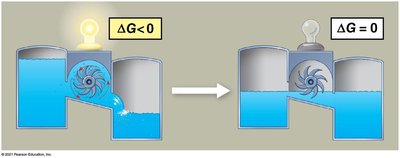
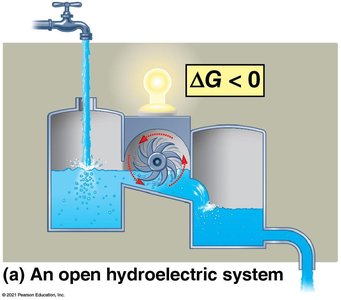
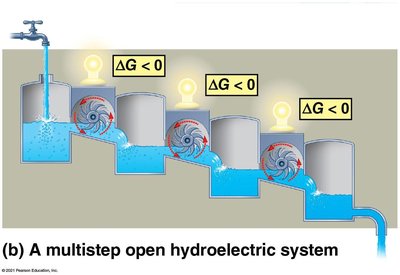
Thermodynamics is the study of energy transformations. Biological systems, as open systems, exchange both energy and matter with their surroundings. The two fundamental laws of thermodynamics govern all energy transformations in living organisms:
First Law (Conservation of Energy): Energy can be transferred or transformed, but cannot be created or destroyed.
Second Law: Every energy transfer or transformation increases the entropy (disorder) of the universe.
Entropy is a measure of molecular disorder or randomness. As energy is transformed, some is lost as heat, increasing entropy.
Spontaneous and Nonspontaneous Processes
Spontaneous process: Increases entropy and can proceed without energy input.
Nonspontaneous process: Decreases entropy and requires energy input.
Free Energy and Biological Work
Gibbs Free Energy (G) and ΔG
Gibbs free energy (G) is the portion of a system's energy that can perform work at constant temperature and pressure. The change in free energy (ΔG) determines whether a process is spontaneous:
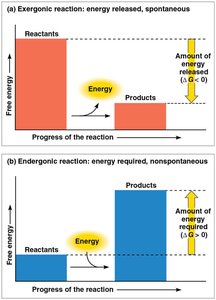
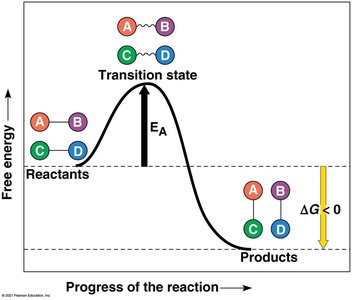
ΔG < 0: Spontaneous process (exergonic reaction).
ΔG > 0: Nonspontaneous process (endergonic reaction).
ΔG = 0: System is at equilibrium; no net change occurs.
The equation for free energy change is:
Exergonic reactions release energy, while endergonic reactions require energy input.
Exergonic vs. Endergonic Reactions
Exergonic reaction: Proceeds with a net release of free energy (ΔG < 0); spontaneous.
Endergonic reaction: Absorbs free energy from surroundings (ΔG > 0); nonspontaneous.
Types of Cellular Work
Chemical work: Pushing endergonic reactions (e.g., synthesis of polymers).
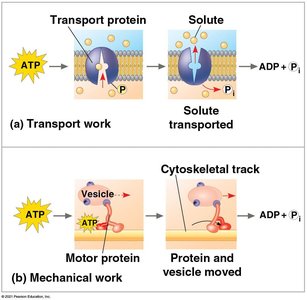
Transport work: Pumping substances across membranes against gradients.
Mechanical work: Movement, such as muscle contraction or movement of cilia.
ATP: The Energy Currency of the Cell
Structure and Hydrolysis of ATP
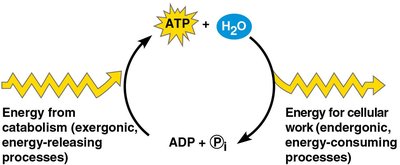
ATP (adenosine triphosphate) consists of ribose (a sugar), adenine (a nitrogenous base), and three phosphate groups. Hydrolysis of ATP releases energy by breaking the terminal phosphate bond, forming ADP and inorganic phosphate (Pi).
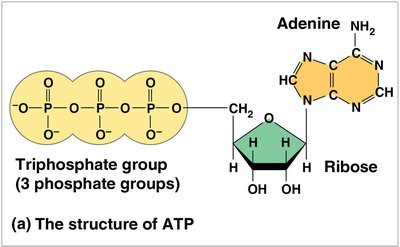
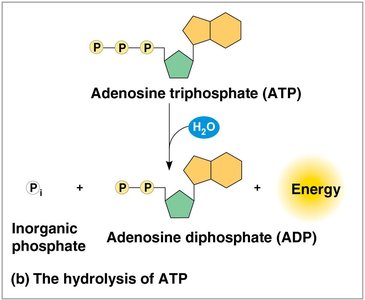
The energy released is not from the phosphate bonds themselves, but from the chemical change to a state of lower free energy.
ATP and Energy Coupling
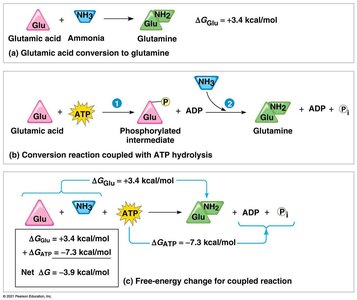
Cells use ATP hydrolysis (an exergonic reaction) to drive endergonic reactions through energy coupling. The transfer of a phosphate group from ATP to another molecule (phosphorylation) makes the recipient more reactive.
The ATP Cycle
ATP is regenerated by the addition of a phosphate group to ADP. The energy for this phosphorylation comes from catabolic (exergonic) reactions. This continuous cycle couples energy-yielding and energy-consuming processes.
Enzymes and Metabolic Reactions
Role of Enzymes
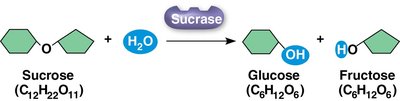
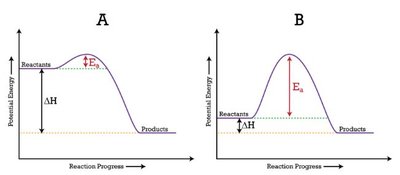
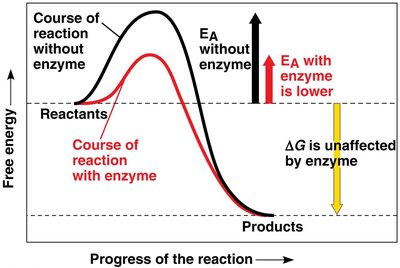
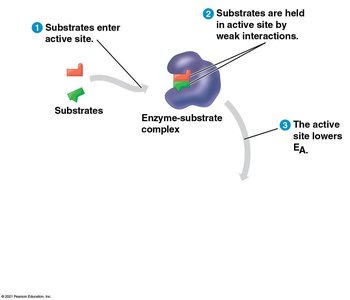
Enzymes are biological catalysts, usually proteins, that speed up metabolic reactions by lowering the activation energy (EA) barrier. They do not alter the ΔG of a reaction, only the rate at which equilibrium is reached.
Enzyme Structure and Specificity
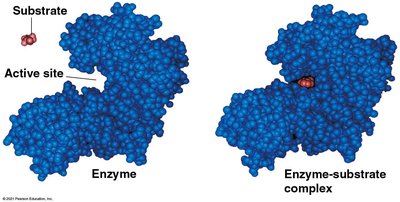
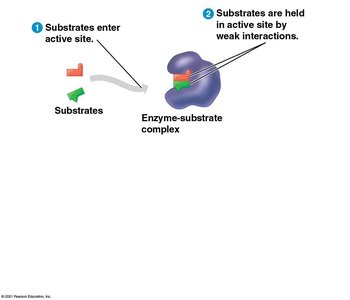
Each enzyme has a unique three-dimensional structure, with an active site that binds specifically to its substrate. The fit between the enzyme and substrate determines enzyme specificity.
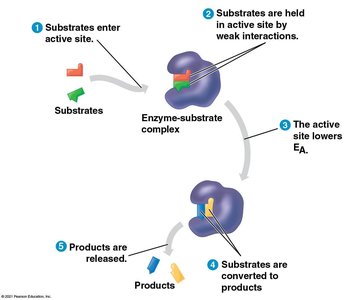
Mechanisms of Enzyme Action
Orienting substrates correctly
Straining substrate bonds
Providing a favorable microenvironment
Direct participation of active site amino acids in the reaction
Factors Affecting Enzyme Activity
Temperature: Each enzyme has an optimal temperature for maximal activity. Higher temperatures can denature enzymes.
pH: Each enzyme has an optimal pH, often reflecting its natural environment (e.g., pepsin in the stomach at pH 2).
Cofactors: Non-protein helpers (inorganic ions or organic coenzymes) required for enzyme function.
Enzyme Inhibition
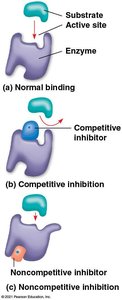
Competitive inhibitors: Resemble the substrate and bind to the active site, blocking substrate access. Can be overcome by increasing substrate concentration.
Noncompetitive inhibitors: Bind elsewhere on the enzyme, causing a conformational change that reduces activity. Often irreversible (e.g., toxins, poisons).
Regulation of Metabolic Pathways
Metabolic Pathways and Feedback Inhibition
Metabolic pathways consist of a series of enzyme-catalyzed steps, transforming a starting molecule into a final product. Cells regulate these pathways to maintain efficiency and conserve resources.
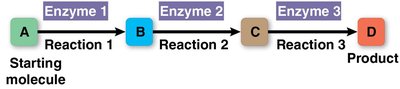
Feedback inhibition: The end product of a pathway inhibits an enzyme involved earlier in the pathway, preventing overproduction.
Allosteric Regulation
Allosteric regulation occurs when a regulatory molecule binds to a site other than the active site, altering enzyme activity. This can either inhibit or stimulate enzyme function. Many allosteric enzymes are composed of multiple subunits and oscillate between active and inactive forms.
Summary Table: Key Concepts in Enzyme Function and Metabolism
Concept | Description | Example |
|---|---|---|
Catabolic Pathway | Breaks down molecules, releases energy | Cellular respiration |
Anabolic Pathway | Builds molecules, consumes energy | Protein synthesis |
Exergonic Reaction | Releases free energy (ΔG < 0), spontaneous | ATP hydrolysis |
Endergonic Reaction | Requires energy input (ΔG > 0), nonspontaneous | Glutamine synthesis |
Enzyme | Biological catalyst, lowers activation energy | Sucrase |
Competitive Inhibitor | Binds active site, blocks substrate | Malonate (inhibits succinate dehydrogenase) |
Noncompetitive Inhibitor | Binds elsewhere, changes enzyme shape | Heavy metals, toxins |
Feedback Inhibition | End product inhibits pathway | Threonine to isoleucine pathway |
Additional info: This guide expands on the lecture outline by providing definitions, examples, and diagrams to clarify the principles of metabolism, thermodynamics, ATP function, enzyme catalysis, and metabolic regulation. It is suitable for exam preparation in introductory college biology courses.
