 Back
Enzymes and Their Role in Metabolic Reactions
Study Guide - Smart Notes
 Tailored notes based on your materials, expanded with key definitions, examples, and context.
Enzymes: Catalysts of Metabolic Reactions
Introduction to Enzymes
Enzymes are biological macromolecules that act as catalysts, accelerating chemical reactions in cells without being consumed in the process. They are essential for maintaining the efficiency and regulation of metabolic pathways, allowing reactions to occur rapidly and under controlled conditions.
Catalyst: A substance that increases the rate of a chemical reaction without undergoing permanent change.
Enzyme: Most enzymes are proteins, though some RNA molecules (ribozymes) also have catalytic activity.
Example: The enzyme sucrase catalyzes the hydrolysis of sucrose into glucose and fructose.
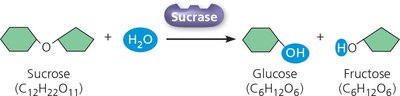
The Activation Energy Barrier
Energy Requirements for Chemical Reactions
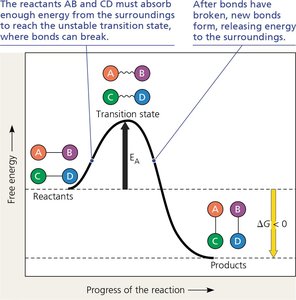
Every chemical reaction involves breaking and forming bonds. To initiate a reaction, reactant molecules must absorb energy to reach an unstable transition state, after which new bonds form and energy is released. The minimum energy required to start a reaction is called activation energy (EA).
Activation Energy (EA): The energy needed to push reactants to the top of an energy barrier.
Transition State: The unstable state where bonds can break and reform.
Exergonic Reaction: A reaction that releases free energy (ΔG < 0).
Example: Hydrolysis of sucrose is exergonic but requires EA to proceed.
How Enzymes Speed Up Reactions
Lowering Activation Energy
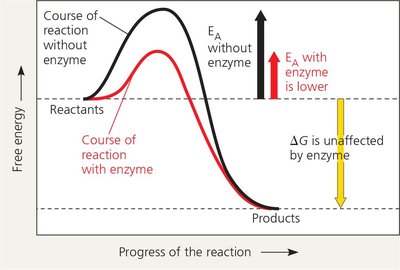
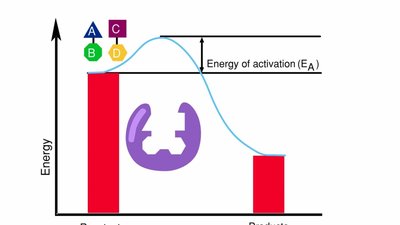
Enzymes accelerate reactions by lowering the activation energy barrier, allowing reactants to reach the transition state at moderate temperatures. Importantly, enzymes do not alter the overall free energy change (ΔG) of a reaction; they only affect the rate.
Enzyme Function: Enzymes lower EA, enabling faster reaction rates.
Specificity: Each enzyme is specific to its substrate and reaction.
Example: Sucrase only acts on sucrose, not other disaccharides.
Substrate Specificity and the Active Site
Enzyme-Substrate Complex and Induced Fit
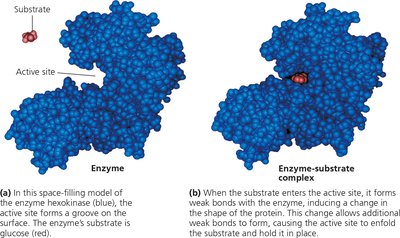
The substrate is the reactant an enzyme acts upon. The enzyme binds to its substrate at a specific region called the active site, forming an enzyme-substrate complex. The active site is shaped to fit the substrate, and often changes shape slightly to achieve a tighter fit, a process known as induced fit.
Active Site: The region of the enzyme where substrate binding and catalysis occur.
Induced Fit: The enzyme changes shape to better accommodate the substrate.
Example: Hexokinase binds glucose at its active site, forming weak bonds and changing shape.
Catalysis in the Enzyme’s Active Site
The Catalytic Cycle
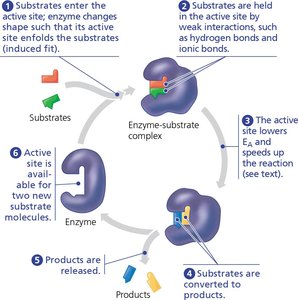
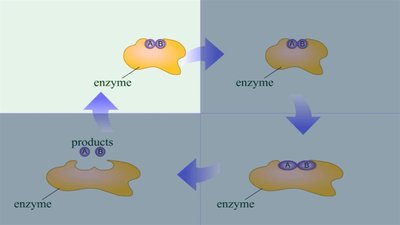
Enzymatic reactions proceed through a cycle: substrate enters the active site, is converted to product, and the enzyme is released unchanged. Enzymes can catalyze thousands of reactions per second, and their action is highly efficient.
Weak Interactions: Substrate is held by hydrogen bonds and ionic bonds.
Catalytic Cycle: Enzyme binds substrate, catalyzes reaction, releases product, and repeats.
Saturation: When all enzyme active sites are occupied, the reaction rate is maximized.
Mechanisms of Enzyme Action
How Enzymes Lower Activation Energy
Enzymes use several mechanisms to lower activation energy and speed up reactions:
Orienting substrates correctly for reaction.
Distorting substrate bonds to facilitate transition state formation.
Providing a microenvironment conducive to the reaction (e.g., acidic pocket).
Directly participating in the reaction via temporary covalent bonding.
Example: Enzyme active sites may contain acidic amino acids to facilitate proton transfer.
Factors Affecting Enzyme Activity
Environmental Influences
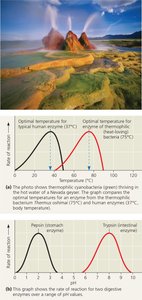
Enzyme activity is influenced by temperature, pH, and the presence of specific chemicals. Each enzyme has optimal conditions for activity, which favor its most active shape.
Optimal Temperature: Most human enzymes function best at 35–40°C.
Optimal pH: Most enzymes are active at pH 6–8, but exceptions exist (e.g., pepsin in the stomach at low pH).
Example: Thermophilic bacteria have enzymes with optimal temperatures above 70°C.
Cofactors and Coenzymes
Nonprotein Helpers
Many enzymes require cofactors for activity. Cofactors can be inorganic (metal ions) or organic (coenzymes). Coenzymes are often derived from vitamins and are essential for enzyme function.
Cofactor: Nonprotein molecule required for enzyme activity.
Coenzyme: Organic cofactor, often a vitamin or vitamin derivative.
Example: Zinc, iron, and copper ions serve as cofactors for various enzymes.
Enzyme Inhibition
Competitive and Noncompetitive Inhibitors
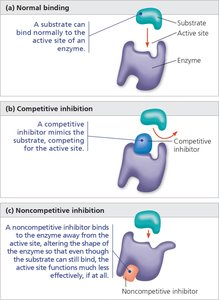
Enzyme inhibitors are chemicals that reduce enzyme activity. Competitive inhibitors mimic the substrate and compete for the active site, while noncompetitive inhibitors bind elsewhere, altering the enzyme’s shape and reducing its effectiveness.
Competitive Inhibitor: Competes with substrate for active site binding.
Noncompetitive Inhibitor: Binds to another part of the enzyme, changing its shape.
Example: Penicillin is a competitive inhibitor of bacterial cell wall synthesis enzymes.
The Evolution of Enzymes
Genetic Variation and Natural Selection
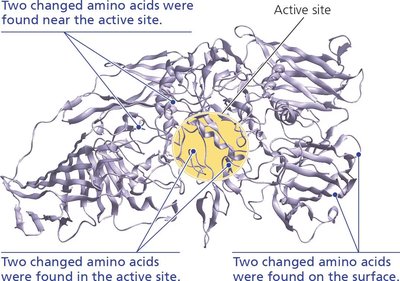
Enzymes evolve through mutations in the genes encoding them. Changes in amino acids, especially near the active site, can alter enzyme function. If the new function is beneficial, natural selection favors the mutated gene, leading to the evolution of new enzymes.
Mutation: Permanent change in DNA sequence, potentially altering enzyme activity.
Natural Selection: Favors beneficial mutations, leading to new enzyme functions.
Example: Laboratory evolution of β-galactosidase in Escherichia coli to break down a new sugar.
Scientific Skills Exercise: Enzyme Activity Over Time
Experimental Data and Analysis
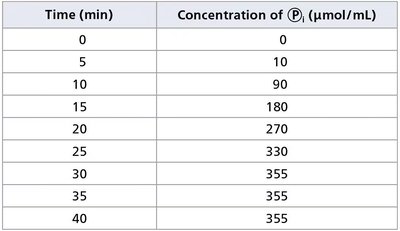
Enzyme activity can be measured by tracking product formation over time. For example, glucose 6-phosphatase activity in liver cells is monitored by measuring inorganic phosphate (Pi) concentration in the buffer.
Independent Variable: Time (min)
Dependent Variable: Concentration of Pi (μmol/mL)
Pattern: Pi concentration increases rapidly, then plateaus as the enzyme becomes saturated.
Time (min) | Concentration of Pi (μmol/mL) |
|---|---|
0 | 0 |
5 | 10 |
10 | 90 |
15 | 180 |
20 | 270 |
25 | 330 |
30 | 355 |
35 | 355 |
40 | 355 |
Key Equations
Free Energy Change:
Activation Energy: (energy required to reach transition state)
Enzyme-Substrate Reaction:
Summary Table: Types of Enzyme Inhibition
Type | Mechanism | Effect |
|---|---|---|
Competitive | Binds to active site | Blocks substrate, reversible by increasing substrate concentration |
Noncompetitive | Binds elsewhere | Changes enzyme shape, reduces activity, not reversible by substrate |
Conclusion
Enzymes are vital for life, enabling rapid and regulated metabolic reactions. Their specificity, efficiency, and adaptability are central to cellular function, and their activity is influenced by environmental conditions, cofactors, and inhibitors. Understanding enzyme mechanisms is fundamental to biology and biochemistry.
