 Back
Enzymes, Carbohydrates, and Spectrophotometry: Core Concepts for General Biology
Study Guide - Smart Notes
 Tailored notes based on your materials, expanded with key definitions, examples, and context.
Enzymes
Definition and Importance
Enzymes are biological catalysts, primarily proteins, that accelerate chemical reactions in living organisms without being consumed in the process. Their function is essential for sustaining life, as they enable metabolic reactions to occur rapidly and efficiently under physiological conditions.
Enzyme Structure: Most enzymes are proteins composed of long chains of amino acids folded into a unique three-dimensional shape.
Biological Catalyst: Enzymes lower the activation energy required for reactions, thereby increasing the reaction rate.
Substrate: The specific molecule upon which an enzyme acts (e.g., ATP).
Active Site: The region on the enzyme where the substrate binds, and the chemical reaction occurs. The shape of the active site determines enzyme specificity and function.
Activation Energy: The minimum energy required to initiate a chemical reaction. Enzymes reduce this barrier, facilitating the transition state.
Example: Digestive enzymes such as amylase break down starch into sugars in the human body.
Enzyme Specificity and Models
Enzymes are highly specific, typically acting on a single substrate or a group of closely related molecules. This specificity is due to the unique arrangement of amino acids in the active site.
Lock and Key Model: Proposes that the enzyme and substrate have complementary geometric shapes that fit exactly, explaining high specificity but not the stabilization of the transition state.
Induced-Fit Model: Suggests that the enzyme's active site is flexible and molds itself around the substrate for an optimal fit, enhancing catalytic efficiency and allowing product release after the reaction.
Example: Hexokinase changes shape to bind glucose, facilitating phosphorylation in glycolysis.
Carbohydrates and Monosaccharides
Structure and Function
Carbohydrates are organic molecules composed of carbon, hydrogen, and oxygen. Monosaccharides are the simplest form of carbohydrates and serve as building blocks for more complex sugars.
Monosaccharides: Simple sugars such as glucose, galactose, and fructose. These are isomers, sharing the same chemical formula but differing in atomic arrangement.
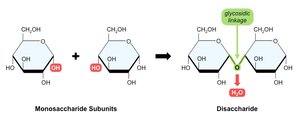
Glycosidic Bond: A covalent bond formed between two monosaccharides during a dehydration reaction, resulting in the formation of a disaccharide and the release of water.
Example: Sucrose is formed from glucose and fructose via a glycosidic linkage.
Enzyme Assays and Spectrophotometry
Glucose Oxidase/Peroxidase Assay
This assay is used to determine the concentration of free glucose in a sample through a coupled enzymatic reaction that produces a colored product, which can be measured spectrophotometrically.
Step 1: Glucose oxidase catalyzes the oxidation of glucose to gluconic acid and hydrogen peroxide (H2O2).
Step 2: Peroxidase uses H2O2 to oxidize a dye, forming a colored chromogen.
Detection: The intensity of the colored product is measured using a spectrometer, which correlates with glucose concentration.
Spectrophotometry Principles
Spectrophotometry is the quantitative measurement of the absorption or transmission of light by a solution. It is widely used in biology to determine the concentration of solutes.
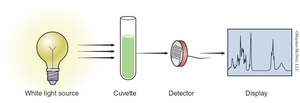
Instrument Components: A typical spectrophotometer consists of a light source, a cuvette containing the sample, a detector, and a display for results.
Blank Calibration: The instrument is calibrated with a blank (containing all components except the analyte) to set a baseline for 100% transmittance (0 absorbance).
Light Absorbance and Transmittance
When light passes through a solution, some wavelengths are absorbed while others are transmitted. The color observed corresponds to the transmitted or reflected wavelengths.
Absorbance (A): The capacity of a substance to absorb light at a specific wavelength.
Transmittance (T): The fraction of light that passes through the sample; it is the logarithmic inverse of absorbance.
If all light passes through (no absorption): Absorbance = 0, Transmittance = 100%.
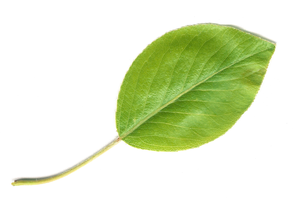
Example: A green leaf appears green because it transmits or reflects green wavelengths and absorbs others.
Beer-Lambert Law
The Beer-Lambert Law quantitatively relates the absorbance of light to the properties of the material through which the light is traveling.
Equation: The absorbance (A) is directly proportional to the concentration (c) of the absorbing species and the path length (l) of the sample cell.
A: Absorbance (no units)
\varepsilon: Molar absorptivity (L mol-1 cm-1)
c: Concentration (mol L-1)
l: Path length (cm)
This law allows for the creation of a standard curve, which can be used to determine unknown concentrations from measured absorbance values.
Laboratory Techniques: Pipetting
Serological Pipettes and Micropipettes
Accurate measurement and transfer of liquids are fundamental skills in biological laboratories.
Serological Pipettes: Used for volumes greater than 1 mL (1000 µL). To pipette a specific volume, subtract the desired volume from the total pipette volume and draw up to that marker.
Micropipettes: Used for small volumes. P1000 covers 100–1000 µL; P100 covers 10–100 µL.
Example: To pipette 3 mL with a 10 mL serological pipette, draw liquid up to the 7 mL mark (10 – 3 = 7).
Summary Table: Enzyme Models
Model | Description | Key Feature |
|---|---|---|
Lock and Key | Enzyme and substrate fit exactly due to complementary shapes | High specificity, rigid fit |
Induced Fit | Enzyme changes shape to bind substrate optimally | Flexible fit, transition state stabilization |
Best Practices and Lab Safety
Wear appropriate lab attire (no shorts, crop tops, or open-toed shoes).
Keep benches clear and clean; no food or drinks allowed.
Properly dispose of gloves and clean workspaces after experiments.
References and Academic Integrity
All figures and tables must be properly captioned and cited in APA format.
Reference lists should be in alphabetical order with hanging indents.
