 Back
Enzymes: Structure, Function, and Regulation in Biological Systems
Study Guide - Smart Notes
 Tailored notes based on your materials, expanded with key definitions, examples, and context.
Proteins and Enzymes
Introduction to Proteins and Enzymes
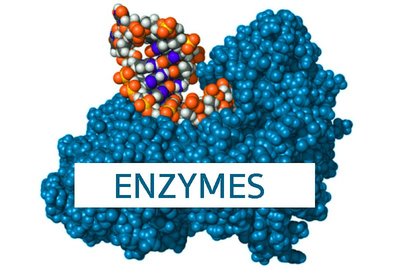
Proteins are one of the four major classes of biological macromolecules and serve a wide variety of functions in living organisms. Among their most important roles is acting as enzymes, which are biological catalysts that accelerate chemical reactions necessary for life.
Proteins are polymers made of amino acids linked by peptide bonds.
Enzymes are a specific class of proteins that catalyze biochemical reactions without being consumed in the process.
Enzyme names typically end with the suffix -ase (e.g., lactase).
Enzyme Structure and Function
How Enzymes Work
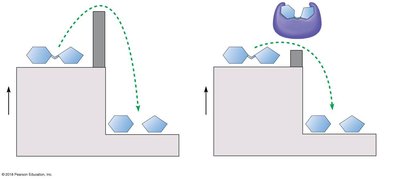
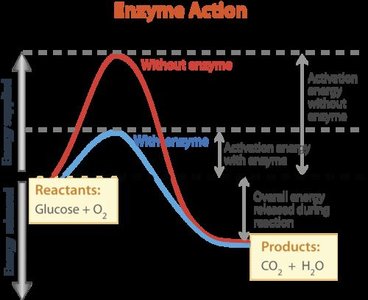
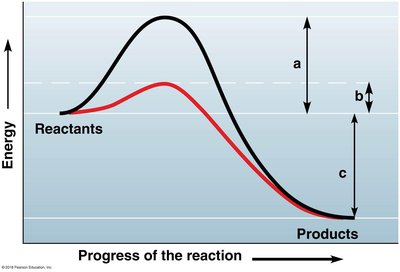
Enzymes function by lowering the activation energy required for a reaction to proceed, thereby increasing the reaction rate. They achieve this by binding to specific reactant molecules called substrates at their active sites.
Activation Energy (Ea): The minimum energy required to initiate a chemical reaction.
Enzymes reduce the activation energy barrier, making it easier for reactions to occur at cellular temperatures.
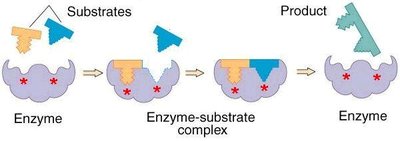
The active site is the region of the enzyme where the substrate binds and the reaction occurs.
Induced Fit Model
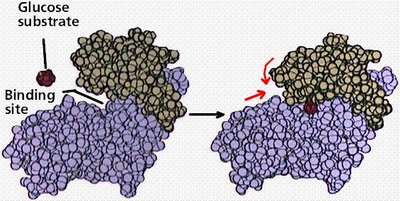
The induced fit model describes how enzymes change shape slightly to accommodate the substrate, enhancing the enzyme's ability to catalyze the reaction.
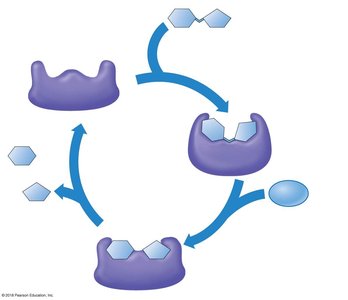
The substrate enters the enzyme's active site.
The enzyme molds around the substrate, facilitating bond breaking or formation.
The product is released, and the enzyme returns to its original shape.
Enzyme Regulation
Enzyme Inhibition
Enzyme activity can be regulated by molecules that decrease or prevent their activity. There are two main types of enzyme inhibitors: competitive and non-competitive.
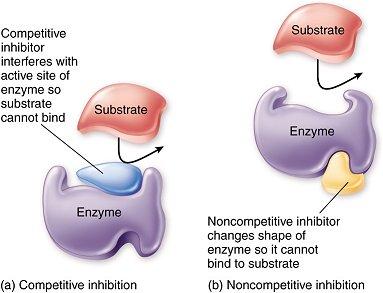
Competitive Inhibitors: Molecules that resemble the substrate and compete for binding at the active site, blocking substrate access.
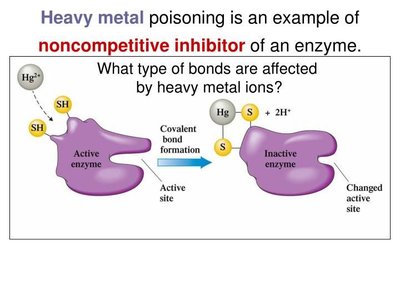
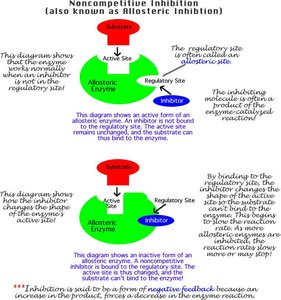
Non-competitive Inhibitors: Molecules that bind to a different site (allosteric site) on the enzyme, causing a conformational change that reduces or eliminates enzyme activity.
Competitive Inhibition
Competitive inhibitors must be structurally similar to the substrate to fit into the active site.
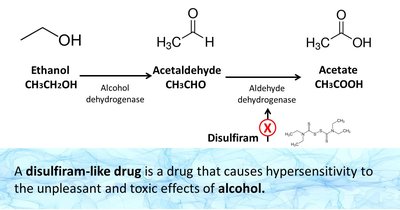
Examples: DDT (blocks nervous system enzymes), penicillin (blocks bacterial cell wall synthesis), disulfiram (blocks aldehyde oxidase in alcohol metabolism).
Non-competitive (Allosteric) Inhibition
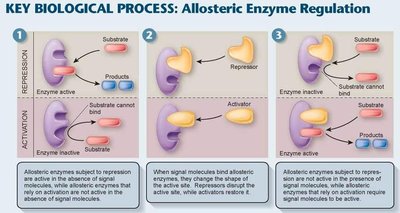
Non-competitive inhibitors bind to the allosteric site, not the active site.
This binding alters the enzyme's shape, preventing substrate binding or reducing catalytic activity.
Often reversible and used by cells to regulate metabolic pathways.
Example: Heavy metal poisoning (e.g., mercury ions) can act as non-competitive inhibitors.
Enzyme Specificity
Why Cells Have Many Different Enzymes
Each enzyme has a unique three-dimensional structure, especially at its active site, which allows it to bind only specific substrates. This specificity ensures that enzymes catalyze only particular reactions, contributing to the regulation and efficiency of cellular metabolism.
The shape of an enzyme's active site generally fits a specific substrate ("lock and key" or "induced fit" models).
Cells require hundreds of different enzymes to catalyze the diverse reactions necessary for life.
Enzyme Kinetics and Energy Diagrams
Energy Changes in Enzyme-Catalyzed Reactions
Enzymes do not change the overall energy released or absorbed in a reaction but lower the activation energy required to reach the transition state.
Exergonic reactions release energy; endergonic reactions absorb energy.
Enzymes make it possible for reactions to proceed rapidly at physiological temperatures.
Macromolecules: Review Table
Classes of Biological Molecules and Their Components
Biological macromolecules are classified into four main groups: carbohydrates, lipids, proteins, and nucleic acids. Each group has distinct building blocks and functions.
Class | Monomer/Component | Functions | Examples |
|---|---|---|---|
Carbohydrates | Monosaccharide | Energy for cell, raw material, plant cell support | Starch, glycogen |
Lipids | Glycerol, fatty acid | Energy storage, hormones, cell membrane structure | Phospholipids |
Proteins | Amino acid | Enzymes, transport, communication, movement, defense, storage, receptor | Lactase, muscle proteins, antibodies |
Nucleic Acids | Nucleotide | Heredity, information storage and transfer | DNA, RNA |
Key Terms and Concepts
Enzyme: Protein catalyst that speeds up biochemical reactions.
Substrate: The reactant molecule upon which an enzyme acts.
Active Site: The region of the enzyme where the substrate binds.
Allosteric Site: A site other than the active site where molecules can bind and regulate enzyme activity.
Competitive Inhibitor: A molecule that competes with the substrate for the active site.
Non-competitive Inhibitor: A molecule that binds to the enzyme at a site other than the active site, altering enzyme function.
Example Questions for Review
What is the difference between a competitive inhibitor and a non-competitive inhibitor?
What is an allosteric site?
A. The site where the substrate bonds with the enzyme
B. The site that breaks apart the substrate
C. The site that bonds two substrates together
D. The site that regulates the enzyme's activity
