 Back
Essential Chemistry for Biology: Foundations for Life
Study Guide - Smart Notes
 Tailored notes based on your materials, expanded with key definitions, examples, and context.
Essential Chemistry for Biology
Introduction
Chemistry is fundamental to understanding biological processes. All living things are composed of chemicals, and the interactions between these chemicals underpin life itself. This chapter explores the basic chemical principles essential for biology, including the structure of atoms, types of chemical bonds, properties of water, and the significance of acids and bases.
Matter, Elements, and Atoms
Definitions and Basic Concepts
Matter: Anything that has mass and occupies space.
Mass: The amount of material in an object.
Atom: The smallest unit of an element, retaining its chemical properties.
Elements, Molecules, and Compounds
Element: A pure substance consisting of only one type of atom (e.g., oxygen gas).
Molecule: Two or more atoms bonded together.
Compound: A molecule composed of at least two different elements (e.g., H2O).
Chemical Composition of the Human Body
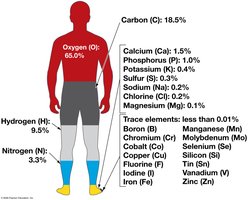
Just four elements—oxygen, carbon, hydrogen, and nitrogen—make up about 96% of the human body’s weight. Only 25 elements are essential for human life, and trace elements are required in very small amounts but are still vital for health.
Atomic Structure
Subatomic Particles
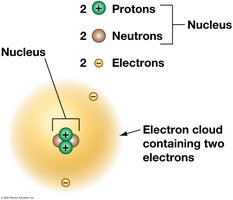
Proton: Positively charged particle found in the nucleus.
Neutron: Neutral particle found in the nucleus.
Electron: Negatively charged particle orbiting the nucleus.
Atomic Number, Mass Number, and Isotopes
Atomic number: Number of protons in an atom (unique for each element).
Mass number: Total number of protons and neutrons.
Isotopes: Atoms of the same element with different numbers of neutrons.
Radioactive isotopes: Unstable isotopes that decay, emitting radiation.
Electron Shells and the Octet Rule
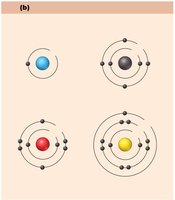
Electrons occupy energy levels called shells around the nucleus.
The octet rule states that atoms are most stable with 8 electrons in their outer shell (except H and He, which are stable with 2).
Shell capacities: 1st shell = 2, 2nd shell = 8, 3rd shell = 18 electrons.
Chemical Bonds
Types of Chemical Bonds
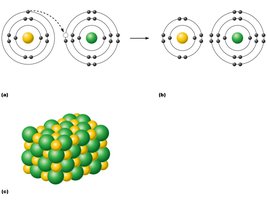
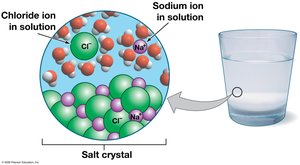
Ionic bonds: Formed when electrons are transferred from one atom to another, creating ions (charged atoms).
Covalent bonds: Formed when two atoms share electrons to fill their valence shells.
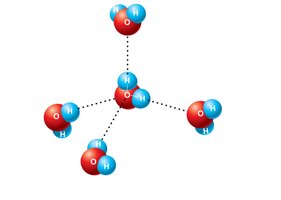
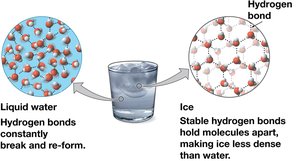
Hydrogen bonds: Weak attractions between a slightly positive hydrogen atom and a slightly negative atom (often oxygen or nitrogen) in another molecule.
Ionic Bonds
Ion: An atom with a charge due to loss or gain of electrons.
Cation: Positively charged ion (lost electrons).
Anion: Negatively charged ion (gained electrons).
Ionic bonds result from the attraction between oppositely charged ions.
Covalent Bonds
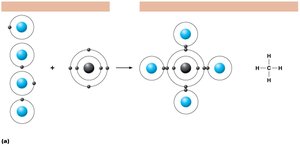
Atoms share pairs of electrons to achieve stability.
Single, double, or triple bonds can form depending on the number of shared electron pairs.
Example: Methane (CH4) forms when carbon shares electrons with four hydrogen atoms.
Hydrogen Bonds
Hydrogen bonds are much weaker than ionic or covalent bonds but are crucial for the properties of water and the structure of biological molecules like DNA and proteins.
They occur when a hydrogen atom covalently bonded to one electronegative atom is attracted to another electronegative atom.
Chemical Reactions
Reactants and Products
Chemical reaction: The process of rearranging atoms to form new substances.
Reactants: Starting materials in a reaction.
Products: Substances formed as a result of the reaction.
Matter is conserved in chemical reactions; atoms are neither created nor destroyed.
Example equation:
Water and Life
Importance of Water
Life originated in water and continues to depend on it.
Cells are composed of 70–95% water.
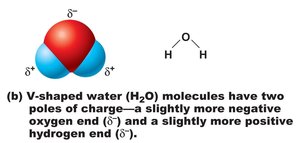
Water’s unique properties are due to its polarity and ability to form hydrogen bonds.
Cohesion and Surface Tension
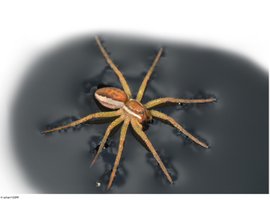
Cohesion: The tendency of water molecules to stick together due to hydrogen bonding.
Cohesion enables the transport of water in plants and creates high surface tension.
Temperature Moderation
Water absorbs and releases heat slowly, moderating temperature changes in organisms and environments.
Evaporative cooling: As water evaporates, it removes heat, cooling surfaces (e.g., sweating).
Ice Floats: Biological Significance
As water freezes, molecules form a crystalline structure held by hydrogen bonds, making ice less dense than liquid water.
Floating ice insulates water below, allowing aquatic life to survive in cold climates.
Water as the Solvent of Life
Solution: A homogeneous mixture of two or more substances.
Solvent: The substance that dissolves another (water is the universal solvent).
Solute: The substance being dissolved.
Water’s polarity allows it to dissolve many substances, forming aqueous solutions essential for biological processes.
Acids, Bases, and pH
Definitions and the pH Scale
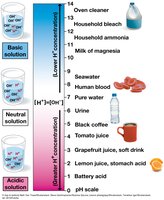
Acid: A substance that increases the hydrogen ion (H+) concentration in a solution.
Base: A substance that decreases the hydrogen ion concentration, often by accepting H+ or releasing OH−.
pH scale: Measures the concentration of H+ ions; ranges from 0 (most acidic) to 14 (most basic), with 7 being neutral.
The scale is logarithmic: each unit represents a tenfold change in H+ concentration.
Buffers: Substances that minimize changes in pH by accepting or donating H+ ions.
Ocean Acidification
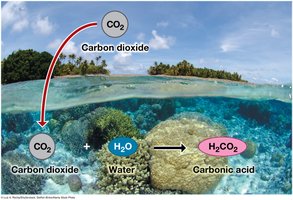
Increased atmospheric CO2 dissolves in oceans, forming carbonic acid and lowering pH.
Ocean acidification threatens marine life, especially organisms that build shells or skeletons from calcium carbonate (e.g., corals).
Major Biological Themes Illustrated
Structure and function: The structure of water molecules explains their function in supporting life.
Pathways that transform energy and matter: Chemical reactions rearrange matter, essential for metabolism.
Interactions within biological systems: Environmental changes (e.g., CO2 emissions) can affect distant ecosystems (e.g., coral reefs).
