 Back
Essential Equations for College Biology: Structure, Function, Genetics, and Ecology
Study Guide - Smart Notes
 Tailored notes based on your materials, expanded with key definitions, examples, and context.
Key Mathematical and Conceptual Equations in Biology
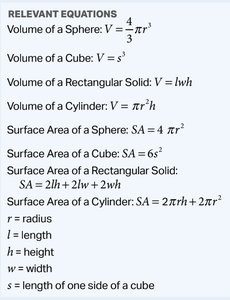
Volume and Surface Area in Biological Contexts
Understanding the volume and surface area of different shapes is crucial in biology for analyzing cell size, organelle structure, and physiological processes such as diffusion and osmosis. These equations are foundational for topics such as cell structure, transport, and metabolic rates.
Volume of a Sphere:
Volume of a Cube:
Volume of a Rectangular Solid:
Volume of a Cylinder:
Surface Area of a Sphere:
Surface Area of a Cube:
Surface Area of a Rectangular Solid:
Surface Area of a Cylinder:
Definitions: = radius, = length, = height, = width, = length of one side of a cube.
Water Potential and Transport in Plants
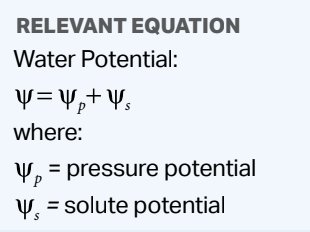
Water potential is a key concept in plant physiology, describing the potential energy of water in a system. It determines the direction of water movement and is essential for understanding osmosis, transpiration, and nutrient transport in plants.
Water Potential:
= pressure potential
= solute potential
Solute Potential of a Solution
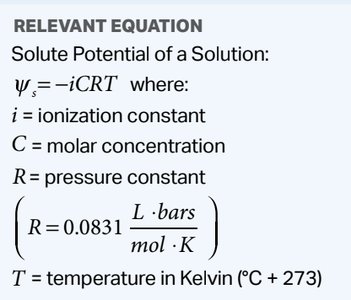
The solute potential quantifies the effect of dissolved solutes on water potential. It is always negative or zero, as solutes lower the free energy of water.
Solute Potential:
= ionization constant
= molar concentration
= pressure constant ()
= temperature in Kelvin ()
Probability in Genetics
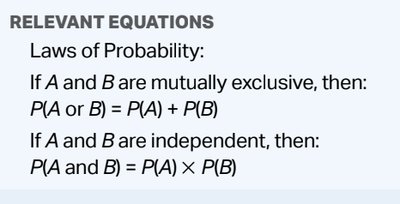
Probability laws are fundamental for predicting genetic outcomes, such as the inheritance of traits, using Punnett squares and population genetics models.
Mutually Exclusive Events:
Independent Events:
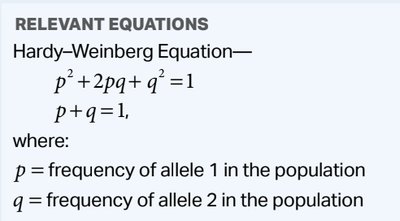
Hardy-Weinberg Equilibrium
The Hardy-Weinberg equation models allele and genotype frequencies in a non-evolving population. It is a foundational concept in population genetics and evolutionary biology.
= frequency of allele 1
= frequency of allele 2
Population Growth Models
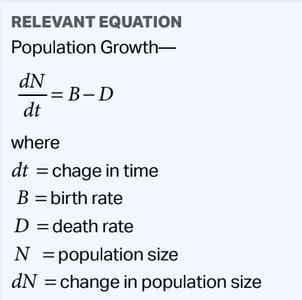
Population growth equations are used to describe how populations change over time, which is essential for understanding ecology, conservation, and evolutionary dynamics.
Basic Population Growth:
= change in time, = birth rate, = death rate, = population size, = change in population size
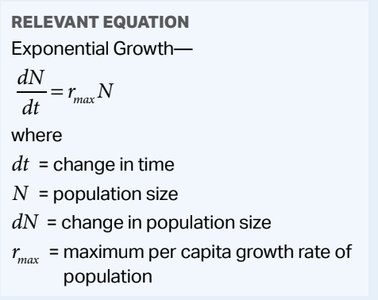
Exponential Growth
= maximum per capita growth rate of population
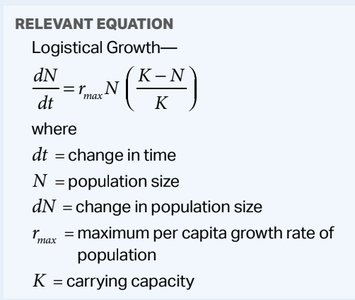
Logistical Growth
= carrying capacity
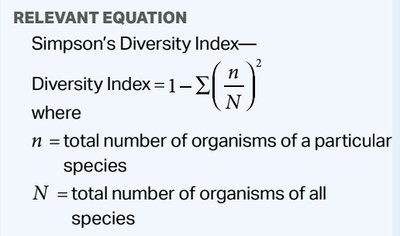
Biodiversity Measurement: Simpson's Diversity Index
Simpson's Diversity Index is used to quantify biodiversity within a community, reflecting both species richness and evenness. It is important for ecological studies and conservation biology.
Diversity Index:
= total number of organisms of a particular species
= total number of organisms of all species
Additional info: These equations are directly relevant to the study of cell structure and function, genetics, population biology, and ecology, and are commonly used in college-level biology courses for calculations and conceptual understanding.
