 Back
BackEukaryotic Cell Structure: Organization and Function
Study Guide - Smart Notes
 Tailored notes based on your materials, expanded with key definitions, examples, and context.
Eukaryotic Cell Structure
Overview of Eukaryotic Cells
Eukaryotic cells are highly organized and compartmentalized, containing membrane-bound organelles that perform specialized functions. These cells are found in animals, plants, fungi, and protists, and are distinguished from prokaryotic cells by their complexity and the presence of a nucleus.
Plasma membrane: Encloses the cell, controlling the movement of substances in and out.
Cytosol: The fluid portion of the cytoplasm where many metabolic reactions occur.
Organelles: Specialized structures such as the nucleus, mitochondria, endoplasmic reticulum, and others.
Cytoskeleton: Network of protein filaments providing structural support and facilitating movement.
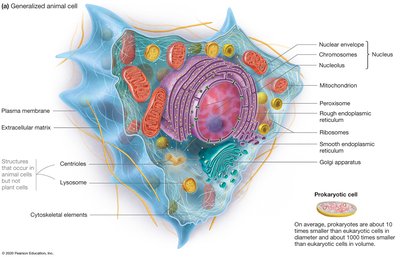
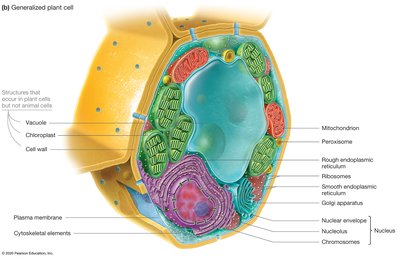
Key differences between animal and plant cells: Plant cells contain a cell wall, chloroplasts, and a large central vacuole, which are absent in animal cells.
Eukaryotic Cell Structure: A Parts List
The Nucleus
The nucleus is the control center of the cell, responsible for storing and transmitting genetic information. It is surrounded by a double-membrane nuclear envelope, which contains pore-like openings for molecular transport.
Nuclear envelope: Double membrane with pores for regulated exchange of materials.
Nuclear lamina: Lattice-like sheet of fibrous proteins lining the inner surface, providing structural support.
Nucleolus: Distinct region where ribosomal RNA (rRNA) is synthesized and ribosome subunits are assembled.
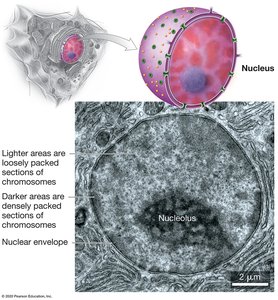
Example: The nucleolus is prominent in cells with high rates of protein synthesis, such as pancreatic cells.
Ribosomes
Ribosomes are complex molecular machines responsible for protein synthesis. Unlike most organelles, ribosomes lack a surrounding membrane.
Free ribosomes: Suspended in the cytosol; synthesize proteins that function in the cytosol or are imported into organelles like the nucleus.
Bound ribosomes: Attached to the endoplasmic reticulum; synthesize proteins destined for secretion, insertion into membranes, or packaging within organelles.
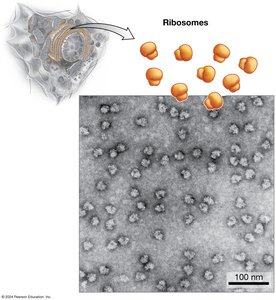
Example: Cells that secrete large amounts of protein, such as plasma cells, have abundant rough endoplasmic reticulum with many bound ribosomes.
Endoplasmic Reticulum (ER)
The endoplasmic reticulum (ER) is an extensive network of membranes continuous with the nuclear envelope. It is divided into two regions with distinct structures and functions:
Rough ER (RER): Studded with ribosomes, giving it a rough appearance. Involved in the synthesis of proteins that are shipped to other organelles, inserted into the plasma membrane, or secreted from the cell.
Smooth ER (SER): Lacks ribosomes. Contains enzymes that catalyze reactions involving lipids, including lipid synthesis and detoxification of harmful substances. Also serves as a reservoir for ions.
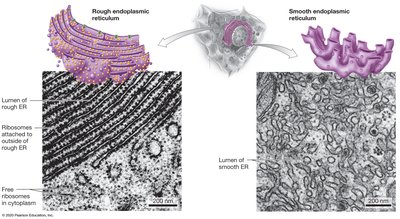
Protein processing in the RER: As proteins are synthesized by ribosomes on the RER, they are translocated into the lumen, where they are folded and processed. These proteins may function as signaling molecules, membrane transporters, or enzymes.
Functions of the SER: Synthesis of phospholipids and steroids, metabolism of carbohydrates, and detoxification of drugs and poisons.
Table: Comparison of Rough and Smooth Endoplasmic Reticulum
Feature | Rough ER (RER) | Smooth ER (SER) |
|---|---|---|
Surface | Studded with ribosomes | Lacks ribosomes |
Main Function | Protein synthesis and processing | Lipid synthesis and detoxification |
Product Destination | Other organelles, plasma membrane, secretion | Cytosol, membranes, storage |
Additional info: The compartmentalization of eukaryotic cells allows for specialization of cellular processes, increasing efficiency and complexity compared to prokaryotic cells.
