 Back
Eukaryotic Cellular Structure, Function, and Energy Transformations
Study Guide - Smart Notes
 Tailored notes based on your materials, expanded with key definitions, examples, and context.
Eukaryotic Cellular Internal Structure and Function
Nucleus
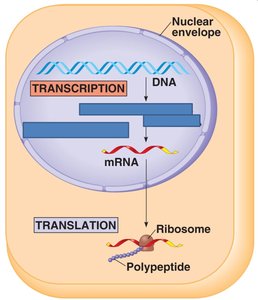
The nucleus is the central organelle in eukaryotic cells responsible for storing genetic information in the form of DNA. It is surrounded by a double membrane called the nuclear envelope, which regulates the movement of molecules in and out of the nucleus.
DNA is organized into chromosomes within the nucleus.
Transcription occurs in the nucleus, where DNA is used as a template to synthesize messenger RNA (mRNA).
mRNA exits the nucleus through nuclear pores to be translated in the cytoplasm.
Cytoplasm
The cytoplasm is the region between the nucleus and the plasma membrane, containing organelles and the cytosol. It is the site of many metabolic reactions and provides structural support to the cell.
Ribosomes
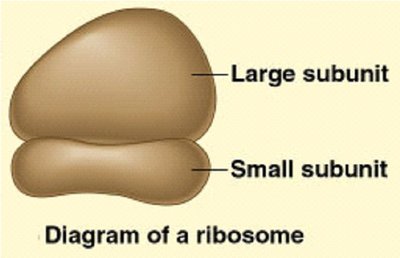
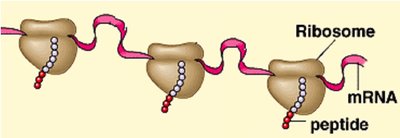
Ribosomes are molecular machines responsible for protein synthesis. They can be found free in the cytoplasm or attached to the rough endoplasmic reticulum.
Each ribosome consists of a large subunit and a small subunit.
Ribosomes translate mRNA into polypeptides (proteins).
Endoplasmic Reticulum (ER)
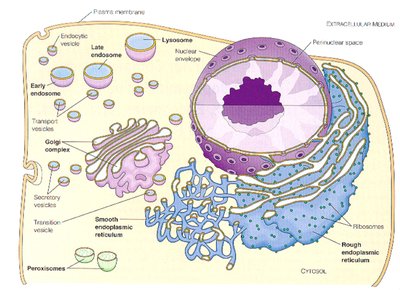
The endoplasmic reticulum is a network of membranes involved in protein and lipid synthesis.
Rough ER: Studded with ribosomes, synthesizes and processes proteins.
Smooth ER: Lacks ribosomes, synthesizes lipids and detoxifies chemicals.
Golgi Apparatus
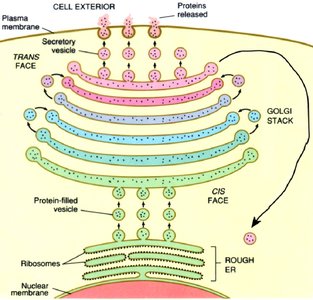
The Golgi apparatus modifies, sorts, and packages proteins and lipids for secretion or delivery to other organelles.
Proteins from the rough ER are transported to the Golgi in vesicles.
The Golgi has a cis face (receiving side) and a trans face (shipping side).
Secretory vesicles release proteins to the cell exterior.
Lysosomes, Vacuoles, and Peroxisomes
Lysosomes contain digestive enzymes for breaking down macromolecules. Vacuoles are storage organelles, especially prominent in plant cells. Peroxisomes contain enzymes for detoxification and lipid metabolism.
Mitochondria and Plastids
Mitochondria are the powerhouses of the cell, generating ATP through cellular respiration. Plastids (including chloroplasts) are found in plant cells and are involved in photosynthesis and storage.
Cytoskeleton
The cytoskeleton is a dynamic network of protein filaments that provides structural support, facilitates cell movement, and organizes organelles.
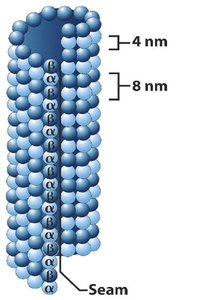
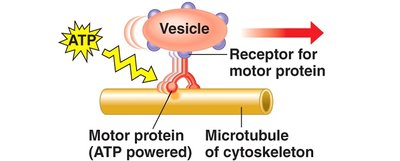
Microtubules: Hollow tubes made of tubulin, involved in cell shape, transport, and division.
Microfilaments: Thin filaments made of actin, important for cell movement and muscle contraction.
Intermediate filaments: Provide mechanical strength.
Flagella and Cilia
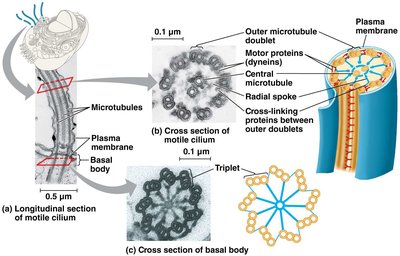
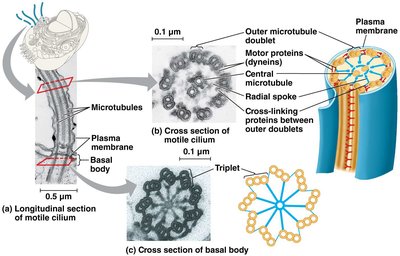
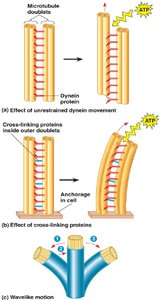
Flagella and cilia are extensions of the cell membrane supported by microtubules. They are involved in cell movement and fluid transport.
Both structures have a characteristic "9+2" arrangement of microtubules.
Movement is powered by motor proteins (dyneins) and ATP.
Muscle Contraction
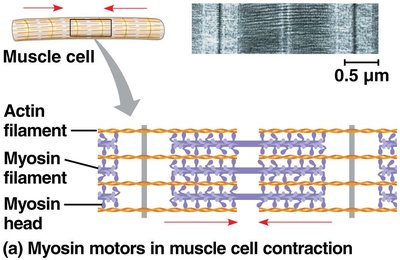
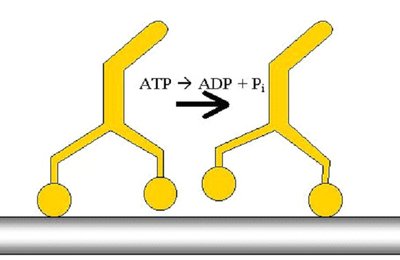
Muscle contraction is driven by the interaction of actin and myosin filaments, powered by ATP hydrolysis.
Myosin heads bind to actin filaments and pull, causing contraction.
Intercellular Junctions
Intercellular junctions are specialized structures that connect cells and facilitate communication, adhesion, and impermeability.
Gap junctions: Tunnels for communication.
Tight junctions: Sealing for impermeability.
Desmosomes: Spot welds for strength.
Extracellular Matrix (ECM)
The extracellular matrix is a complex network of proteins and carbohydrates outside cells, providing structural support and regulating cell behavior.
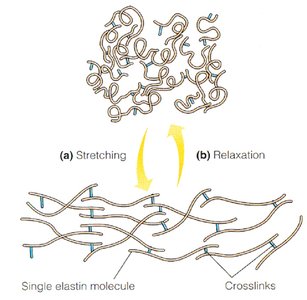
Major components include collagen, elastin, and proteoglycans.
ECM is essential for tissue integrity and signaling.
Energy and Chemical Reactions
Thermodynamics
Thermodynamics is the study of energy transformations. Biological systems obey two fundamental laws:
First Law of Thermodynamics: Energy cannot be created or destroyed, only transformed.
Second Law of Thermodynamics: Energy transformations increase entropy (disorder) in the universe.
Chemical Reactions
Chemical reactions in cells are classified as exergonic (energy-releasing) or endergonic (energy-requiring).
Exergonic reactions: Release energy, spontaneous.
Endergonic reactions: Require energy input, non-spontaneous.
Enzymes: Biological catalysts, almost all are proteins, speed up reactions by lowering activation energy.
Biological Energy Currency
ATP (adenosine triphosphate) is the primary energy carrier in cells. Energy is stored in chemical bonds and released during hydrolysis.
ATP hydrolysis:
Controlling Biochemical Reactions
Cells regulate biochemical reactions through various mechanisms:
Temperature: Affects enzyme activity.
pH: Enzymes have optimal pH ranges.
Allosteric regulation: Enzyme activity is modulated by binding of regulators at sites other than the active site.
Feedback inhibition: End product of a pathway inhibits an earlier step, preventing overproduction.
Animal Tissues - Histology
Introduction to Tissues
Tissues are groups of cells with similar structure and function, along with their extracellular matrix. Organs are composed of multiple tissues, and organ systems are groups of organs working together.
Epithelial Tissue
Epithelial tissue covers body surfaces and lines cavities, providing protection, absorption, secretion, and flexibility.
Cells are tightly packed, with distinct apical and basal surfaces.
Basal lamina supports the basal surface.
Types include simple (single layer), stratified (multiple layers), pseudostratified (appears layered), and glandular/cuboidal (secretion).
Specialized junctions: tight junctions, desmosomes.
Connective Tissue
Connective tissue connects and supports other tissues, with few cells and extensive extracellular matrix.
Loose connective tissue: Flexible, surrounds organs.
Dense/fibrous connective tissue: High collagen, forms tendons and ligaments.
Cartilage: Thick matrix, synthesized by chondrocytes, no blood vessels.
Bone: Mineralized matrix, osteocytes secrete matrix.
Blood: Cells in liquid matrix; erythrocytes (red), leucocytes (white), platelets (clotting).
Muscle Tissue
Muscle tissue is specialized for contraction and movement. Types include skeletal (voluntary, striated), cardiac (heart, involuntary), and smooth (involuntary, non-striated).
Contraction is based on sliding filament model: actin and myosin filaments interact, powered by ATP.
Nervous Tissue
Nervous tissue consists of neurons (information transfer) and glial cells (support). It is essential for communication and coordination in multicellular organisms.
Summary Table: Major Animal Tissue Types
Tissue Type | Main Function | Key Features |
|---|---|---|
Epithelial | Protection, absorption, secretion | Tightly packed, polarity, junctions |
Connective | Support, connection | Few cells, extensive matrix |
Muscle | Contraction, movement | Actin/myosin, striated or smooth |
Nervous | Information transfer | Neurons, glial cells |
