 Back
Eukaryotic Diversity and Plant Evolution: Life Cycles, Synapomorphies, and Major Lineages
Study Guide - Smart Notes
 Tailored notes based on your materials, expanded with key definitions, examples, and context.
Eukaryotic Diversity
Major Eukaryotic Lineages
Eukaryotes are a diverse group of organisms characterized by cells with a nucleus and membrane-bound organelles. The main eukaryotic supergroups include TSAR (Stramenopila, Alveolata, Rhizaria), Excavata, Archaeplastida, Opisthokonta, and Amoebozoa. Each lineage is defined by unique synapomorphies (shared derived traits) and evolutionary innovations.
TSAR: Includes Stramenopiles (e.g., diatoms, brown algae), Alveolates (e.g., ciliates, dinoflagellates), and Rhizaria (e.g., radiolarians).
Excavata: Characterized by unique feeding grooves and includes groups like Euglenids and Diplomonads.
Archaeplastida: Encompasses green algae, red algae, and land plants; defined by primary endosymbiosis and photosynthetic pigments.
Opisthokonta: Includes fungi and animals.
Amoebozoa: Includes slime molds and lobose amoebae.
Synapomorphies of Eukaryotes
Nucleus: Membrane-bound compartment for genetic material.
Mitochondria: Result of endosymbiosis, essential for cellular respiration.
Cytoskeleton: Provides structural support and enables cell movement.
Membrane Infolding: Origin of the nucleus and endoplasmic reticulum.
Life Cycles in Eukaryotes
Types of Life Cycles
Eukaryotes exhibit three main types of life cycles, each defined by the timing of meiosis and the dominance of haploid or diploid stages.
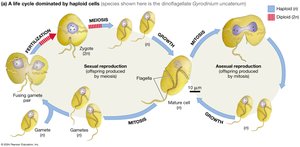
Haploid Dominant (Zygotic Meiosis): Most of the life cycle is haploid; meiosis occurs after fertilization. Common in many algae and fungi.
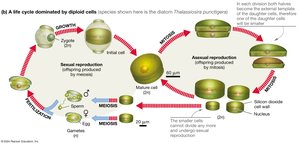
Diploid Dominant (Gametic Meiosis): Most of the life cycle is diploid; meiosis produces gametes. Typical of animals.
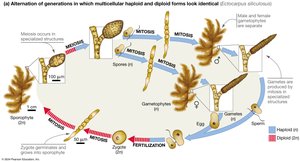
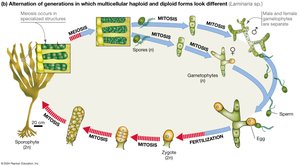
Alternation of Generations (Sporic Meiosis): Both haploid (gametophyte) and diploid (sporophyte) multicellular stages exist. Found in plants and some algae.
Example: Haploid Dominant Life Cycle
In dinoflagellates, the life cycle is dominated by haploid cells, with sexual reproduction occurring via fusion of gametes and meiosis following zygote formation.
Example: Diploid Dominant Life Cycle
Diatoms exhibit a diploid-dominant life cycle, where most cells are diploid and meiosis produces haploid gametes.
Example: Alternation of Generations
Brown algae (e.g., kelp) and land plants show alternation of generations, with both haploid and diploid multicellular forms.
Archaeplastida: Evolution and Synapomorphies
Primary Endosymbiosis and Photosynthetic Pigments
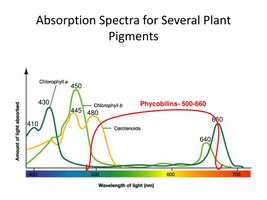
Archaeplastida is defined by the acquisition of plastids via primary endosymbiosis, resulting in the presence of chlorophyll a, beta-carotene, and phycobilins. This group includes green algae, red algae, and land plants.
Chlorophyll a: Essential pigment for photosynthesis.
Phycobilins: Accessory pigments found in red algae.
Floridean Starch: Storage polysaccharide in red algae.
Major Groups within Archaeplastida
Glaucophyta: Freshwater algae with unique plastids.
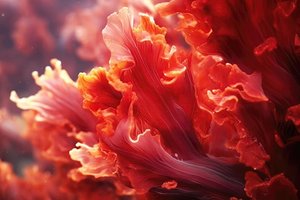
Rhodophyta (Red Algae): Marine algae with phycobilins and floridean starch.
Viridiplantae (Green Plants): Includes green algae and land plants; characterized by chlorophyll b and loss of phycobilins.
Evolutionary Innovations in Land Plants
Sporopollenin: Tough polymer protecting spores and pollen.
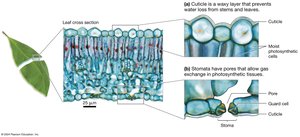
Pores and Stomata: Structures for gas exchange.
Cuticle: Waxy layer preventing water loss.
Phylogeny and Classification of Green Plants
Phylogenetic Relationships
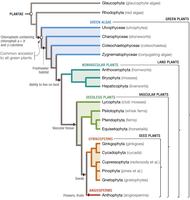
Green plants (Viridiplantae) are divided into green algae and land plants. Land plants are further classified into seedless vascular plants, gymnosperms, and angiosperms.
Green Algae: Includes Ulvophyceae, Stoneworts, Coleochaetes, and Zygnematophyceae.
Land Plants (Embryophyta): Characterized by complex gametangia and alternation of generations.
Tracheophyta: Vascular plants with specialized tissues for water and nutrient transport.
Spermatophyta: Seed plants, including gymnosperms and angiosperms.
Life Cycle Innovations in Land Plants
Alternation of Generations
Land plants exhibit alternation of generations, with a reduction in the gametophyte stage in more derived groups. Mosses have a dominant gametophyte, while ferns and seed plants have a dominant sporophyte.
Seed Plant Innovations
Heterospory: Production of two types of spores (microspores and megaspores).
Pollen: Male gametophyte adapted for dispersal.
Seeds: Embryo protected by a seed coat and nutritive tissue.
Summary Table: Major Plant Groups and Innovations
Group | Key Innovations | Life Cycle |
|---|---|---|
Green Algae | Chlorophyll b, loss of phycobilins | Zygotic meiosis |
Land Plants | Sporopollenin, cuticle, stomata | Sporic meiosis (alternation of generations) |
Seed Plants | Heterospory, pollen, seeds | Sporophyte dominant |
Angiosperms | Flowers, fruit | Sporophyte dominant |
Additional info:
Some details about the evolutionary timeline and major extinction events can be inferred from the geological time scale diagram.
Not all lineages are presented in the notes, but the main groups relevant to college biology are covered.
