 Back
BackEukaryotic RNA Processing: Modifications and Splicing
Study Guide - Smart Notes
 Tailored notes based on your materials, expanded with key definitions, examples, and context.
RNA Processing in Eukaryotic Cells
Overview of RNA Processing
In eukaryotic cells, the primary RNA transcript (pre-mRNA) undergoes several modifications before it becomes mature messenger RNA (mRNA) ready for translation. These modifications include the alteration of both ends of the transcript and the removal of noncoding sequences. This process ensures the stability, export, and proper translation of mRNA.
Alteration of mRNA Ends
5′ Cap and Poly-A Tail
Both ends of a pre-mRNA molecule are modified in specific ways to protect the RNA and facilitate its function:
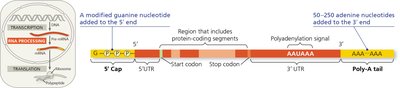
5′ Cap: A modified guanine nucleotide is added to the 5′ end of the pre-mRNA after the first 20–40 nucleotides are transcribed. This cap helps protect the mRNA from degradation and assists in ribosome binding during translation.
Poly-A Tail: At the 3′ end, an enzyme adds 50–250 adenine nucleotides, forming a poly-A tail. This tail also protects the mRNA and aids in its export from the nucleus.
Untranslated Regions (UTRs): The 5′ UTR and 3′ UTR are regions at each end of the mRNA that are not translated into protein but play roles in regulation and ribosome binding.
Functions of the 5′ Cap and Poly-A Tail:
Facilitate export of mature mRNA from the nucleus
Protect mRNA from hydrolytic enzymes
Assist ribosome attachment for translation
RNA Splicing: Removal of Introns
Split Genes and the Splicing Process
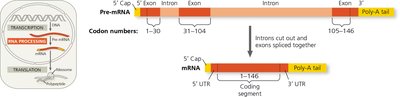
Most eukaryotic genes contain noncoding sequences called introns interspersed among coding sequences known as exons. During RNA splicing, introns are removed from the pre-mRNA, and exons are joined together to form a continuous coding sequence in the mature mRNA.
Introns: Noncoding regions that are removed during RNA processing.
Exons: Coding regions that remain in the mRNA and are usually translated into protein.
UTRs: Although part of exons, the 5′ and 3′ UTRs are not translated into protein but remain in the mature mRNA.
RNA polymerase II transcribes both introns and exons, but only exons (and UTRs) are present in the final mRNA that exits the nucleus.
Mechanism of RNA Splicing
The Spliceosome
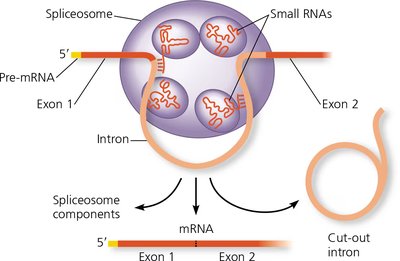
The removal of introns is carried out by a large complex called the spliceosome, which is composed of proteins and small RNAs. The spliceosome recognizes specific sequences at the intron-exon boundaries, excises the intron, and joins the exons together. The small RNAs within the spliceosome play both structural and catalytic roles in this process.
The spliceosome binds to short nucleotide sequences at each end of the intron.
The intron is cut out and rapidly degraded.
The exons are ligated to form the mature mRNA.
Alternative RNA Splicing
Generating Protein Diversity
Alternative RNA splicing allows a single gene to produce multiple polypeptides by varying which segments are treated as exons during RNA processing. This mechanism greatly increases the diversity of proteins that an organism can produce, explaining how humans can generate 75,000–100,000 different proteins from about 20,000 genes.
Alternative splicing: Different combinations of exons are joined together, resulting in different mRNA variants from the same gene.
Ribozymes: Catalytic RNA Molecules
RNA as an Enzyme
Some RNA molecules, known as ribozymes, can function as enzymes. In certain cases, such as in the ciliate protist Tetrahymena, RNA splicing can occur without proteins; the intron RNA catalyzes its own removal. The discovery of ribozymes demonstrated that not all biological catalysts are proteins.
Properties of Ribozymes:
RNA can form complex three-dimensional structures essential for catalysis.
Some RNA bases have functional groups that participate in catalysis.
RNA can hydrogen-bond with other nucleic acids, adding specificity to its catalytic activity.
Example: Self-splicing of pre-rRNA in Tetrahymena is catalyzed by the RNA itself, not by proteins.
Summary Table: Key Features of Eukaryotic RNA Processing
Feature | Description | Function |
|---|---|---|
5′ Cap | Modified guanine nucleotide added to 5′ end | Protection, export, ribosome binding |
Poly-A Tail | 50–250 adenine nucleotides added to 3′ end | Protection, export, translation efficiency |
Introns | Noncoding sequences removed during splicing | Allow alternative splicing, gene regulation |
Exons | Coding sequences joined together in mRNA | Encode protein sequence |
Spliceosome | Complex of proteins and RNAs | Catalyzes removal of introns and joining of exons |
Ribozymes | RNA molecules with catalytic activity | Self-splicing, other catalytic roles |
Additional info: The presence of introns and alternative splicing are major contributors to the complexity of eukaryotic gene expression and proteome diversity.
