 Back
BackLec: 8 Evidence for Evolution: Biogeography and Homology
Study Guide - Smart Notes
 Tailored notes based on your materials, expanded with key definitions, examples, and context.
Evidence for Evolution
Biogeography
Biogeography is the study of the distribution of species and ecosystems in geographic space and through geological time. It provides key evidence for evolution by showing how species are distributed and how their genetic similarities often reflect geographic proximity rather than ecological similarity.
Definition: Biogeographical evidence refers to patterns in the distribution of organisms that support evolutionary theory.
Key Point: Closely related species are often found in the same geographic region, even if they occupy different habitats.
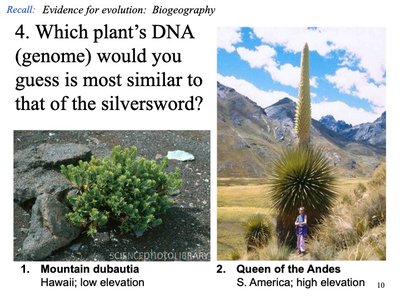
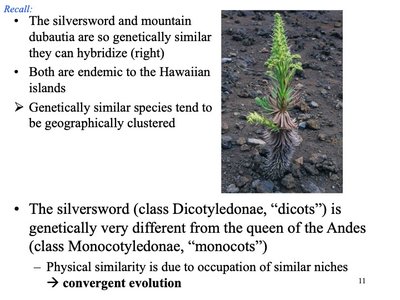
Example: The silversword (Argyroxiphium sandwicense) is found only on Hawaiian islands at high elevations, while the mountain dubautia is found at low elevations in Hawaii. Both are genetically similar and can hybridize, indicating recent common ancestry. In contrast, the Queen of the Andes, found in South America, is physically similar to the silversword but genetically distinct, illustrating convergent evolution.

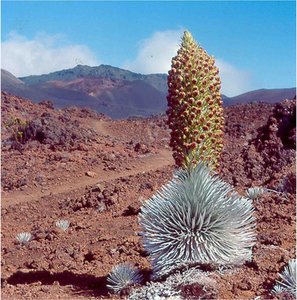
Plant | Location | Elevation | Genetic Similarity to Silversword |
|---|---|---|---|
Mountain dubautia | Hawaii | Low | High |
Queen of the Andes | South America | High | Low |

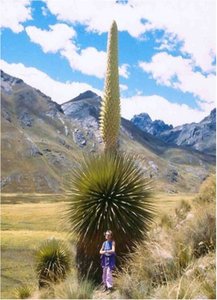
Convergent Evolution: Physical similarity between distantly related species is often due to adaptation to similar ecological niches, not shared ancestry.
Geographic Clustering: Genetically similar species tend to be geographically clustered, supporting the idea of common descent.

Continental Isolation and DNA Similarity
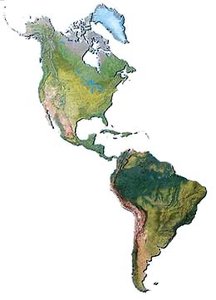
North and South America were geographically isolated for most of the last 250 million years, leading to distinct evolutionary lineages. Alpine plants in the Rockies and Andes have similar adaptations but very different DNA, while lowland and alpine plants in South America are closely related genetically despite ecological differences.
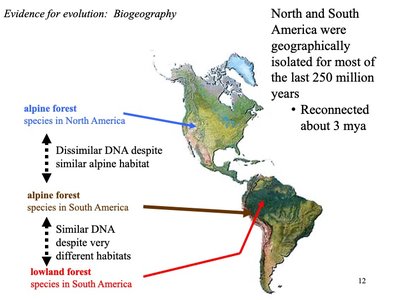
Key Point: DNA similarity is often determined more by geography than by physical similarity.
Ring Species
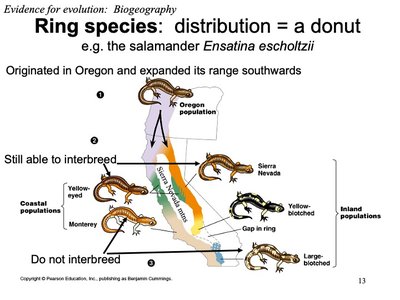
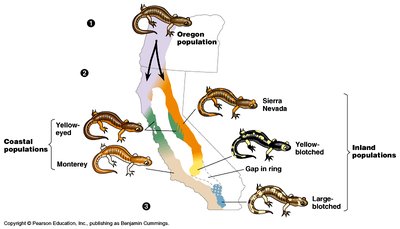
Ring species illustrate how populations distributed around a geographic barrier can gradually diverge, with adjacent populations able to interbreed, but terminal populations unable to do so. This demonstrates the continuum between microevolution and macroevolution.
Example: The salamander Ensatina escholtzii forms a ring species around the Sierra Nevada mountains. Populations originating in Oregon expanded southwards, and while adjacent populations can interbreed, those at the ends of the ring cannot.
Homology
Morphological Homology
Morphological homology refers to similarities in the structure of organs or body parts among different species, indicating common ancestry. These structures may serve different functions but share a fundamental design.
Pentadactyl Limb: The pentadactyl limb (five-digit limb) is found in all vertebrates, including humans, cats, and birds. Despite differences in function, the basic bone structure is conserved.
Mammalian Skulls: All mammals initially have 28 bones in their skull, though the size and shape vary greatly among species. This reflects modification of ancestral structures rather than independent creation.
Embryological Homology
Embryological homology is the similarity in early developmental stages among different species. For example, vertebrate embryos (including humans, cats, and chickens) all exhibit gill slits and tails, features inherited from aquatic ancestors.
Key Point: Embryos of organisms with very different adult morphologies can be remarkably similar early in development, reflecting shared ancestry.
Molecular Homology
Molecular homology involves similarities at the molecular level, such as DNA, RNA, and protein sequences. The universality of the genetic code is a powerful indicator of common descent.
Genetic Code: The genetic code is nearly universal among all living organisms. For example, the DNA sequence coding for a specific amino acid sequence in humans is the same as in bacteria.
Key Point: The genetic code is arbitrary; any codon could theoretically code for any amino acid. Once established, it is highly conserved because mutations altering the code would be catastrophic.
Example: A gene from a firefly inserted into a tobacco plant produces the same protein (luciferase), demonstrating the universality of the code.
Organism | DNA Sequence | Amino Acid Sequence |
|---|---|---|
Human | ACCACCTACACC | Tryptophan-Tryptophan-Methionine-Tryptophan |
E. coli | ACCACCTACACC | Tryptophan-Tryptophan-Methionine-Tryptophan |
Conserved Trait: The genetic code is a conserved trait, preserved through evolutionary time.
Exceptions: Some unicellular microbes have minor differences in their genetic code, but overall similarity remains too high for independent origin to be plausible.
Summary
Biogeographical evidence, morphological, embryological, and molecular homologies all support the theory of evolution.
The universality of the genetic code indicates that all life is descended from a common ancestor.
Evolution works on variation that is already present; new traits arise from random processes such as mutation, crossing over, and chromosome segregation.
Additional info:
These notes cover topics from Ch. 18 (Evolution) and Ch. 19 (Population Genetics), directly relevant to college-level biology.
