 Back
BackEvolution and Natural Selection: Foundations, Evidence, and Misconceptions
Study Guide - Smart Notes
 Tailored notes based on your materials, expanded with key definitions, examples, and context.
Evolution and Natural Selection
Introduction to Evolution and Natural Selection
Evolution is the gradual change of a population through time, driven by mechanisms such as natural selection. Natural selection is the process that explains how and why populations evolve, favoring traits that increase an individual's fitness—defined as the likelihood that an individual contributes offspring to the next generation. Traits that help individuals survive and reproduce become more common in a population over generations.
Common Descent: Species alive today share common ancestors.
Fitness: The likelihood that an individual contributes offspring to the next generation.
Adaptation: A trait that makes an organism well-suited to its environment.
Natural Selection: The process by which individuals with advantageous traits survive and reproduce more successfully.
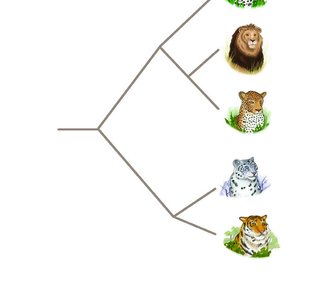
Example: The closest living relatives of birds are alligators and crocodiles, so birds share many traits with reptiles. Fossil data show that horse ancestors increased in size over time, demonstrating evolutionary trends.
Relationship Between Evolution and Natural Selection
Natural selection is the primary mechanism by which evolution occurs. While evolution refers to the change in populations over time, natural selection explains how these changes happen through differential survival and reproduction.
Key Point: Natural selection acts on existing variation within a population; it does not create new variation.
Key Point: Populations evolve, not individuals.
Conceptual Frameworks in Evolutionary Thinking
Typological vs. Population Thinking
Typological thinking views species as fixed and unchanging, with variation seen as deviation from an ideal form. In contrast, population thinking recognizes the importance of variation among individuals and sees species as dynamic entities that change over time.
Typological Thinking: Focuses on an idealized form; variation is considered imperfection.
Population Thinking: Emphasizes the significance of variation among individuals; species are not fixed and can change over time.
Example: Dog breed standards reflect typological thinking because they use an idealized form for comparison.
Ladder vs. Tree Thinking
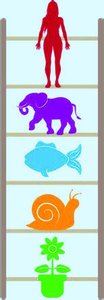
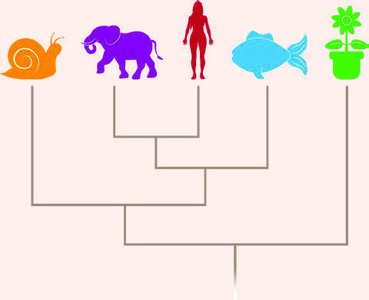
Ladder thinking (Great Chain of Being) arranges species hierarchically from simple to complex, assuming species are unchanging. Tree thinking, used in modern biology, organizes species based on evolutionary relationships and common descent, recognizing that all populations have been evolving for the same amount of time.
Ladder Thinking: Focuses on hierarchy and complexity.
Tree Thinking: Focuses on evolutionary relationships and common ancestry.
Reading Phylogenetic Trees
Understanding Phylogenetic Trees
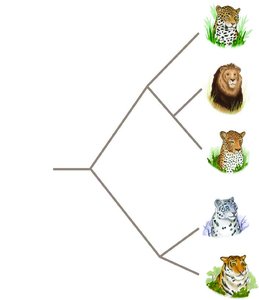
Phylogenetic trees are diagrams that represent evolutionary relationships among species based on common descent. Branches represent lineages over time, and nodes represent common ancestors. The relatedness of species is determined by how recently they share a common ancestor.
Branches: Lineages over time.
Nodes: Common ancestors.
Relatedness: Determined by proximity to a common node.
History of Evolutionary Thought
Geological Thinking and the Age of Earth
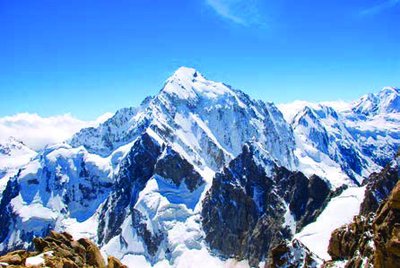
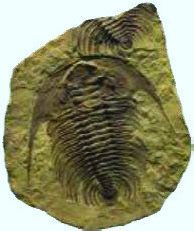
Geological discoveries in the 18th and 19th centuries established that Earth is very old and changes slowly over time. Uniformitarianism, proposed by James Hutton and popularized by Charles Lyell, states that geological processes occurring today are the same as those in the past. Fossil records, studied by Georges Cuvier, provide evidence for extinction and evolutionary change.
Uniformitarianism: Geological processes are consistent over time; change is gradual.
Fossil Evidence: Shows extinct organisms and evolutionary transitions.
Lamarck and the Inheritance of Acquired Traits
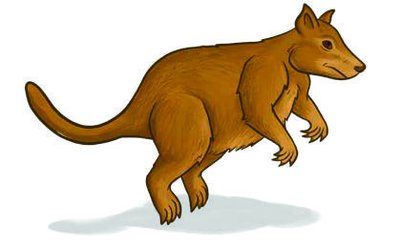
Jean-Baptiste de Lamarck proposed that traits acquired during an organism's lifetime could be inherited by offspring (inheritance of acquired traits) and that use or disuse of traits could enhance or diminish them. Modern genetics has shown that acquired traits are not inherited; only genetic traits are passed to offspring.
Use and Disuse: Traits become more or less developed depending on use.
Inheritance of Acquired Traits: Traits developed during an organism's life are inherited (now known to be incorrect).
Darwin, Wallace, and the Theory of Natural Selection
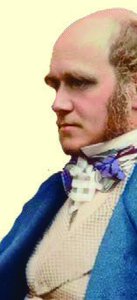
Charles Darwin and Alfred Russel Wallace independently developed the theory of evolution by natural selection. Darwin's observations during his voyage on the HMS Beagle, especially in the Galapagos Islands, and Wallace's studies in the Malay Archipelago, provided key evidence for their ideas. Their work established natural selection as the primary mechanism of evolution.
Darwin: Observed variation among species and fossils; developed the theory over many years.
Wallace: Independently conceived a similar theory; his letter prompted Darwin to publish.
Mechanisms and Evidence of Natural Selection
Key Insights for Understanding Natural Selection
Natural selection requires heritable variation within a population. More offspring are produced than can survive, leading to competition. Individuals with advantageous traits have higher fitness and are more likely to survive and reproduce, causing those traits to become more common in the population over time.
Variation: Essential for natural selection to act.
Overproduction: More offspring are produced than can survive.
Selection: Differential survival and reproduction based on traits.
Evolution: Change in the frequency of traits in a population over generations.
Artificial Selection vs. Natural Selection
Artificial selection is the selective breeding of organisms by humans for desired traits, while natural selection is driven by environmental pressures. Both processes change the frequency of traits in a population, but the selective agent differs (humans vs. environment).
Natural Selection | Artificial Selection | Both |
|---|---|---|
Environment selects traits | Humans select traits | Requires variation |
Competition for resources | Controlled breeding | Changes trait frequency |
Evidence for Natural Selection
Natural selection can be observed in real time, such as the evolution of antibiotic resistance in bacteria or color changes in populations of mice and moths due to environmental changes. Classic examples include industrial melanism in the peppered moth and the evolution of herbicide resistance in weeds.
Variation: Some individuals are resistant to antibiotics or have different coloration.
Selection: Environmental pressures (e.g., predators, chemicals) favor certain traits.
Population Evolution: The frequency of advantageous traits increases over generations.
Evidence of Evolution
Homology and Analogy
Homologous traits are similar due to shared ancestry, while analogous traits are similar due to convergent evolution (independent origins). For example, the forelimbs of mammals are homologous, while the wings of birds and insects are analogous.
Homology: Similar structure, common ancestry (e.g., limb bones in tetrapods).
Analogy: Similar function, different ancestry (e.g., wings in birds and bats).
Types of Homologies
Vestigial Structures: Traits that have lost most or all of their original function (e.g., pelvic bones in whales).
Embryological Homology: Similar traits in embryos of different species (e.g., pharyngeal arches in vertebrates).
Molecular Homology: Similar DNA and protein sequences in related organisms.
Fossil Evidence
Fossils provide direct evidence of evolutionary change and extinction. Sedimentary rock layers allow paleontologists to date fossils and reconstruct evolutionary histories. Transitional fossils, such as Archaeopteryx, demonstrate evolutionary links between major groups.
Geologic Layers: Older fossils are found in deeper layers.
Transitional Forms: Fossils with traits of both ancestral and derived groups.
Common Misconceptions About Evolution
Clarifying Misunderstandings
Several misconceptions about evolution persist. For example, evolution is not 'just a theory'—in science, a theory is a well-supported explanation. Individuals do not evolve; populations do. Natural selection does not produce perfect organisms, and adaptations are not developed for future needs but are responses to current environments.
Misconception: Evolution is just a theory. Correction: It is a well-supported scientific theory.
Misconception: Individuals evolve. Correction: Only populations evolve over generations.
Misconception: Natural selection creates perfect organisms. Correction: Selection only acts on existing variation and involves trade-offs.
