 Back
Evolution and the Origin of Species: Mechanisms, Evidence, and Speciation
Study Guide - Smart Notes
 Tailored notes based on your materials, expanded with key definitions, examples, and context.
Evolution and the Origin of Species
Introduction to Evolution
Evolution is the process by which life changes over time, driven by mechanisms such as natural selection, mutation, gene flow, and genetic drift. The formation of new species (speciation) and the accumulation of evidence from various scientific fields support the theory of evolution. The concept of 'descent with modification' describes how species share common ancestry but accumulate differences over generations.
Historical Perspectives on Evolution
Pre-Darwinian Views
Aristotle: Species are fixed and unchanging, arranged in a 'scala naturae' (scale of nature).
Old Testament: Species are individually designed and perfect for their environment.
Carolus Linnaeus: Developed binomial nomenclature for naming organisms (e.g., Homo sapiens).
Jean-Baptiste Lamarck: Proposed inheritance of acquired characteristics (e.g., giraffes stretching necks).
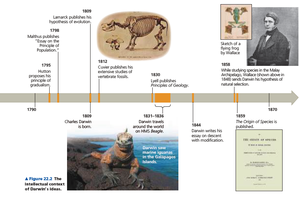
Charles Darwin and the Intellectual Context
Charles Darwin (1809–1882): Naturalist who studied biogeography, geology, and fossils. His voyage on the HMS Beagle (1831–1836) led to the development of his theory of evolution by natural selection, published in "The Origin of Species" (1859).
Georges Cuvier: Father of paleontology; proposed catastrophism to explain fossil strata.
Jean-Baptiste Lamarck: Early evolutionary ideas, including use and disuse of traits.
Mechanisms of Evolution
Descent with Modification and Adaptive Radiation
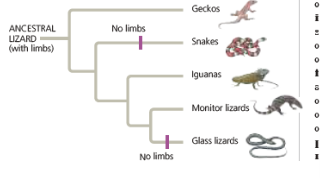
Darwin proposed that all organisms are descendants of a common ancestor, with adaptations arising to fit specific environments. Adaptive radiation describes the diversification of species from a common ancestor into various forms adapted to different habitats.
Phylogenetic trees: Visual tools to understand evolutionary relationships among species.
Artificial Selection
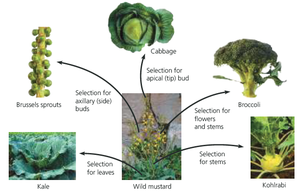
Artificial selection is the process by which humans select for desirable traits in plants and animals, leading to significant changes over generations.
Example: Selection of different parts of wild mustard has produced crops like cabbage, broccoli, kale, and Brussels sprouts.
Natural Selection
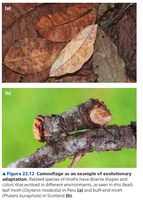
Natural selection is the process by which individuals with advantageous heritable traits survive and reproduce more successfully, leading to adaptation over time. Alfred Russel Wallace independently conceived similar ideas.
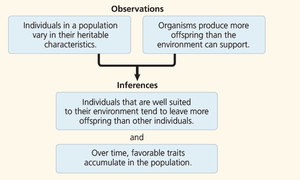
Key observations: Variation in traits and overproduction of offspring.
Key inferences: Differential survival and reproduction lead to accumulation of favorable traits.
Main Concepts of Natural Selection
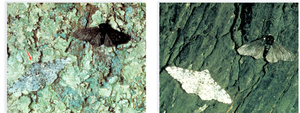
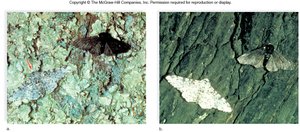
Individuals with certain heritable traits survive and reproduce at higher rates.
Favorable adaptations increase in frequency over generations.
Environmental changes can lead to new adaptations and possibly new species.
Preconditions for Natural Selection
Traits must be heritable.
More individuals are produced than can survive (differential reproduction).
Some traits confer a reproductive advantage (differential adaptiveness).
Variation must be present in the population.
Fitness: The ability to survive and reproduce, passing genes to the next generation.
Genetic Variation
Genetic variation is essential for evolution. It arises from mutations (new alleles) and sexual reproduction (genetic shuffling through crossing over, independent assortment, and fertilization).
Fitness: The reproductive success of an organism in passing its genes to the next generation.
Evidence for Evolution
Fossil Record and Phylogenetic Trees
Fossils provide evidence of gradual changes and transitions between species.
Phylogenetic trees illustrate evolutionary relationships.
Comparative Anatomy
Homology: Similar structures due to common ancestry (e.g., mammalian forelimbs).
Divergent evolution: Homologous structures adapt to different functions.
Convergent Evolution
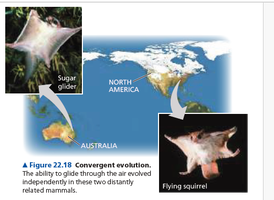
Convergent evolution results in analogous structures—similar functions but not due to common ancestry (e.g., wings of birds and insects, sugar glider and flying squirrel).
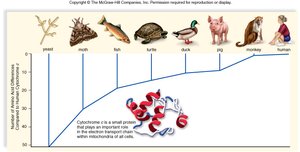
Biochemical Evidence
DNA, RNA, and protein similarities reveal evolutionary relationships.
More conserved molecular regions indicate closer relationships.
Vestigial Structures
Vestigial structures are remnants of features that served important functions in ancestors (e.g., human appendix, wings in flightless birds).
Speciation: Formation of New Species
Definition of Species and Speciation
A species is a group of organisms capable of interbreeding to produce fertile offspring and are reproductively isolated from other groups. Speciation occurs when populations become reproductively isolated and diverge over time.
Types of Speciation
Allopatric speciation: Geographic isolation leads to divergence (e.g., separated by land, sea, or mountains).
Sympatric speciation: Occurs in the same geographic area, often due to genetic or behavioral barriers (e.g., polyploidy in plants, ecological or behavioral separation).
Polyploidy in Sympatric Speciation
Autopolyploid: Extra chromosome sets from a single species.
Allopolyploid: Extra chromosome sets from two different species.
Reproductive Isolation Mechanisms
Prezygotic barriers: Habitat, timing, behavior, mechanical isolation.
Postzygotic barriers: Hybrid sterility or inviability.
Modern Synthesis: Genetics and Evolution
Key Mechanisms of Evolution
Natural selection: Differential survival and reproduction of individuals with advantageous traits.
Mutation: Random changes in DNA, source of new genetic variation.
Gene flow: Movement of alleles between populations (migration).
Genetic drift: Random changes in allele frequencies, especially in small populations.
Non-random mating: Mating patterns that affect genotype frequencies.
Genetic Drift
Founder effect: A few individuals establish a new population with a different gene pool.
Bottleneck effect: A severe reduction in population size alters allele frequencies.
Gene Flow
Migration of fertile individuals introduces or removes alleles from populations, affecting genetic diversity.
Microevolution vs. Macroevolution
Microevolution: Small-scale changes in allele frequencies within populations (e.g., insecticide resistance).
Macroevolution: Large-scale evolutionary changes (e.g., speciation, extinction, major transitions).
The Hardy-Weinberg Principle
Equations and Application
Allele frequency equation:
Genotype frequency equation:
Used to test whether a population is evolving by comparing expected and observed genotype frequencies.
Conditions for Hardy-Weinberg Equilibrium
No mutations
Random mating
No natural selection
Extremely large population size
No gene flow
Departure from these conditions results in evolutionary change.
Summary
Evolution explains biological diversity through mechanisms such as natural selection, mutation, gene flow, and genetic drift.
Speciation creates new species over time.
Multiple lines of evidence support evolutionary theory.
