 Back
BackEvolution, Biodiversity, and Population Ecology: Core Concepts and Mechanisms
Study Guide - Smart Notes
 Tailored notes based on your materials, expanded with key definitions, examples, and context.
Evolution and Genetic Variation
Definitions and Key Concepts
Understanding evolution and population ecology requires familiarity with several foundational terms:
Species: A group of organisms capable of interbreeding and producing fertile offspring. Scientific names use a two-part format: Genus species (e.g., Mimus polyglottos).
Population: All individuals of a species living in a specific area at a given time.
Evolution: Change in the genetic composition of a population over time, leading to alterations in appearance or behavior.
Natural Selection: The process by which individuals with advantageous traits survive and reproduce more successfully, passing those traits to future generations.
Sources of Genetic Variation
Genetic variation is essential for evolution and adaptation. It arises from:
Mutations: Random changes in DNA; if present in gametes, they can be inherited.
Sexual Reproduction: Offspring inherit a unique combination of parental genes.
Immigration/Emigration: Movement of individuals into or out of populations alters gene pools.
Non-random Mating: Selective mating can shift genetic makeup within a population.
Mechanisms of Evolution
Natural Selection
Natural selection is a primary mechanism of evolution. It requires:
Overproduction of offspring, leading to competition for resources.
Variation in traits among individuals.
Heritability of traits (genetic basis).
Individuals with advantageous traits survive and reproduce, increasing those traits in the population over generations.
Artificial Selection
Artificial selection is human-directed breeding for desired traits, commonly used in agriculture and animal husbandry. Unlike natural selection, the traits favored may not enhance survival in the wild.
Speciation
Speciation is the evolutionary process by which new species arise. The most common form is allopatric speciation, where geographic separation leads to genetic divergence and reproductive isolation.
Physical barriers (e.g., mountains, rivers) split populations.
Different mutations and selection pressures act on each group.
Over time, populations diverge enough that they can no longer interbreed.
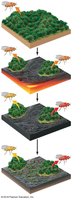
Speciation vs. Extinction
Speciation: Formation of new species.
Extinction: Loss of all individuals of a species. Extinction can be gradual (background rate) or rapid (mass extinction events).
Vulnerability to extinction increases with small population size, low genetic diversity, specialization, endemism, and island dwelling.
Biodiversity
Definition and Importance
Biodiversity encompasses the variety of life at all levels: genes, species, populations, and communities. Scientists value biodiversity for ecosystem stability, resilience, and the provision of resources and services.
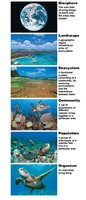
Ecology: Levels of Organization
Definitions in Community Ecology
Ecosystem: The community of living organisms and their interactions with the abiotic environment.
Community: All populations of different species in an area and their interactions.
Habitat: The specific environment where an organism lives.
Niche: The functional role of an organism within its community.
Population Ecology
Population Size, Density, and Distribution
Population Size: Total number of individuals in a population.
Population Density: Number of individuals per unit area.
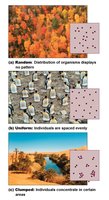
Population Distribution: Spatial arrangement of individuals, which can be:
Random: No predictable pattern.
Uniform: Evenly spaced, often due to territoriality or competition.
Clumped: Individuals aggregate in patches, often where resources are concentrated.
Population Growth
Natality: Birth rate.
Mortality: Death rate.
Immigration: Movement into a population.
Emigration: Movement out of a population.
The population growth rate is calculated as:
Exponential Growth
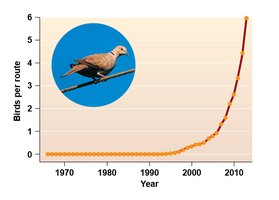
Exponential growth occurs when resources are unlimited, resulting in a constant rate of increase:
where is the population at time , is the initial population, is the intrinsic growth rate, and is Euler's number.
Limits to Exponential Growth
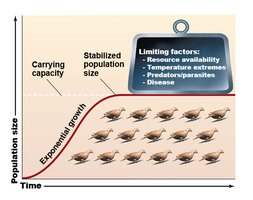
Exponential growth is unsustainable due to limiting factors such as competition, resource scarcity, disease, predation, and environmental conditions. The carrying capacity () is the maximum population size an environment can support long-term.
Logistic Growth
Logistic growth describes how populations grow rapidly at first, then slow as they approach carrying capacity:
Population Regulation
Density-dependent factors: Effects increase with population density (e.g., competition, disease, predation).
Density-independent factors: Effects are unrelated to population density (e.g., weather, natural disasters).
Life History Strategies
r-selected species: High reproductive rate, low parental investment, fluctuating populations, often below carrying capacity.
K-selected species: Low reproductive rate, high parental investment, stable populations near carrying capacity.
Summary Table: Population Growth Models
Model | Equation | Key Features |
|---|---|---|
Exponential | Unlimited resources, rapid growth, unsustainable | |
Logistic | Growth slows as carrying capacity is reached |
Example: A population of rabbits introduced to an island with abundant resources will initially grow exponentially, but as resources become limited, growth will slow and stabilize at the carrying capacity.
Additional info: The equations and examples provided are standard in population ecology and help clarify the mathematical basis for population growth models.
