 Back
Evolution by Natural Selection and Hardy-Weinberg Equilibrium
Study Guide - Smart Notes
 Tailored notes based on your materials, expanded with key definitions, examples, and context.
Evolution by Natural Selection
Introduction to Natural Selection
Natural selection is a fundamental mechanism of evolution, describing how individuals with advantageous traits are more likely to survive and reproduce in a given environment. Over generations, these beneficial traits become more common in the population, leading to evolutionary change.
Natural selection: The process by which individuals with traits that provide an advantage in a specific environment are more likely to survive and reproduce, passing those traits to the next generation.
Individuals better adapted to their environment survive longer and produce more offspring than less-suited individuals.
This process leads to the accumulation of advantageous traits in the population over time.
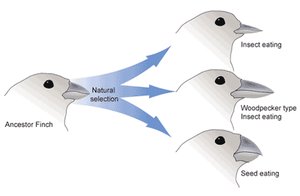
Adaptation and Camouflage
An adaptation is a heritable trait that increases an organism’s ability to survive and reproduce in a particular environment. Camouflage is a classic example of an evolutionary adaptation, allowing organisms to blend into their surroundings to avoid predation or to hunt more effectively.
Camouflage: An adaptation that enables animals to conceal themselves in their environment.
Helps prey avoid predators or allows predators to approach prey unnoticed.
If the environment changes, the advantage of camouflage may be lost, affecting survival rates.
Peppered Moth Case Study: Evolution in Action
The peppered moth (Biston betularia) provides a well-documented example of natural selection in response to environmental change during the Industrial Revolution in England.
Before the Industrial Revolution, light-colored moths were common, blending in with lichen-covered trees.
As pollution increased, tree trunks darkened due to soot, and light-colored lichens died off.
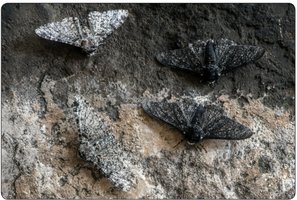
Light-colored moths became more visible to predators, while dark-colored (melanistic) moths were better camouflaged and survived at higher rates.
By 1898, dark moths made up about 98% of the population in industrial areas, while light moths remained common in rural areas.
Genetic Variation and Fitness
Variation in traits, such as coloration in moths, is essential for natural selection. Traits that confer a survival or reproductive advantage increase in frequency over generations.
Trait variation: In peppered moths, the two main color variations are light-colored (peppered) wings and dark-colored (melanistic) wings.
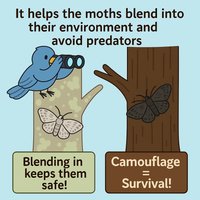
Advantage of color: Camouflage helps moths avoid predators, increasing their chances of survival and reproduction.
Fitness: The genotype or phenotype that is best suited to the environment has the highest fitness, meaning it leaves more offspring in the next generation.
Hardy-Weinberg Equilibrium
Allele and Genotype Frequencies
The Hardy-Weinberg equilibrium provides a mathematical model to study genetic variation in populations. It predicts how gene frequencies will be inherited from one generation to the next in an idealized, non-evolving population.
Allele frequency: The proportion of a specific allele in a population’s gene pool.
Genotype frequency: The proportion of individuals with a specific genetic makeup (genotype) in the population.
These frequencies help scientists understand the genetic structure of populations and detect evolutionary changes.
Hardy-Weinberg Equations
The Hardy-Weinberg principle uses two key equations to describe allele and genotype frequencies in a population:
Allele frequency equation:
Where p is the frequency of the dominant allele, and q is the frequency of the recessive allele.
Genotype frequency equation:
Where p^2 is the frequency of homozygous dominant individuals, 2pq is the frequency of heterozygous individuals, and q^2 is the frequency of homozygous recessive individuals.
Assumptions of Hardy-Weinberg Equilibrium
For a population to remain in Hardy-Weinberg equilibrium (no evolution), five conditions must be met:
Large Population Size (No Genetic Drift): The population must be very large to prevent random changes in allele frequencies.
No Mutation: No new alleles are introduced by mutation.
No Migration (No Gene Flow): No individuals enter or leave the population, preventing the introduction or removal of alleles.
Random Mating: Individuals mate randomly with respect to the trait being studied; no sexual selection or inbreeding.
No Natural Selection: All genotypes have equal fitness; no genotype is favored over another.
Application: Predicting Offspring Genotypes
In a cross between two heterozygous individuals (Aa × Aa), the expected ratio of offspring genotypes is:
1 AA : 2 Aa : 1 aa
In a population of beetles, if genotype bb is best camouflaged and thus has the highest fitness, it will become more common over generations due to natural selection.
Summary Table: Hardy-Weinberg Assumptions and Effects
Assumption | Effect if Violated |
|---|---|
Large Population Size | Genetic drift can cause random changes in allele frequencies |
No Mutation | New alleles can alter allele frequencies |
No Migration | Gene flow can introduce or remove alleles |
Random Mating | Non-random mating can change genotype frequencies |
No Natural Selection | Selection can increase or decrease allele frequencies |
