 Back
BackEvolution by Natural Selection: Mechanisms, Evidence, and Population Dynamics
Study Guide - Smart Notes
 Tailored notes based on your materials, expanded with key definitions, examples, and context.
Evolution by Natural Selection
Introduction to Evolution by Natural Selection
Evolution by natural selection is a fundamental concept in biology, explaining how populations change over time due to differential survival and reproduction of individuals with advantageous traits. This process is driven by genetic variation, environmental pressures, and the inheritance of traits.
Key Terms in Evolutionary Biology
Allele: Alternative forms of a gene that may occur at a given locus.
Gene: A sequence of DNA or RNA that is the functional unit of inheritance, controlling the transmission and expression of one or more traits.
Genotype: All or part of the genetic constitution of an individual or group.
Locus: The position in a chromosome of a particular gene or allele.
Diploid: Having two haploid sets of homologous chromosomes.
Struggle for Existence and Inequality
Case Study: Atlantic Cod (Gadus callarias)
The concept of the struggle for existence is illustrated by the Atlantic cod, a large marine fish and important food source. A single 10-year-old female can produce approximately 2 million eggs per season, but only a tiny fraction survive to adulthood due to high predation and mortality rates.
99% of eggs are consumed as plankton.
Of the survivors, 90% die before the end of their first year.
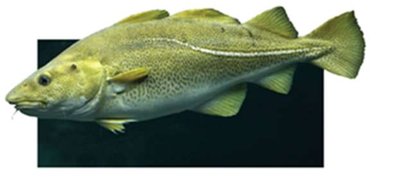
Trophy Hunting and Inadvertent Evolution
Human Impact on Evolution
Human activities such as trophy hunting and commercial fishing can drive rapid evolutionary changes in wild populations by selectively removing individuals with certain traits.
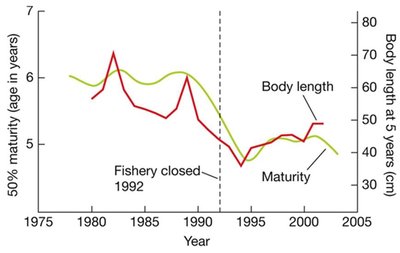
Targeting older, larger fish (e.g., cod) has led to a reduction in the age and size at which these fish mature.
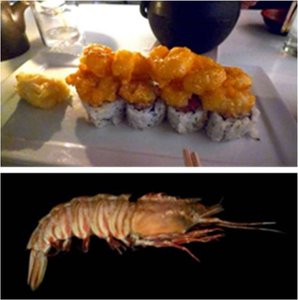
In rock shrimp, harvesting the largest individuals (all females) has selected for genes that switch sex at a smaller size, resulting in more, but smaller, females.
Case Study: African Elephants
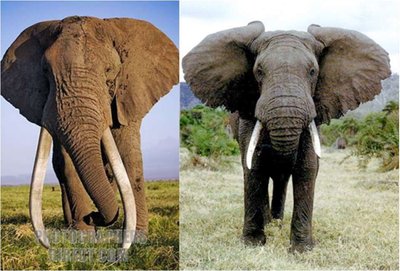
Poaching for ivory has led to a decrease in the proportion of elephants with tusks, demonstrating how human selection pressures can alter population genetics.
Mechanisms of Evolution
Processes Influencing Evolution
Allele frequencies in populations can change over time due to several mechanisms:
Mutation: Random changes in DNA that introduce new genetic variation.
Natural Selection: Differential survival and reproduction of individuals with advantageous traits.
Genetic Drift: Random changes in allele frequencies, especially in small populations.
Gene Flow: Movement of alleles between populations through migration.
Phenotype refers to the observable characteristics of individuals, determined by genotype and environmental factors. Natural selection operates only on phenotypic traits with a genetic basis.
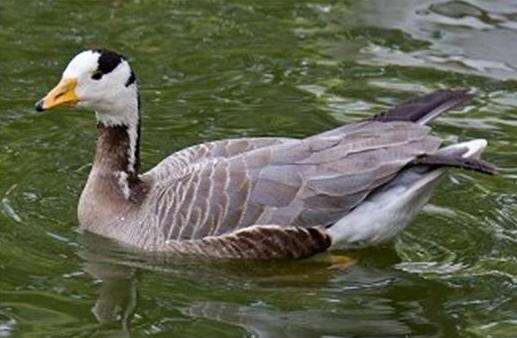
Example: Bar-headed Geese
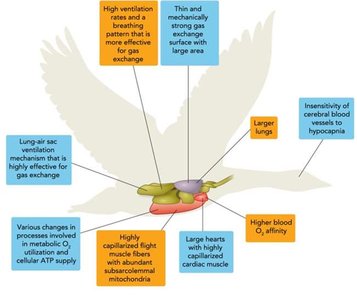
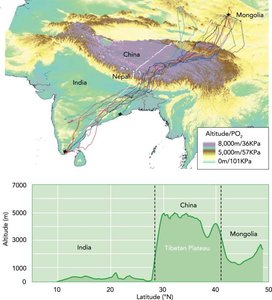
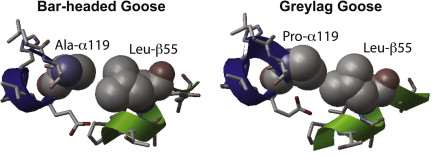
Bar-headed geese migrate over the Himalayas and have evolved hemoglobin with a very high affinity for oxygen, allowing them to survive at high altitudes.
Population Dynamics and Growth
Population Size and Change
Population size changes as a result of births, deaths, immigration, and emigration. Populations are open and dynamic entities.
Nt+1 = Nt + B - D + I - E, where Nt is population size at time t, B is births, D is deaths, I is immigrants, and E is emigrants.
Geometric and Exponential Growth
Geometric growth: where is the finite rate of increase.
Exponential growth: where r is the intrinsic rate of increase.
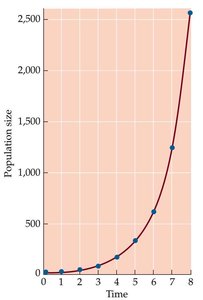
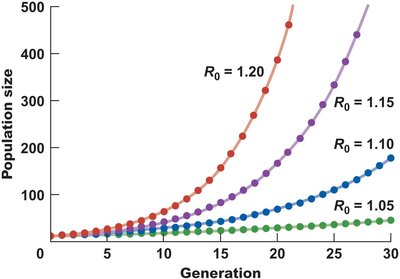
Life Tables
Life tables summarize survival and reproductive rates in populations, providing insight into population dynamics and replacement rates.
Age (in 3-month periods) | Number alive | Survival rate | Survivorship | Fecundity |
|---|---|---|---|---|
0 | 843 | 0.856 | 1.000 | 0 |
1 | 722 | 0.730 | 0.856 | 0 |
2 | 527 | 0.600 | 0.625 | 620 |
3 | 316 | 0.456 | 0.375 | 410 |
4 | 144 | 0.375 | 0.171 | 210 |
5 | 54 | 0.185 | 0.064 | 60 |
6 | 10 | 0.000 | 0.008 | 30 |
7 | 0 | 0.000 | 0.000 | 0 |
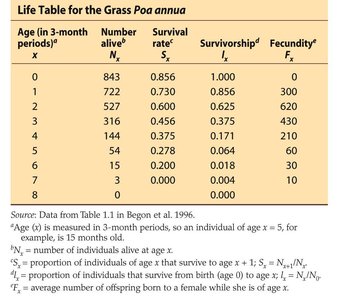
Variation and Selection
Historical Perspectives
Early evolutionary biologists were divided into "Mendelians," who focused on large, discrete differences (macromutations), and "Biometricians," who studied small, continuous variations. The modern evolutionary synthesis integrated these views, recognizing that both large and small genetic changes contribute to evolution.
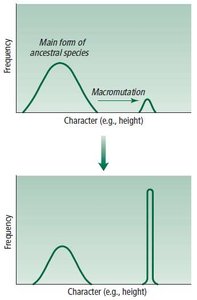
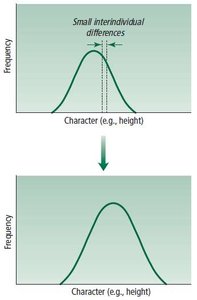
Types of Variation in Traits
Discontinuous variation: Traits with a few discrete values (e.g., sex cell production, earlobe attachment).
Continuous variation: Traits with a range of values (e.g., height, weight, milk yield).
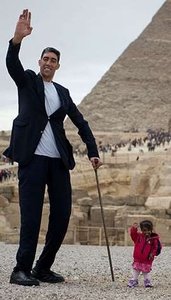
Natural Selection and Population Differences
Natural selection can result in differences between populations, especially when environmental pressures differ across regions.
Modes of Natural Selection
Stabilizing, Directional, and Disruptive Selection
Natural selection can act on quantitative traits in three main ways:
Stabilizing selection: Preserves the average phenotype by selecting against extremes.
Directional selection: Favors individuals at one phenotypic extreme.
Disruptive selection: Favors individuals at both extremes over intermediates.
Directional Selection Example
Droughts favored large beak size in medium ground finches, shifting the population mean.
Stabilizing Selection Example
Parasites and predators of Eurosta flies select for intermediate gall sizes, as both small and large galls are more likely to be attacked.
Disruptive Selection Example
African seedcrackers have two food sources, leading to selection for both large and small beak sizes, but not intermediate sizes.
Adaptive Evolution
Examples of Adaptive Evolution
Horse locomotion and dentition evolved in response to environmental changes from the Eocene to the Pleistocene.
Beak length in bugs evolved in response to fruit size in different geographic regions.
Clines, or gradual changes in a trait across a geographic region, are seen in the frequency of the AdhS allele in Drosophila as latitude increases.
Summary Table: Modes of Natural Selection
Type of Selection | Effect on Trait Distribution | Example |
|---|---|---|
Stabilizing | Reduces variation, favors average | Gall size in Eurosta flies |
Directional | Shifts mean, favors one extreme | Beak size in finches |
Disruptive | Favors both extremes | Beak size in seedcrackers |
Further Reading: Scott – Biological Science Ch. 34; Chiyo et al. (2015), Saccheri & Hanski (2006).
