 Back
BackEvolution by Natural Selection: Mechanisms, Evidence, and Modern Applications
Study Guide - Smart Notes
 Tailored notes based on your materials, expanded with key definitions, examples, and context.
Chapter 22: Evolution by Natural Selection
Introduction to Evolution by Natural Selection
Evolution by natural selection is a foundational theory in modern biology, independently formulated by Charles Darwin and Alfred Russel Wallace. This theory explains how populations adapt to diverse environments and reveals that populations of organisms evolve over time. Scientific theories consist of two main components: a pattern (observations about the natural world) and a process (the mechanism that produces the pattern).
The Rise of Evolutionary Thought
The theory of evolution by natural selection marked a scientific revolution, replacing the long-held idea of special creation with a radically different understanding of life's diversity.
Typological Thinking (Plato): Each organism is an unchanging example of a perfect type.
Scale of Nature (Aristotle): Species are fixed and organized in a linear hierarchy from simple to complex, with humans at the top.
Lamarckian Evolution: Species change over time by moving up the scale of nature, with acquired traits passed to offspring (e.g., giraffes stretching their necks).
Darwin & Wallace: Proposed that species change through time based on variation among individuals in populations, not a linear progression. Individuals with advantageous traits produce more offspring.
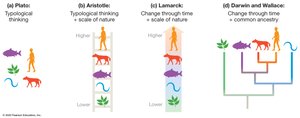
22.2 The Pattern of Evolution: Have Species Changed, and Are They Related?
Darwin described evolution as descent with modification: modern species are modified descendants of ancestral species. The pattern component of evolution by natural selection predicts that species change through time and are related by common ancestry.
Evidence for Change through Time
Fossil Record: Fossils are traces of organisms from the past, organized into the fossil record.
Sedimentary Rocks: Formed in layers, with younger layers on top of older ones, allowing scientists to determine the relative ages of fossils.
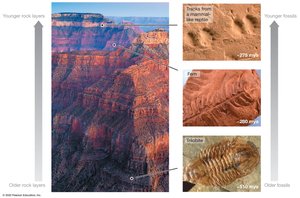
Geologic Time Scale: Divides Earth's history into eons, eras, periods, and epochs. Radiometric dating shows Earth is about 4.6 billion years old, with life appearing 3.4–3.8 billion years ago.
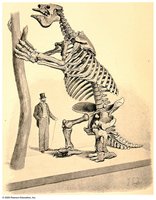
Extinction: Many fossils are of extinct species, showing that species are dynamic and the array of life has changed over time. Over 99% of all species are now extinct.
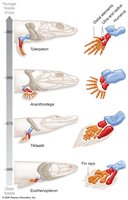
Transitional Features: Fossil species often show traits intermediate between ancestral and derived species, supporting the prediction that transitional forms should exist.
Vestigial Traits: Reduced or nonfunctional structures similar to functioning organs in related species (e.g., human coccyx, whale hip bones) provide evidence for change through time.
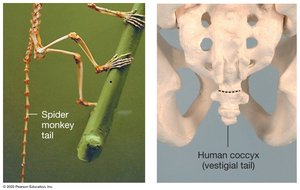
Evolution Observed Today: Evolutionary changes have been documented in contemporary populations, such as antibiotic resistance in bacteria and changes in finch beak shape.
Evidence for Common Ancestry
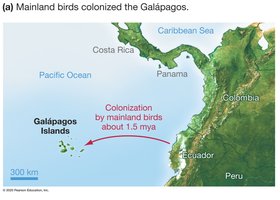
Geographic Distribution: Similar species are often found in the same geographic area, as seen in Darwin's Galápagos finches.
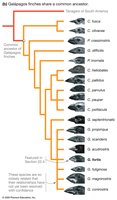
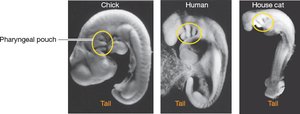
Homology: Similarity due to common ancestry, observed at three levels:
Genetic Homology: Similar DNA, RNA, or amino acid sequences across species.
Developmental Homology: Similar embryonic structures or processes (e.g., pharyngeal pouches in vertebrate embryos).
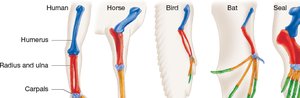
Structural Homology: Similar adult morphology (e.g., vertebrate limb bones).
Speciation Observed: New species have been observed forming from preexisting species, such as diverging populations of killer whales.
Summary Table: Evidence for Evolution
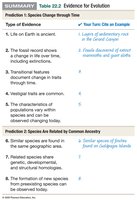
Type of Evidence | Example |
|---|---|
Life on Earth is ancient | Layers of sedimentary rock in the Grand Canyon |
Fossil record shows change over time | Fossils discovered of extinct mammals and giant sloths |
Transitional features | Intermediate forms in tetrapod limb evolution |
Vestigial traits | Human coccyx, whale hip bones |
Species change observed today | Antibiotic resistance in bacteria |
Similar species in same area | Galápagos finches |
Homology | Genetic, developmental, and structural similarities |
Speciation observed | Killer whale populations diverging |
22.3 The Process of Evolution: How Does Natural Selection Work?
Darwin's key contribution was describing natural selection as the process that explains descent with modification. Influenced by Malthus's idea of the "struggle for existence," Darwin recognized that more individuals are born than can survive, leading to competition for resources. His observations of artificial selection and natural variation led to the formulation of natural selection.
Darwin’s Four Postulates
Variation exists among individuals in a population.
Some trait differences are heritable.
Survival and reproductive success are highly variable.
Individuals with advantageous traits are more likely to survive and reproduce (not a random sample).
Modern synthesis condenses these into: Heritable variation leads to differential reproductive success.
Key Definitions
Biological Fitness: The ability to produce surviving, fertile offspring relative to others in the population.
Adaptation: A heritable trait that increases fitness in a particular environment.
Selection: Differential reproduction as a result of heritable variation.
22.4 Evolution in Action: Measuring Natural Selection in Populations Today
The theory of evolution by natural selection is testable and observable in real time. Two case studies illustrate this process:
Case Study 1: Antibiotic Resistance in Mycobacterium tuberculosis
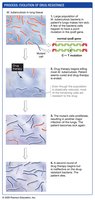
Tuberculosis (TB) is caused by M. tuberculosis. The rise of antibiotic-resistant strains has made TB a global health emergency.
Resistance is often due to mutations in genes such as rpoB, which alter the target of antibiotics like rifampin, preventing the drug from binding and allowing the bacteria to survive and reproduce.
Testing Darwin’s Postulates:
Variation existed (resistant and nonresistant strains).
Variation was heritable (genetic basis).
Reproductive success varied (only resistant bacteria survived antibiotics).
Selection occurred (resistant bacteria increased in frequency).
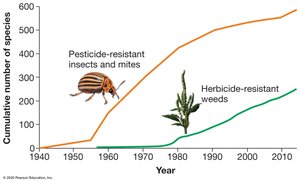
Drug resistance is a growing problem, with resistance to antibiotics, pesticides, and herbicides increasing globally.
Case Study 2: Beak Size and Shape in Galápagos Finches
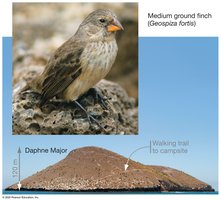
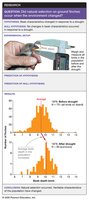
Peter and Rosemary Grant studied medium ground finches on Daphne Major, finding that beak form and body size are heritable.
A severe drought acted as a natural experiment, causing a shift in beak depth: deeper beaks became more common due to their advantage in cracking large seeds.
Key Concepts in Evolution by Natural Selection
Individuals Do Not Adapt: Acclimatization is a phenotypic change in an individual, not a genetic change passed to offspring. Adaptation involves changes in allele frequencies in a population.
Natural Selection Is Not Goal Directed: Evolution is not purposeful or progressive; mutations are random, and adaptations do not arise because organisms "need" them.
Fitness Trade-Offs: Adaptations often involve compromises between traits (e.g., egg size vs. number, growth rate vs. lifespan).
Historical and Environmental Constraints: Evolution is limited by existing traits and changing environments. Not all traits are adaptive, and even adaptive traits are constrained by history and genetics.
Other Evolutionary Processes: Besides natural selection, evolution can occur through genetic drift, gene flow, and mutation, which are random with respect to fitness.
