 Back
BackEvolution II: Mechanisms and Evidence for Evolutionary Change
Study Guide - Smart Notes
 Tailored notes based on your materials, expanded with key definitions, examples, and context.
How Life Changes Over Time: Evolution II
Lecture Overview
This lecture explores the mechanisms and evidence for evolutionary change, focusing on Darwin's observations and inferences, the process of natural selection, and several lines of evidence supporting evolution. Key examples include adaptive radiations, direct observations of evolutionary change, homology, the fossil record, and biogeography.
Darwin’s Observations and Inferences
Key Inferences from Darwin
Inference #1: Individuals whose inherited traits give them a higher probability of surviving and reproducing in a given environment tend to leave more offspring than other individuals.
Inference #2: This unequal ability of individuals to survive and reproduce will lead to the accumulation of favourable traits in the population over generations.
These inferences form the foundation of the theory of natural selection, explaining how populations evolve over time as advantageous traits become more common.
Mechanisms of Natural Selection
How Natural Selection Works
Natural selection operates under three essential conditions:
Variation in traits: Individuals within a population vary in their characteristics.
Heritability: Traits must be heritable, meaning they can be passed from parents to offspring.
Non-random survival and reproduction: Individuals with traits better suited to the environment are more likely to survive and reproduce.
Without these conditions, natural selection cannot drive evolutionary change.
Evidence for Evolution
Types of Evidence
Multiple lines of scientific evidence support the theory of evolution:
Direct observations (e.g., real-time changes in populations)
Adaptive radiations (rapid diversification from a common ancestor)
Homology (similarities due to shared ancestry)
The fossil record (documenting extinction, origin, and change)
Biogeography (geographic distribution of species)
Adaptive Radiations
Definition and Examples
Adaptive radiation is the rapid evolution of diversely adapted species from a common ancestor, often following mass extinctions, the evolution of novel traits, or colonization of new regions. Geographic isolation, such as the formation of islands, can facilitate adaptive radiation by allowing populations to diversify in response to different environmental pressures.
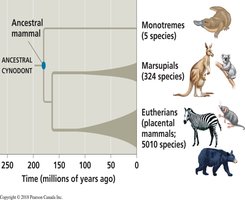
Mammals underwent adaptive radiation after the extinction of dinosaurs, leading to a dramatic increase in diversity and size.
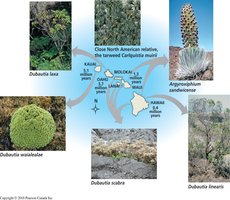
Hawaiian Islands are a modern example, where colonization of new environments with little competition led to the evolution of many unique species.
Direct Observations of Evolutionary Change
Soapberry Bugs and Introduced Plants
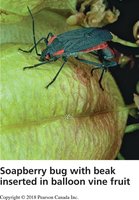
Soapberry bugs provide a clear example of natural selection in action. These insects use their beaks to feed on seeds inside fruits. The effectiveness of feeding depends on the match between beak length and fruit size:
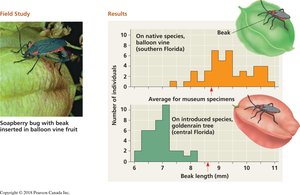
In southern Florida, soapberry bugs feed on the native balloon vine, which has large fruit, resulting in longer beaks.
In central Florida, they feed on the introduced goldenrain tree, which has smaller fruit, resulting in shorter beaks.
Beak size evolved in less than 35 years, demonstrating rapid evolutionary change in response to environmental shifts.
The Evolution of Drug-Resistant Bacteria
Another direct observation is the evolution of antibiotic resistance in bacteria:
Staphylococcus aureus (including MRSA) evolved resistance to penicillin and methicillin within a few years of their introduction.
Resistance arises because natural selection favors bacteria with mutations that confer survival advantages in the presence of antibiotics.
Indiscriminate use of antibiotics accelerates the selection for resistant strains.
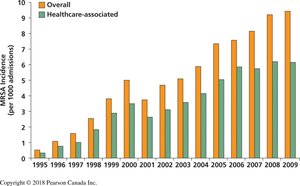
Additional info: This pattern is also seen in other pathogens, such as vancomycin-resistant enterococci (VRE), and in insects that become resistant to pesticides.
Angling-Induced Evolution in Fish
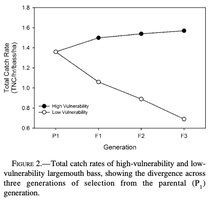
Human activities can drive evolutionary change. In largemouth bass, vulnerability to angling (being caught by fishing) is heritable:
Fish with high vulnerability to angling are more likely to be harvested, while those with low vulnerability survive and reproduce.
Over generations, this selective pressure can alter the genetic makeup of the population.
Homology and Convergent Evolution
Homology
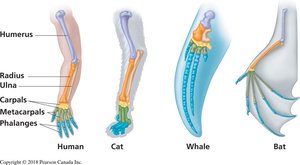
Homology refers to similarities among organisms due to shared ancestry. Homologous structures are anatomical features that are variations on a common structural theme. For example, the forelimbs of humans, cats, whales, and bats have similar bone arrangements but serve different functions.
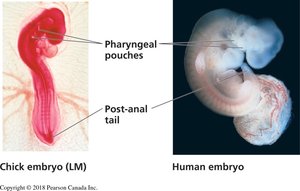
Comparative embryology reveals homologies not visible in adults, such as the presence of a post-anal tail and pharyngeal arches in all vertebrate embryos.
Vestigial structures are remnants of features that served important functions in ancestors but have lost their primary function (e.g., wings in flightless birds).
Convergent Evolution
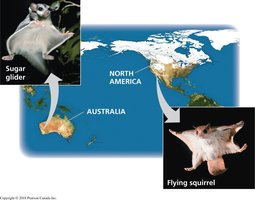
Convergent evolution occurs when distantly related organisms independently evolve similar traits as they adapt to similar environments. These analogous traits do not indicate common ancestry but rather similar selective pressures.
Example: Wings in birds (aves) and bats (mammals) are analogous structures.
The Fossil Record
Fossils as Evidence of Evolution
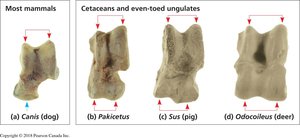
The fossil record documents the history of life, providing evidence for:
The extinction of species
The origin of new groups
Changes within groups over time
Biogeography
Geographic Distribution of Species
Biogeography is the study of the geographic distribution of species. The breakup of the supercontinent Pangaea and subsequent continental drift have shaped the distribution and evolution of organisms. Endemic species, found only in specific locations (often islands), provide evidence for evolution as they are closely related to species on nearby mainlands but have adapted to unique environments.
Summary
In summary, evolution is supported by multiple lines of evidence, including direct observations, adaptive radiations, homology, the fossil record, and biogeography. Natural selection acts on heritable variation, leading to the accumulation of advantageous traits in populations over generations. These processes explain the diversity of life observed today.
