 Back
BackEvolution: Mechanisms, Evidence, and Patterns
Study Guide - Smart Notes
 Tailored notes based on your materials, expanded with key definitions, examples, and context.
Evolution: Mechanisms, Evidence, and Patterns
Introduction to Evolution
Evolution is the process by which populations of organisms change over generations through variations in traits, often driven by environmental pressures. This process explains both the diversity and unity of life on Earth.
Evolution occurs at the population level, not in individuals.
It involves changes in the frequency of alleles (gene variants) within a population over time.
All living things share common characteristics and are made up of organic compounds.
Theories of Evolution
Jean-Baptiste Lamarck's Theory
Lamarck was a French biologist who proposed that organisms change over long periods through the use and disuse of organs, and that acquired characteristics could be inherited by offspring.
Use and Disuse: Organs used more frequently become larger and stronger; those not used deteriorate.
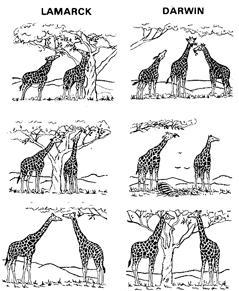
Inheritance of Acquired Characteristics: Traits acquired during an organism's lifetime can be passed to offspring (e.g., giraffes stretching their necks).
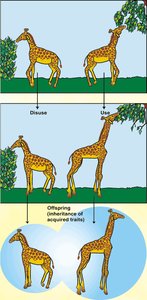
Additional info: Lamarck's ideas were later disproven, as acquired traits are not inherited genetically.
Charles Darwin and Natural Selection
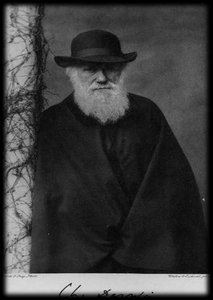
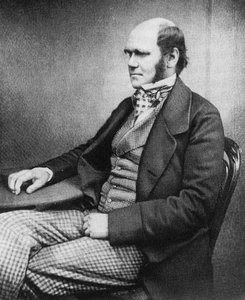
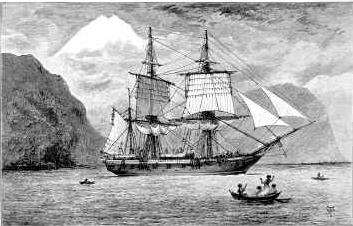
Charles Darwin, a British naturalist, developed the theory of evolution by natural selection. His observations during the voyage of the H.M.S. Beagle, especially in the Galapagos Islands, were foundational to his ideas.
Darwin was not the first to propose evolution, but he was the first to provide a mechanism (natural selection) and extensive evidence.
Alfred Russel Wallace independently conceived a similar theory.
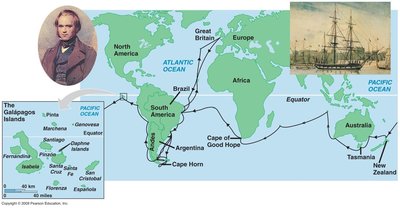
Darwin's Theory of Natural Selection
Natural selection is the process by which organisms with traits best suited to their environment are more likely to survive and reproduce, passing those traits to the next generation.
Overproduction: More offspring are produced than can survive.
Limited Resources: Resources such as food and space are finite.
Genetic Variation: Individuals in a population vary in their traits, some of which are heritable.
Differential Survival and Reproduction: Individuals with advantageous traits are more likely to survive and reproduce.
Example: Darwin's finches on the Galapagos Islands evolved different beak shapes to exploit different food sources.
Comparing Lamarck and Darwin
Lamarck and Darwin both sought to explain how species change over time, but their mechanisms were different.
Lamarck: Traits acquired during life are inherited.
Darwin: Natural selection acts on heritable variation; only genetic traits are passed on.
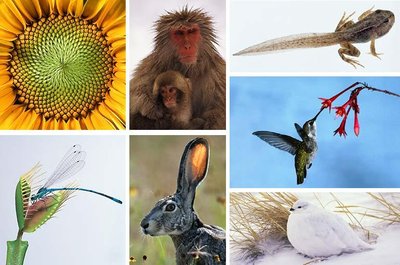
Evidence for Evolution
Fossil Record
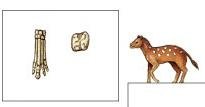
The fossil record provides chronological evidence of past life forms and their transitions, showing gradual changes over millions of years.
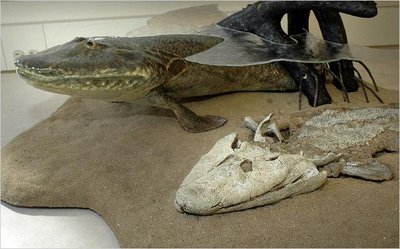
Transitional fossils (e.g., Tiktaalik) show intermediate forms between major groups, such as fish and tetrapods.

Comparative Anatomy
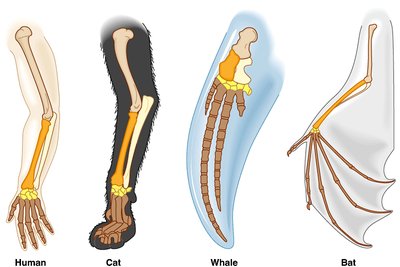
Comparing anatomical structures among species reveals evolutionary relationships.
Homologous Structures: Similar structures with different functions, inherited from a common ancestor (e.g., human arm, cat leg, whale flipper, bat wing).
Analogous Structures: Different structures with similar functions, evolved independently due to similar environmental pressures (convergent evolution).
Vestigial Structures: Remnants of structures that served important functions in ancestors but are reduced or unused in descendants (e.g., eyes in blind cave fish).
Comparative Embryology
Embryos of different species often show similar stages of development, indicating common ancestry.
Similar embryonic features suggest evolutionary relationships.
Molecular Biology
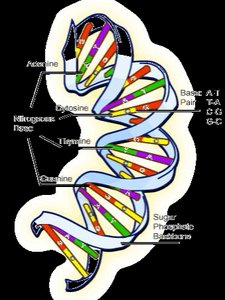
Comparing DNA and protein sequences among organisms reveals genetic similarities and differences, providing strong evidence for common ancestry.
Proteins such as hemoglobin and cytochromes are found across many species, with variations reflecting evolutionary divergence.
Patterns of Evolution
Divergent Evolution
Divergent evolution occurs when two or more species sharing a common ancestor become more different over time, often due to different environmental pressures or niches.
Results in homologous structures.
Convergent Evolution
Convergent evolution is the process by which unrelated organisms independently evolve similar traits as a result of adapting to similar environments or ecological niches.
Results in analogous structures.
Example: Marsupial mammals in Australia and placental mammals elsewhere have evolved similar forms to fill similar niches.
Coevolution
Coevolution occurs when two or more species reciprocally affect each other's evolution. This often happens in close ecological relationships, such as predator-prey or mutualistic partnerships.
Example: The evolutionary arms race between cheetahs and gazelles, or the mutualistic relationship between E. coli and humans.
Cladistics and Phylogenetic Trees
Cladograms
A cladogram is a diagram that shows evolutionary relationships among species based on shared derived characteristics. Each branch point represents a common ancestor, and groups are organized into clades.
Cladograms help visualize divergence and common ancestry.

Phylogenetic Trees
Phylogenetic trees are diagrams that depict evolutionary relationships based on genetic, anatomical, or fossil evidence. They show patterns of lineage branching and divergence over time.
Artificial Selection
Artificial selection, or selective breeding, is the process by which humans breed plants and animals for desired traits. This is not the same as natural selection, as the selective pressure is imposed by humans rather than the environment.
Example: Breeding dogs for specific behaviors or appearances.
Genetic Variation and Natural Selection
Genetic variation within a population is essential for natural selection to act. Variation arises from mutations, sexual reproduction, and gene flow. Natural selection increases or decreases the frequency of alleles based on their impact on fitness.
Fitness: The ability of an organism to survive and reproduce in its environment.
Natural selection does not create perfect organisms; it edits existing variation.
Summary Table: Types of Evolutionary Evidence
Type of Evidence | Description | Example |
|---|---|---|
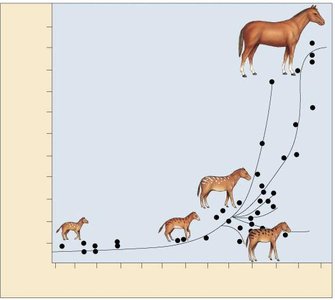
Fossil Record | Chronological evidence of past life forms and transitions | Horse evolution, Tiktaalik fossil |
Comparative Anatomy | Homologous, analogous, and vestigial structures | Human arm and bat wing, cave fish eyes |
Comparative Embryology | Similar embryonic stages among species | Vertebrate embryos |
Molecular Biology | DNA and protein sequence similarities | Hemoglobin, cytochrome c |
Key Terms
Evolution: Change in the genetic composition of a population over time.
Natural Selection: Differential survival and reproduction of individuals due to differences in phenotype.
Fitness: The reproductive success of an organism in its environment.
Homologous Structures: Structures derived from a common ancestor.
Analogous Structures: Structures with similar function but different evolutionary origins.
Vestigial Structures: Reduced or nonfunctional remnants of organs.
Cladogram: Diagram showing evolutionary relationships.
Phylogenetic Tree: Diagram showing evolutionary history and relationships.
